When Belonging Must Be Proved: Assam’s Kashem Ali wins long citizenship battle Kashem Ali, a handcart puller from Bongaigaon, was forced to defend his citizenship despite extensive documentary evidence linking his family to Assam
28, Oct 2026 | CJP Team
For years, Kashem Ali lived under the shadow of a question that should never have haunted a man born in Assam: did he belong to the country he had always called home?
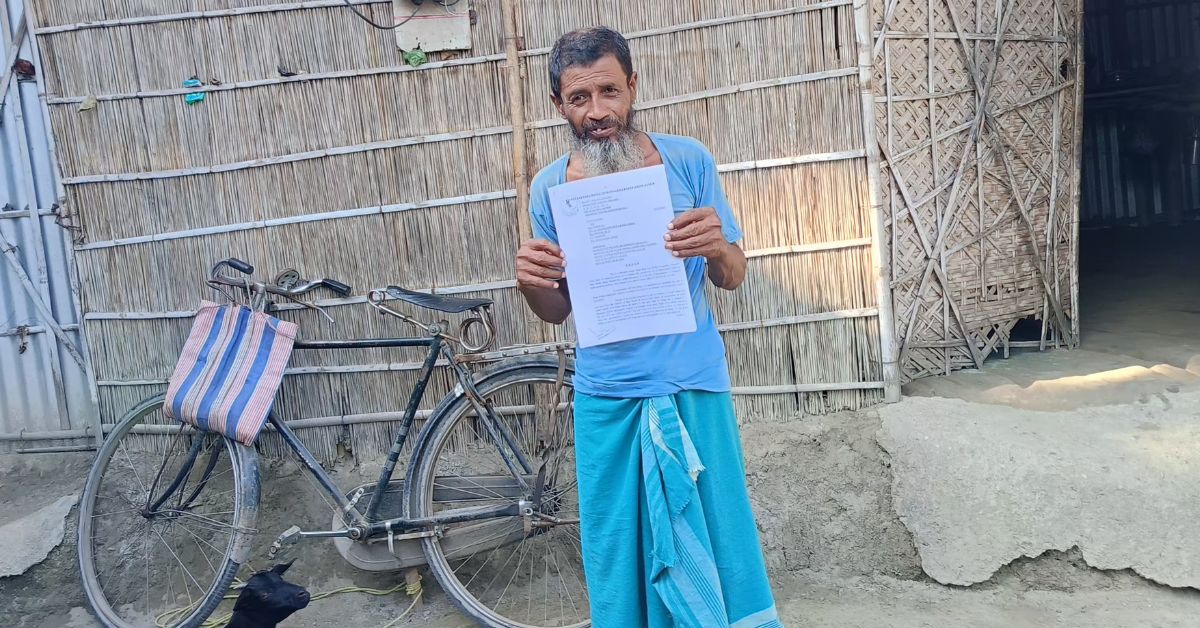
A thelawala by occupation, Kashem Ali earns his living by pulling a handcart through the heat and rain, working day after day to support his wife, Suraton Khatun, and their two sons, Sahjahan Ali and Sahajamal Ali. He is neither a politician nor a person of influence. He is a working man whose life has been consumed by a legal battle over his citizenship, despite documentary records linking his family to Assam decades before the March 25, 1971, cut-off date.
Every week, CJP’s dedicated team in Assam, comprising community volunteers, district volunteer motivators, and lawyers, provides vital paralegal support, counseling, and legal aid to many affected by the citizenship crisis in over 24 districts in Assam. Through our hands-on approach, 12,00,000 people successfully submitted completed NRC forms (2017-2019). We fight Foreigner Tribunal cases monthly at the district level. Through these concerted efforts, we have achieved an impressive success rate of 20 cases annually, with individuals successfully obtaining their Indian citizenship. This ground level data ensures informed interventions by CJP in our Constitutional Courts. Your support fuels this crucial work. Stand with us for Equal Rights for All #HelpCJPHelpAssam. Donate NOW!
On October 25, 2026, Kashem finally received a measure of relief. The Foreigners Tribunal No. 1, Bongaigaon, held that he had successfully discharged the statutory burden of proving that he was not a foreigner and was a citizen of India. The decision came after a prolonged legal fight, with assistance from Citizens for Justice and Peace (CJP).
But the end of Kashem’s ordeal does not mean the end of the family’s suffering. His wife, Suraton, was declared a D-voter in 2019 and remains unable to exercise her voting rights for ten years, until 2029. The husband has now been recognised as an Indian citizen, while his wife continues to live with the consequences of a citizenship-related determination that has deprived her of a fundamental democratic entitlement.
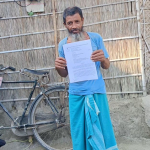
Kashem Ali, outside his home in Assam, looking through all his case related documents
A case registered in 2004, notice served only in 2022
The case, State of Assam vs Md. Kashem Ali, was heard by Foreigners Tribunal No. 1, Bongaigaon, under BNGN/FT Case No. 1205/2010, arising from BNGN/IM(D)T Case No. 1944/2003. According to the case records, proceedings were registered in 2004 based on an order issued by the Superintendent of Police (Border). Yet Kashem did not receive notice until March 2022. Eighteen years had passed between the registration of the case and the service of notice upon him.
For a man dependent on daily earnings to sustain his family, such prolonged uncertainty carries consequences far beyond a courtroom. The years between registration and notice, followed by the legal proceedings themselves, meant that Kashem had to confront an allegation of foreign origin while continuing to make a living through manual labour. When his wife’s case had previously come up, Kashem was unaware of CJP and had incurred considerable expenses. This time, knowing that legal assistance was available, he approached the organisation for help.
CJP’s legal team, led by legal member Dewan Abdur Rahim and his two junior colleagues, took up his case before the Tribunal. The defence challenged both the basis of the allegation and the way the investigation had purportedly been conducted. In his written statement filed on December 10, 2025, Kashem put his position in straightforward terms: the case was not maintainable in law or on facts, he was not a foreigner, and he had been born in Assam.
Born in Assam, with family records predating 1971
Kashem Ali was born in 1968 in Village No. 1 Dhupuri, under Manikpur Police Station in Bongaigaon district, Assam. He was the son of Nojumuddin Sheikh, also recorded under variations of the name Naju Sheikh, and Panful Nessa, also known as Panful. His father died in 1974, while his mother died in 2018. His paternal grandfather, Najirulla, also recorded as Nojib, was the father of four children: Naju Sheikh, Yunus Ali, Khalek Miya and Khatim Bibi. Kashem has one sister, Toshiran Bibi, against whom, according to the information placed before the Tribunal, no foreigners case is pending.
Kashem married Suraton Khatun, daughter of the late Toyab Ali of Village No. 2 Dhupuri, in 1988. Together, they raised two sons. These were not merely family details. They formed part of the chain of relationships and documentary evidence through which Kashem sought to establish his identity and his connection to Assam.
The defence placed particular emphasis on records showing that Kashem’s parents were enrolled as voters in Assam in 1966, five years before the March 25, 1971, cut-off date relevant to the determination of citizenship in Assam. Subsequent electoral records also documented Kashem and his wife as voters over several decades. Despite this documentary trail, Kashem was compelled to establish before a Tribunal that he was not a foreigner.
Eighteen documents to establish what should never have been in doubt
To discharge the burden imposed under Section 9 of the Foreigners Act, 1946, Kashem produced 18 documents before the Tribunal, recorded as Exhibits A to Q, with Exhibit A-1 as an additional document. He also obtained a Panchayat certificate. The evidence included land and revenue records, historical electoral rolls, school records, identity documents and a death certificate. Together, these materials were relied upon to establish his family links, place of birth and long-standing presence in Assam.
Among the most significant records was the certified copy of the 1966 electoral roll for Dhupuri Part I under the Bijni Legislative Assembly Constituency. It recorded Nojumuddin, son of Nojir Ullah, and Panful, wife of Nojumuddin, as voters. The 1971 electoral roll for Dhupuri Part I also recorded Nojmoddin Sheikh, son of Nojib, and Panful Nessa, wife of Nojmoddin, alongside other members of the extended family.
The records connecting Kashem himself to the electoral rolls began with the 1997 list for Dhupuri Part II, which recorded Kasem Ali, son of the late Nasimuddin Sheikh, and Suraton Khaton, wife of Kasem. The 2008 list also included both husband and wife. Kashem appeared in the electoral rolls for 2010, 2014, 2017, 2018, 2019 and 2020, with variations in the spelling of his name and his father’s name across different records.
The documentary evidence also included a land record showing Kashem’s father as the recorded owner and possessor of 4 bighas, 1 katha and 17 lessas of land under Annual Patta No. 27, with Dag Nos. 155, 156 and 200 in Village No. 1 Dhupuri. A revenue payment receipt in Kashem’s name accompanied the record.
A school certificate issued by the head teacher of 480 No. Dabaguri Lower Primary School recorded Kashem Ali, son of Noju Sheikh, as having studied in Class I in 1975. His Election Commission of India-issued Elector Photo Identity Card, dated March 6, 2024, was also produced.
Other documents included a ration card issued by the Food, Civil Supplies and Consumer Affairs Department in the name of Suraton Khatun, identifying her as Kashem’s wife; Kashem’s PAN card and Aadhaar card; and the death certificate of Panful Bewa, issued by the relevant health authorities in Manikpur.
The documents did not all serve the same evidentiary purpose. Rather, the defence relied on them collectively to establish the links between Kashem, his parents, his wife, his residence and the historical records of his family. The sheer volume of documentation required to defend his citizenship underscores the burden imposed on ordinary people facing allegations of foreign origin. For Kashem, years of family history had to be assembled, authenticated, translated and placed before a Tribunal before he could obtain legal recognition of what he had maintained from the outset: he was not a foreigner.
Defence challenges the investigation
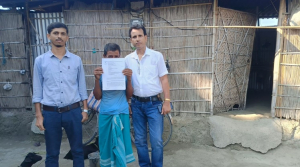
CJP Team Assam with Kashem Ali outside his home in Assam
A central part of the defence was its challenge to the investigation that had led to the reference against Kashem. The CJP legal team argued that the investigating officer had submitted a report without conducting a genuine inquiry. According to the defence, the officer had neither visited Kashem’s home nor recorded his statement, seized any documents or examined any witnesses. The defence further questioned the credibility of the witnesses named in connection with the case.
The allegation, the advocate argued, rested on the assertion that Kashem had entered Assam from a specified territory after March 25, 1971. Kashem denied this outright, maintaining that he had never come to Assam from East Pakistan or Bangladesh and had been born in the state in 1968.
The defence also addressed discrepancies in the spelling of names across official records. Kashem appeared as Kasem Ali or Kashem Ali, while his father’s name was variously recorded as Nojumuddin, Nasimuddin, Najim Uddin Sheikh and Nojim Uddin Sheikh. The legal team argued that these variations were clerical inconsistencies and did not establish that the records referred to different individuals.
Such discrepancies can create serious difficulties for people whose names are recorded across different government departments, particularly when records are handwritten, translated or entered by officials over several decades. For poor families with limited means to scrutinise or correct official documentation, a spelling variation can become a formidable obstacle in proving identity and family links. The defence maintained that the differences in Kashem’s records had to be assessed in their proper context, alongside the broader documentary evidence, rather than treated as grounds to doubt his citizenship.
Revenue official corroborates land records
Kashem and two other defence witnesses gave evidence before the Tribunal. One of them, Defence Witness No. 2, Subash Medhi, a S.K. of the Manikpur Revenue Circle, proved the Jamabandi produced as Exhibit A after furnishing official documents underlying its issuance. The revenue official’s evidence provided an official basis for the land record relied upon by the defence. It formed part of the wider evidentiary case through which Kashem sought to establish his family’s links to the land and locality.
After considering the evidence and arguments, the Tribunal concluded that Kashem had successfully discharged the statutory burden under Section 9 of the Foreigners Act, 1946. It held that the opposite party was not a foreigner but a citizen of India. The decision brought relief after years of uncertainty and a prolonged legal battle. It also meant that the allegation of foreign origin could not stand in the face of the evidence accepted by the Tribunal.
A husband declared Indian, a wife still denied her vote
Yet Kashem’s relief is incomplete in the most painful sense: his wife continues to bear the consequences of a separate citizenship-related proceeding. Suraton Khatun’s case had come before a Foreigners Tribunal in 2019, when she was kept in the D-voter category. As a result, she remains unable to vote for ten years, from 2019 to 2029.
Her name appeared alongside Kashem’s in the 1997 electoral roll, and she was again recorded as a voter in the 2008 roll. The family ration card also identifies her as Kashem’s wife. She is the mother of their two sons and has shared the same home and family life through the years in which her husband was forced to defend his citizenship.
Nevertheless, the consequences of the proceedings against her remain in place. Kashem’s successful defence does not, by itself, restore Suraton’s voting rights or resolve her separate case. The contrast is stark. In 2026, a Tribunal recognised Kashem as an Indian citizen after examining the documentary evidence. His wife, whose name appeared in electoral records decades earlier, remains unable to participate in elections until 2029 because of her D-voter status.
For this family, the cost of citizenship proceedings is not measured only in legal expenses or years spent answering an allegation. It is also measured in the democratic rights lost while the proceedings cast a shadow over their lives.
CJP’s intervention brings relief, but the larger questions remain
On October 25, Advocate Dewan Abdur Rahim and CJP State In-charge Nanda Ghosh, representing Team CJP, visited Kashem’s home and handed him a copy of the Tribunal’s judgment. After years of uncertainty, he could finally breathe a sigh of relief. He welcomed the team with tea and expressed his gratitude to CJP for helping him navigate the legal battle.
For Kashem, the judgment is a hard-won victory. For CJP, it is another reminder of the importance of accessible legal assistance for people facing citizenship proceedings, particularly those without the financial means to sustain a prolonged fight on their own.
But his case also raises questions that extend far beyond one family. Why did a case registered in 2004 result in notice being served only in March 2022? What safeguards exist to prevent allegations resting on inadequate investigations from subjecting people to years of uncertainty? How should authorities assess discrepancies in names across decades of public records, particularly when historical documentation is inconsistent? And what happens to those who cannot assemble 18 documents, secure witnesses, pay legal expenses or find an organisation willing to help?
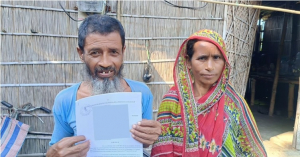
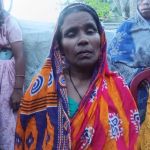
Kashem Ali with his wife outside their home in Assam
Kashem Ali is not a case number. He is a man who pulls a handcart to feed his family, a husband to Suraton, a father to two sons, a brother to Toshiran and the son of parents whose names appear in Assam’s historical records. His case demonstrates how the burden of proving citizenship can fall on ordinary people even when documentary records trace their families to Assam before the 1971 cut-off date. It also shows why legal aid can make the difference between confronting a case alone and having the opportunity to place one’s evidence before a Tribunal.
CJP’s intervention helped Kashem secure relief. But how many others face similar allegations without access to legal assistance, the resources to gather documents or the means to sustain years of proceedings?
And while Kashem can finally put this chapter behind him, Suraton must still wait for the restoration of her democratic rights. Their story is not simply one of a man declared Indian after a long legal battle. It is a reminder of the human cost of citizenship proceedings in Assam, where the right to belong can become a prolonged struggle for people whose lives, families and records are already rooted in the state.
The order may be read below:
Related:
CJP helps secure Ajabha Khatun’s release after 772 days in Assam’s Matia detention camp
Floods | Documents | Courts: CJP’s Fight for Citizenship in Assam
Nationality Before Deportation: The Rajubala Das case
Another CJP Victory: Barpeta Tribunal declares Alam Khan ‘not a foreigner’