‘Free the Temple’, ‘Defend the Faith’, ‘Take Up Weapons’: How festivals became vehicles for anti-Muslim hate in September From contested places of worship to demographic fearmongering, speeches cast Muslims as an existential threat, framing exclusion as religious defence
01, Oct 2026 | CJP Team
Religion is not merely invoked in these episodes as a matter of faith. It is repeatedly deployed as a political marker of belonging. Hindu religious symbols, places of worship, historical grievances and claims about the Hindu population are placed alongside assertions about Muslims, producing a familiar binary: the Hindu community as a threatened collective and Muslims as the alleged source of that threat.
The incidents documented this month of September range from demands linked to the Mathura temple-mosque dispute and provocative religious sloganeering outside a mosque to warnings against alleged “infiltrators”, claims of Hindu demographic decline and repeated exhortations to acquire weapons. While the speakers and settings differ, the rhetoric follows recognisable patterns of exclusion and otherisation.
From a place of worship to a demand for its “liberation”
Location: Basti, Uttar Pradesh
Date: September 4
On the occasion of Krishna Janmashtami, Vishva Hindu Mahasangh leader Akhilesh Singh asserted that if those celebrating Janmashtami had taken an oath to celebrate it only after demolishing the mosque in Mathura, similar to the Babri Masjid, and “freeing” the temple, it would have been “freed” long ago. He claimed that Krishna had been imprisoned in a jail and that the temple had been occupied. He also announced a march for “Krishna Janmabhoomi” in October.
https://t.me/hindutvawatchin/5188
On September 4 in Basti, Uttar Pradesh, Vishva Hindu Mahasangh leader Akhilesh Singh used the occasion of Krishna Janmashtami to invoke the Mathura mosque-temple dispute. He said that if those celebrating Janmashtami had taken an oath to celebrate it only after demolishing the mosque in Mathura, “like the Babri Masjid”, and “freeing” the temple, it would have been “freed” long ago. He also announced a march for “Krishna Janmabhoomi” in October.
The significance of this rhetoric lies in the transformation of a contested place of worship into a religious obligation. The mosque is not presented simply as a structure involved in an ongoing legal and political dispute. Its presence is rhetorically framed as an obstacle to the fulfilment of a Hindu religious claim.
The invocation of the Babri Masjid demolition is particularly concerning. A constitutional and legal dispute over a place of worship is thereby connected to a historical episode in which a mosque was demolished by a extremist mobilisation. The language of “liberation” further recasts the removal of a Muslim religious site as an act of religious restoration. This is one of the recurring mechanisms through which religious difference becomes exclusionary: a particular religious community is represented as occupying space that rightfully belongs to another.
When religious practice becomes a public assertion against Muslims
Location: Achalpur, Amravati, Maharashtra
Date: September 8
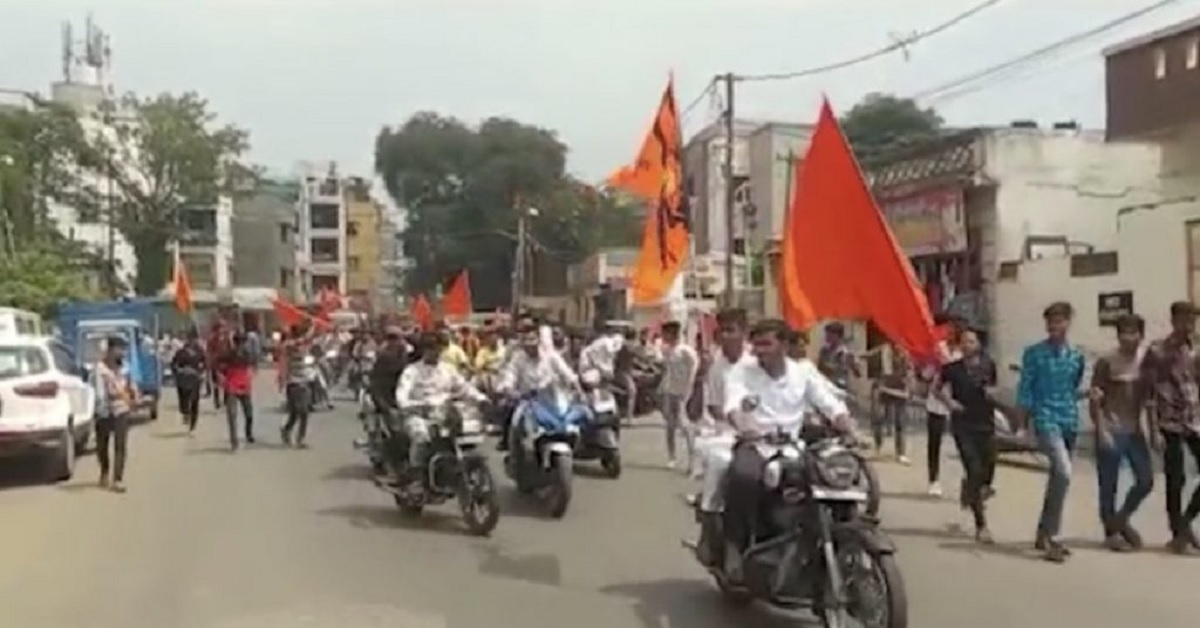
During a grand Kanwar Yatra organised by Jableshwar Baba Mitra Mandal, participants recited the Hanuman Chalisa and raised “Jai Shri Ram” slogans outside a mosque, with former MP Navneet Rana seen reciting the Hanuman Chalisa. The religious recitation and slogan-shouting reportedly led to brief communal tension, following which security was tightened in the area.
https://t.me/hindutvawatchin/5194
A similar dynamic appeared in Achalpur, Amravati, on September 8, where participants in a Kanwar Yatra organised by Jableshwar Baba Mitra Mandal recited the Hanuman Chalisa and raised “Jai Shri Ram” slogans outside a mosque. Former MP Navneet Rana was seen participating in the recitation. The incident reportedly generated brief communal tension, after which security was increased.
When religious activity is deliberately performed outside another community’s place of worship and accompanied by slogans that have acquired a powerful political resonance, religion can cease to function merely as an expression of personal faith. It can become a public demonstration of dominance, particularly where the immediate setting is already communally sensitive. The issue, therefore, is not the Hanuman Chalisa itself. It is the use of religious symbolism in a setting where the identity of another religious community becomes part of the spectacle.
Constructing the Muslim as the outsider
Location: Howrah, West Bengal
Date: September 11
A Hindu nationalist speaker, defending religious preacher Dhirendra Shastri’s comment about banning non-vegetarian food from Durga Puja, warned that anyone who insulted a saint again would be “beaten so badly” that they would be unable to get up. He targeted those he termed “Bangladeshi infiltrators”, accusing them of disrespecting Bengali culture and vandalising Durga Puja pandals, breaking Saraswati idols, and setting fire to pandals. He named Muslim leaders from opposition parties and alleged that such people had “become Bengalis” and accused “intellectuals” of abusing Hindus who worship Durga and Saraswati. He claimed that efforts had begun in Bengal to get rid of this “drug” from their minds.
https://t.me/hindutvawatchin/5258
In Howrah, West Bengal, on September 11, a Hindu nationalist speaker defending religious preacher Dhirendra Shastri’s remarks on non-vegetarian food during Durga Puja threatened that anyone who insulted a saint again would be “beaten so badly” that they would be unable to get up. The speech then moved from defending a religious figure to identifying an alleged enemy.
The speaker referred to people he described as “Bangladeshi infiltrators” and accused them of disrespecting Bengali culture, vandalising Durga Puja pandals, breaking Saraswati idols and setting fire to pandals. Muslim political leaders were named, while “intellectuals” were accused of abusing Hindus who worship Durga and Saraswati. This is a familiar form of otherisation: disparate questions of nationality, religion, culture, political affiliation and alleged criminality are collapsed into a single hostile category.
The label “Bangladeshi infiltrator” is particularly potent in this construction. It does not merely describe an alleged immigration status. In the speech, it becomes attached to a broader image of the Muslim as someone who does not belong to Bengal, does not respect its culture and is therefore positioned outside the legitimate social body. The result is a rhetorical equation in which defending Hindu religious culture is presented as requiring resistance to an allegedly Muslim threat.
From demographic anxiety to militarisation
Location: Rasdhan, Kanpur Dehat, Uttar Pradesh
Date: September 14
During a Ganesh Utsav program, far-right monk Madhuram Sharan Shiva, leader of the armed monks’ group Shiva Shakti Akhada, invoked Partition to claim that Hindus were again facing a similar “tragedy” because they were “weapon less.” He claimed that 10 lakh Hindus were killed during Partition and suggested that a similar number of “Miya” could have been killed had Hindus been armed. He contrasted Hindus’ worship of Ram with his killing of demons and urged Hindus to take up weapons to protect their religion. He also alleged that Hindus were converting to Christianity and Islam because they lacked knowledge of Hindu deities and religious teachings. He urged organisers to establish classes in temples to teach children aged 6–14 about Hindu deities, arguing that merely installing Ganesh idols was not enough to establish dharma.
https://t.me/hindutvawatchin/5263
The speeches by far-right monk Madhuram Sharan Shiva across Uttar Pradesh in September took this logic further. At a Ganesh Utsav programme in Rasdhan, Kanpur Dehat, on September 14, Shiva invoked Partition to claim that Hindus were again facing a similar “tragedy” because they were “weapon less”. He referred to the deaths of Hindus during Partition and suggested that a comparable number of “Miya” could have been killed had Hindus been armed. He invoked Ram’s killing of demons and urged Hindus to take up weapons to protect their religion.
Location: Kanpur Nagar, Uttar Pradesh
Date: September 15
During a Ganesh Utsav program, far-right monk Madhuram Sharan Shiva, leader of the armed monks’ group Shiva Shakti Akhada, questioned why the Ganesh idol does not carry weapons and alleged that Hindus were gradually declining across the world because they had abandoned weapons. He claimed that religious scriptures are torn and places of worship destroyed when Hindus do not practise weapons training, asserting that “if there is knowledge of dharma and shaastra (religious scriptures), that knowledge is incomplete without weapons.”
https://t.me/hindutvawatchin/5256
The following day, at another Ganesh Utsav programme in Kanpur Nagar, he questioned why the Ganesh idol did not carry weapons and argued that religious knowledge was incomplete without weapons.
Location: Makhi, Unnao, Uttar Pradesh
Date: September 16
During a Ganesh Utsav program, far-right monk Madhuram Sharan Shiva, leader of the armed monks’ group Shiva Shakti Akhada, fearmongered about the decline of the Hindu population, citing Pakistan, Afghanistan, and Bangladesh and alleging that Hindu populations in nine states had fallen from around 90% to as low as 5–10%, leaving Hindus unable to organise religious events. He claimed that religious scriptures are torn and places of worship destroyed when Hindus do not practise weapons training, alleging that more than 500,000 temples were destroyed over 500 years. He questioned why “no god” came to protect temples when the Ram temple and Somnath temple were destroyed, arguing that Hindu religious teachings require Hindus to protect their own faith and that “without weapons, protection is impossible.” He urged Hindus to study their religious scriptures and become “dharma yoddhas,” declaring that those who carry weapons become “veers” (brave warriors).
https://t.me/hindutvawatchin/5255
On September 16 in Makhi, Unnao, the rhetoric centred on alleged Hindu demographic decline. Shiva invoked Pakistan, Afghanistan and Bangladesh and made claims about the Hindu population having fallen dramatically in several Indian states. He also alleged that hundreds of thousands of temples had been destroyed over centuries and asked why Hindu gods had not protected temples such as the Ram temple and Somnath. His conclusion was that Hindus themselves must become “dharma yoddhas” and that protection of the faith was impossible without weapons.
The argument begins with fear. Hindus are portrayed as a community in demographic decline, surrounded by hostile forces and historically dispossessed of temples. That fear is then connected to a solution: Hindu unity, physical preparedness and weapons. Religion thus becomes not simply an identity but a justification for militarisation.
The invocation of Hindu gods and religious texts plays an important role in this process. Religious figures are selectively interpreted through the vocabulary of battle, while the distinction between spiritual instruction and physical confrontation is deliberately narrowed. The implied message is that to be a sufficiently committed Hindu, one must be prepared to defend the community against an identified adversary.
The making of an internal enemy
The rhetoric also repeatedly moves beyond an abstract “threat” to identify Muslims as the people against whom Hindu unity must be consolidated. That distinction matters. A speech about preserving one’s religion does not automatically constitute hate speech. But when religious preservation is constructed through the identification of another religious community as dangerous, disloyal, invasive or responsible for historical and contemporary grievances, religious identity becomes a mechanism of exclusion.
The September speeches repeatedly follow this trajectory. Muslims are represented variously as occupants of Hindu sacred spaces, cultural outsiders, demographic threats, political enemies or people against whom Hindus must physically organise. The vocabulary changes, but the underlying structure remains strikingly similar.
From “Hindu culture” to political ownership
Location: Dongri, Mumbai, Maharashtra
Date: September 23
During a Ganesh celebration, BJP MLA Nitesh Rane declared that India was a Hindu Rashtra and said that in Dongri he wanted to hear “Har Har Mahadev” and not “I Love Mohammed”, while describing the government as one based on Hindutva ideology. He also referred to Muslims as “green snakes” and said he would always stand with Hindus in disputes with Muslims.
https://t.me/hindutvawatchin/5278
The September 23 incident in Mumbai brought this directly into electoral and political language. During a Ganesh celebration in Dongri, BJP MLA Nitesh Rane declared that India was a Hindu Rashtra and said that he wanted to hear “Har Har Mahadev” rather than “I Love Mohammed” in Dongri. He described the government as one based on Hindutva ideology, referred to Muslims as “green snakes” and said he would stand with Hindus in disputes involving Muslims. Here, religious identity is explicitly linked to political authority and territorial belonging.
Dongri is not merely a neighbourhood in this formulation. It becomes a symbolic site in which one religious expression is presented as belonging and another as something that should not be heard. The contrast between “Har Har Mahadev” and “I Love Mohammed” is particularly revealing. It converts religious expression into a test of communal ownership: one slogan is presented as appropriate to the space, while the other is implicitly marked as alien. The reference to Muslims as “green snakes” goes a step further by reducing an entire religious community to a dehumanising metaphor.
A recurring grammar of exclusion
Read individually, these incidents come from different contexts. Taken together, however, they reveal a recurring rhetorical grammar.
First step: Sacred injury- A mosque is presented as occupying a Hindu sacred site. A temple is described as having been destroyed. A religious figure is portrayed as having been insulted. Hindu festivals are presented as being under threat.
Second step: Collective identification- The alleged perpetrator is no longer an individual. “Muslims”, “Miya”, “Bangladeshi infiltrators” or an undefined Muslim political establishment become collective categories.
Third step: Invoke fear- The community is portrayed as demographically declining, culturally threatened, historically victimised or physically vulnerable.
Final step: Mobilisation- The proposed response ranges from marches and public religious assertions to demands for religious unity and, in the most extreme speeches, weapons training and physical confrontation.
This progression is important because hate speech does not always begin with an explicit call for violence. It can begin by changing how a community is imagined. A mosque becomes an encroachment. A Muslim becomes an outsider. A demographic change becomes an existential threat. A historical grievance becomes a present danger. Religious self-defence becomes a justification for arming. And eventually, violence or confrontation can be presented as the logical consequence of protecting the community.
Religion as an instrument of otherisation
The central issue running through these September incidents is therefore not religious belief itself. It is the political use of religious identity to divide the population into those who supposedly belong and those who supposedly threaten that belonging. Hindu festivals provide the setting. Temples and mosques provide the symbols. Religious figures provide moral authority. Historical episodes provide grievance. Demographic claims provide fear. Political slogans provide mobilisation. Muslims are repeatedly positioned at the other end of this construction.
This matters because constitutional secularism does not require citizens to abandon their religions. It requires the State and public institutions to recognise citizens as equal members of the political community regardless of religion. The danger in this rhetoric lies precisely in the opposite proposition: that religious identity determines who has a stronger claim to public space, cultural legitimacy or political belonging.
Related:
The Kanwar Yatra: Between devotion and domination
From Statelessness to Citizenship: CJP helps Adori Bibi reclaim her Indian identity
Hate Watch: Jihad rhetoric, forced sloganeering mark UP-Uttarakhand week
Clashes, Slogans, Stone-Pelting: How Eid Milad processions turned tense across India