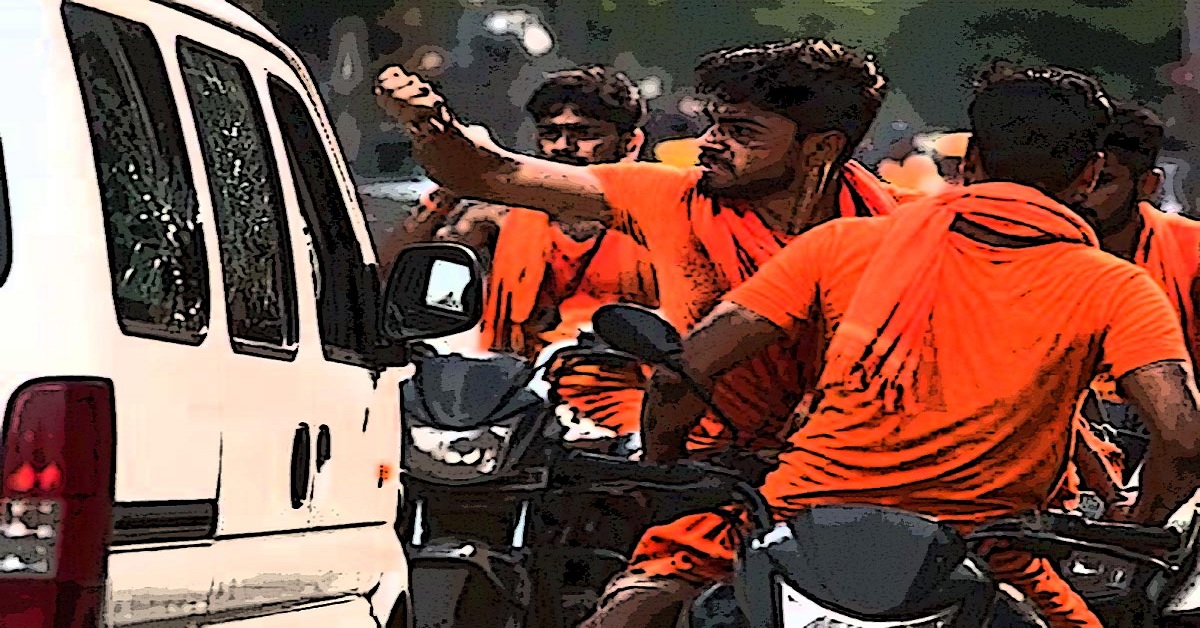
The Kanwar Yatra: Between devotion and domination Religious mobilisation and communal politics have made Muslims, meat sellers and commuters pay the price
19, Aug 2026 | Tanya Arora
Every year during Shravan, millions of devotees of Shiva, Kanwariyas, travel, often on foot, to collect Gangajal from places such as Haridwar, Gaumukh, Gangotri and Sultanganj and carry it back to offer at Shiva temples. For many devotees, the journey is an intensely personal act of faith, austerity and discipline. The 2026 Yatra formally ran from July 30 to August 11, culminating in Sawan Shivratri. There is nothing inherently incompatible between such a religious practice and a constitutional democracy. The problem begins when the exercise of religious freedom is transformed into a claim over everyone else’s freedom.
That distinction has become increasingly difficult to ignore. The 2026 Kanwar season was marked not simply by the ordinary logistical difficulties of accommodating millions of pilgrims, but by repeated reports of assaults, vandalism, intimidation, attacks on vehicles, confrontations with police, targeting of Muslims, pressure on Muslim-owned establishments, and an increasingly aggressive campaign around what citizens may eat or sell during Shravan. The question, therefore, is not whether the Kanwar Yatra should be allowed. It should.
The question is what happens when the State begins accommodating a religious procession to such an extent that the rights of everyone outside the procession begin to appear negotiable? That is where the 2026 Yatra becomes constitutionally significant.
A pilgrimage of millions — and a State willing to rearrange public life around it
The sheer scale of the Kanwar Yatra makes substantial administrative arrangements inevitable. Uttar Pradesh deployed approximately 35,000 police personnel, 151 companies of the Provincial Armed Constabulary and 11 companies of paramilitary forces for the 2026 pilgrimage. According to The Times of India, the State also installed nearly 29,500 CCTV cameras and deployed 395 drones, alongside 1,222 police helpdesks and 829 medical camps. The Uttar Pradesh government had announced an elaborate security and logistical plan even before the Yatra began. The Indian Express reported that round-the-clock control rooms, CCTV surveillance, additional buses and other arrangements were being put in place, with Chief Minister Yogi Adityanath stating that nobody could stop the annual pilgrimage.
The administration’s preparations were explicitly framed around ensuring the safety, convenience and dignity of the Kanwariyas. Uttar Pradesh DGP Rajeev Krishna announced a “zero incident, zero accident” target, while senior officials discussed interstate coordination, medical preparedness, traffic management and surveillance. Again, there is nothing objectionable about this in itself. A democratic State should facilitate the peaceful exercise of religion. But the scale of accommodation raises another question: where is the corresponding obligation to protect those who are not participating in the pilgrimage?
During the Yatra, roads are closed or heavily restricted, schools and institutions in some areas are shut or their schedules altered, businesses are asked to modify operations, and entire stretches of public space are effectively reorganised around the movement of pilgrims. In western Uttar Pradesh, Hindustan Times reported extensive traffic restrictions, including the planned closure of the Delhi-Haridwar National Highway and Ganga Canal Road in Muzaffarnagar for the movement of Kanwariyas. Non-vegetarian eateries and liquor shops were cleared from parts of the route. The Delhi-Meerut Expressway was also closed to regular traffic at the peak of the Yatra, causing severe congestion on alternative routes, according to The Times of India. Such measures can be justified when they are proportionate, temporary and genuinely necessary for public safety. But accommodation cannot become capitulation. And that distinction becomes particularly important when the very group being accommodated is also involved, in individual cases, in disrupting public order.
When a minor collision becomes collective punishment
One of the most disturbing patterns emerging from the 2026 Yatra is the repeated escalation of relatively minor road incidents into collective violence. On July 16, in Purkazi, Muzaffarnagar, a pickup vehicle reportedly brushed against Kanwariyas, reported by The Hindu. What should have been an ordinary traffic dispute escalated into an attack on the vehicle. Videos showed men climbing onto the pickup, smashing its windshield and striking it with sticks. Police intervened, registered a case against unidentified persons and began examining video footage to identify those involved.
The incident is revealing because the vehicle was not accused of deliberately attacking a religious procession. The reported trigger was an accidental collision. Yet the response was collective retaliation. The same pattern appeared in Manglaur town, Haridwar district, Uttarakhand on August 1, when an Alto collided with a Kanwariya and broke his Kanwar. As reported by ETV Bharat, a crowd reportedly pulled the driver from the vehicle, assaulted him and then vandalised the car. Significantly, the driver was himself reportedly a Kanwariya returning with Gangajal. Police eventually intervened and registered an FIR.
These incidents demonstrate that the problem cannot simply be explained as hostility between Hindus and Muslims or as attacks by outsiders upon a religious procession. The underlying problem is the normalisation of mob justice. A collision becomes “desecration”; desecration becomes an excuse for anger; anger becomes collective violence and the crowd becomes the adjudicator. That is precisely the opposite of the rule of law.
The school van attack: When even children are not outside the zone of religious aggression
Perhaps the most disturbing example occurred in Lucknow. On August 3, six Kanwariyas allegedly attacked a school van after a motorcycle associated with the group collided with the vehicle at Charak Chowk. The men allegedly smashed the rear windshield and side mirrors and threatened the driver. The van was carrying schoolchildren. The incident was reported by Hindustan Times, which provided that police subsequently arrested one person in connection with the attack.
The children were not physically injured, but the psychological dimension cannot be dismissed. A school vehicle is not an ideological adversary; a child sitting in a school van is not an obstruction to religious freedom; and a driver involved in a traffic dispute cannot lawfully be subjected to collective punishment because the other side happens to be carrying a Kanwar.
The newspaper records allegations by parents that the police initially refused to register the complaint and instead threatened action against the van for alleged documentation violations. Parents also alleged that the assault occurred in the presence of policemen who failed to intervene. Those allegations require independent investigation and should not be treated as established fact without verification. But they raise an important institutional question: what message is communicated when citizens perceive that the police are more comfortable questioning the victim than confronting the mob?
When the police themselves become targets
The violence has also extended to law-enforcement personnel. In Meerut, as reported by Deccan Herald, a dispute between groups of Kanwariyas following a motorcycle collision reportedly escalated into a fight. A head constable who attempted to intervene was allegedly pushed and beaten before police eventually brought the situation under control. The significance of such incidents goes beyond the injury to an individual officer.
The State cannot maintain public order if the police are expected to negotiate with a mob whose religious identity is treated as a reason for exceptional restraint. A police officer cannot be expected to enforce the law only when the crowd permits him to. Once a group begins attacking police personnel, damaging vehicles and obstructing roads, the religious nature of the gathering cannot operate as a shield. The constitutional obligation is precisely the opposite: the more sensitive the religious context, the more carefully and impartially the State must enforce the law.
The communal turn: When the Kanwar route becomes a map of exclusion
If the violence were limited to road accidents and crowd-management failures, it would be a serious law-and-order problem. But the 2026 Yatra has also revealed a distinctly communal dimension.
The material compiled for this piece records a series of incidents in which Muslim-owned businesses, Muslim participation and Muslim presence along Kanwar routes were specifically targeted.
On July 28 in Dehradun, members of the Hindu Raksha Dal reportedly submitted a memorandum demanding that Muslim shopkeepers remove their shops from the Kanwar route and refrain from offering food or water to pilgrims. The organisation reportedly threatened to shut Muslim-owned shops itself if they did not comply. This is an extraordinary demand. A Muslim offering water to a Hindu pilgrim is not a constitutional violation. A Muslim-owned shop selling lawful food is not a threat to religious freedom. A citizen does not lose the right to conduct a business because a religious procession happens to pass through the locality. And no private organisation has the legal authority to decide that another citizen’s shop must close because of that citizen’s religion.
The danger lies in the gradual normalisation of precisely this idea. The controversy surrounding shopkeeper identity is particularly revealing. In 2024, Uttar Pradesh and Uttarakhand authorities had directed eateries along the Kanwar route to display the names of their owners and employees. The Supreme Court intervened and stayed the directions. It permitted authorities to require disclosure of the nature of food being served but rejected the requirement that owners and employees be identified by name. The constitutional concern was obvious. A food item can be vegetarian or non-vegetarian; a restaurant can be licensed or unlicensed; a kitchen can meet or violate health standards. But the religion of the person selling the food is not a food-safety category.
The Supreme Court’s intervention therefore went directly to the danger of converting a dietary preference into a system of religious identification. The 2026 incidents suggest that the politics behind that controversy has not disappeared. The document records an alleged incident in which a Muslim shopkeeper was pressured to display his name prominently so that Kanwariyas could determine whether the establishment was Muslim-owned. This is the politics of the nameplate in another form. The underlying message is: Know who owns the shop. Know whether he is Muslim. Decide whether you will enter.
That is not neutral consumer information, rather it is communal sorting. And communal sorting becomes particularly dangerous when it occurs in an environment where vigilante groups have already threatened violence. The politics of the Kanwar Yatra in 2026 cannot be understood without examining the increasingly aggressive campaign against meat and non-vegetarian food.
This is where an individual’s religious observance begins to collide with another citizen’s personal autonomy and livelihood. Kanwariyas may choose to abstain from meat. They may insist that the food they themselves consume during their pilgrimage is vegetarian. They may choose not to enter a restaurant serving meat. None of this is controversial. The constitutional problem begins when their dietary discipline is converted into a rule for everyone else.
In Meerut, the district administration issued directions concerning food served along the Kanwar route, including restrictions concerning onion and garlic, while meat and liquor shops were to be closed or covered, according to Hindustan Times.
In Hapur, authorities ordered meat, fish, egg and other non-vegetarian outlets shut from July 26 until further orders, explicitly citing the need to ensure the peaceful passage of the Kanwar Yatra. India Today reported that the closure extended to all such outlets in the relevant area. In Delhi, the MCD ordered action against unauthorised and unlicensed meat shops along Kanwar routes and near 308 Kanwar camps. Hindustan Times reported that the order followed a meeting chaired by Delhi minister Kapil Mishra.
Again, there is an important legal distinction. If a meat shop is illegal, it can be shut. If a business violates municipal rules, it can be proceeded against. If an establishment lacks a licence, the law can be enforced. But if the underlying principle becomes “meat must disappear because Kanwariyas are passing through”, then the State is no longer merely regulating illegal businesses. It is imposing the religious preferences of one group upon the everyday life of everyone else. And this becomes even more troubling because meat businesses in many parts of north India are disproportionately dependent on Muslim workers and proprietors. Thus, what is presented as a religious restriction on food can have a distinctly communal economic impact.
From administrative restriction to vigilante enforcement
The State’s actions are only one part of the story. More alarming is the extent to which private Hindu nationalist organisations have attempted to enforce these restrictions themselves. On July 30, an incident in Ghaziabad took place where a Hindu Raksha Dal member allegedly assaulted a man transporting meat, objecting to the transportation during Shravan.
In Mainpuri, members of Hindu organisations reportedly entered non-vegetarian establishments and egg carts, allegedly abusing shopkeepers and ordering them to close. In Deoband, members of VHP-Bajrang Dal reportedly objected to the sale of chicken and called the police, after which employees were detained and meat was seized. This is where the distinction between religious practice and religious policing becomes essential.
The most striking example of this convergence of religion, meat and administrative power came from Baheri in Uttar Pradesh, where a chicken-biryani shop near the Kanwar route was demolished after Bajrang Dal workers complained about the sale of non-vegetarian food. As reported by Maktoob Media, the owner, Mohd Salman, was detained. Police described the action as preventive and said the establishment was disturbing public peace, while municipal authorities said the structure was an illegal construction over a drain. If the structure was genuinely illegal, the administration must be permitted to enforce municipal law.
But the central question remains one of procedure and proportionality: Was the law enforced because there was an established municipal violation, or did the religious complaint trigger the enforcement action?
The Constitution does not prohibit the State from removing an illegal structure. It does prohibit the State from using public power as a disguised instrument of communal punishment. A shopkeeper cannot be punished for being Muslim. A business cannot be demolished because a vigilante group dislikes what it sells. And “public peace” cannot become a vague administrative formula through which the State converts the demands of a mob into enforceable orders.
The Kanwar Yatra and the politics of Muslim belonging
The communalisation of the Yatra has also extended beyond shops and food. Many inciteful statements from Hindu religious figures and organisations were reported where they were seen demanding that Muslims participating in the Kanwar Yatra conform to Hindu visual markers, including saffron clothing. As reported by Deccan Herald, Right-wing leader Swami Yashveer of Yog Sadhna Ashram questioned the participation of Muslims wearing skull caps or burqas in the Kanwar Yatra, stating that such attire is inappropriate for the pilgrimage and suggesting that those who participate genuinely should formally return to Hinduism. This is an extraordinary conception of religious participation.
If a Muslim chooses to participate in a Hindu pilgrimage peacefully, that should be understood as an expression of individual conscience.
Instead, the political framing asks: Why is a Muslim here?
And then: If he is here, why does he still look Muslim?
The implication is that participation in the religious life of another community is acceptable only after the Muslim has symbolically surrendered his Muslim identity. The rhetoric surrounding the Yatra has also spilled into explicitly territorial and historical claims. Slogans invoking Mathura, Kashi and Deoband, including the formulation that “Mathura and Kashi are just a glimpse; Deoband is yet to come.” Such slogans cannot be dismissed as harmless rhetoric.
The same political impulse surfaced in Agra, where members of the Akhil Bharat Hindu Mahasabha reportedly attempted to enter the Taj Mahal with Kanwar water, asserting the claim that the monument was actually “Tejo Mahalaya”. The Kanwar is consequently being made to carry political baggage far beyond the act of carrying Gangajal. It becomes a symbol of territorial assertion. And, increasingly, a means of demonstrating who can occupy public space and on what terms.
The political nature of the Yatra was especially visible in Maharashtra. During a Kanwar procession in Muslim-majority Mumbra, BJP legislator Nitesh Rane reportedly made remarks asserting that Mumbra “was and will remain” Hindu, according to NDTV‘s reporting. The significance of such rhetoric is difficult to miss. A religious procession in a particular neighbourhood becomes an opportunity to make a claim about the religious ownership of that neighbourhood.
The question is no longer simply: Can Hindus carry out a religious procession in Mumbra?
Of course they can, subject to ordinary law-and-order requirements. The political question being manufactured is: Who does Mumbra belong to?
That is an entirely different proposition. A constitutional democracy does not assign neighbourhoods to religions. Mumbai’s Muslims do not cease to be equal citizens because a Hindu procession passes through their locality. Nor does a Hindu procession become a declaration of territorial ownership. Yet political rhetoric increasingly attempts to make precisely that transformation.
The state, selective enforcement and the constitutional line
There is an uncomfortable contradiction running through the entire Kanwar season. On the one hand, the State has undertaken extensive measures to regulate and facilitate the pilgrimage, deploying thousands of police personnel, installing CCTV cameras and drones, closing roads, diverting traffic, inspecting businesses, shutting meat shops and, in some areas, even altering school schedules. Entire districts have effectively been reorganised around the movement of Kanwariyas. On the other hand, when members of the same pilgrimage are accused of vandalising vehicles, assaulting drivers, confronting police personnel or intimidating businesses, enforcement has at times appeared hesitant, delayed or reactive. The document records several instances in which police intervention allegedly came only after violence had escalated, alongside allegations that FIRs were initially resisted or that accused persons were subsequently released on bonds. These allegations must, of course, be examined individually and should not be used to suggest that every police officer or administration acted in favour of violent Kanwariyas. Yet the recurrence of such allegations raises a larger constitutional concern: selective enforcement is itself a rule-of-law problem. A State that is willing to deploy extraordinary resources to facilitate a religious pilgrimage must be equally willing to enforce the law when individuals participating in that pilgrimage are accused of violating the rights of others.
This brings the discussion to the constitutional limits of religious freedom. The answer to the violence surrounding the Kanwar Yatra is not to restrict the right to practise religion, but to understand that right within the constitutional framework in which it operates. Article 25 guarantees freedom of conscience and the right freely to profess, practise and propagate religion, but that freedom is expressly subject to public order, morality and health, as well as the other fundamental rights guaranteed by Part III of the Constitution. Religious practice is therefore protected, but violence is not; pilgrimage is protected, but vandalism is not; devotion is protected, but intimidation is not. Similarly, while a Kanwariya is free to observe vegetarianism as part of religious practice, that preference does not automatically confer a right to determine what another citizen may eat or sell. A religious assembly is protected, but it cannot become a licence to assault a person who happens to cross its path. The State’s obligations under Articles 14 and 21 are equally important: equality before the law, equal protection, life and personal liberty cannot be subordinated to the preferences or sensitivities of a religious crowd. The Supreme Court’s intervention in the 2024 Kanwar nameplate controversy is instructive in this regard. The Court permitted authorities to regulate the nature of food being served but stayed directions requiring establishments to disclose the names and identities of their owners and employees. The distinction is fundamental: the State may regulate conduct where the law permits it; it cannot turn religious identity itself into a regulatory category merely to accommodate the preferences of one group.
When the state outsources public order to majoritarian sentiment
The otherisation being normalised through meat deserves closer scrutiny because it is often reduced to a question of religious sensitivity, when its consequences extend far beyond individual dietary preferences. Food is closely connected to identity, livelihood, caste, class and community, and for a large number of Indians, eating meat is an ordinary part of everyday life. At the same time, for thousands of workers employed in slaughterhouses, meat markets, restaurants, transportation and allied businesses, the sale and distribution of meat is a source of livelihood. The consequences become even more significant when meat-related businesses are disproportionately associated with particular communities, including Muslims. When the consumption or sale of meat is therefore politically constructed as something that must disappear from public spaces during a Hindu pilgrimage, the impact is not confined to Kanwariyas who voluntarily choose to abstain from it. It can result in restaurants being forced to shut, meat sellers losing their income, workers being sent home, shopkeepers being pressured to alter their businesses and Muslim-owned establishments becoming more visible and vulnerable to targeting. It also sends a wider social message that the everyday dietary choices and livelihoods of one section of citizens can be restricted to accommodate the religious sensitivities of another. The politics of meat, therefore, is not merely a disagreement over food; it is a question of economic freedom, equal citizenship and the extent to which one community’s religious preferences can determine the conditions under which others live and work.
This has a direct constitutional dimension. Article 19 (1) (g) protects every citizen’s right to practise a profession or carry on an occupation, trade or business, subject to restrictions imposed by law. Such restrictions must have a legitimate legal basis and satisfy the requirements of reasonableness; they cannot become constitutionally valid merely because a section of society considers a particular occupation offensive or incompatible with its religious beliefs. A lawful meat business cannot be treated as inherently illegitimate simply because a religious procession is passing through the area. If an establishment is unlicensed, violates municipal regulations or breaches food-safety requirements, the State has both the authority and the responsibility to act against it. But the basis of that action must remain the law and not the demands of a religious crowd.
This leads to the deeper institutional concern surrounding the Kanwar Yatra: the danger of the State allowing majoritarian sentiment to determine the boundaries of public order. A democratic State possesses the legitimate authority to regulate public spaces and enforce the law; a vigilante organisation does not. If the administration considers that meat shops should be temporarily closed along a particular route for a legally defensible public-order or regulatory reason, that decision must emerge from a lawful order, a clearly identifiable statutory basis and a proportionate exercise of administrative power. What cannot happen is for a private organisation to first threaten or demand the closure of businesses and for the administration to subsequently give effect to that demand, whether directly or indirectly. Such a process effectively reverses the constitutional chain of authority: the mob demands, the administration accommodates, and the police enforce.
That inversion is particularly dangerous because it allows majoritarian power to acquire the appearance of State authority. A vigilante group does not become legitimate simply because its demands are subsequently reflected in administrative action, just as a religious sentiment does not become a legal standard merely because it is politically popular. The State’s responsibility is not to determine which community is numerically or politically stronger and then organise public life around its preferences. Its responsibility is to ensure that the strength of one community cannot be converted into the power to determine the rights, livelihoods or freedoms of another. Public order cannot mean the preservation of peace by asking the more vulnerable to surrender their rights; it must mean the equal protection of all citizens, including those whose presence, food, occupation or identity may be politically unpopular.
And yet, there are alternative examples
It is important not to reduce the entire Kanwar Yatra to a narrative of violence or communal hostility. Such a portrayal would be both inaccurate and unfair to the millions of devotees who undertake the pilgrimage peacefully and to the many instances in which Kanwariyas and local communities have demonstrated restraint, accommodation and mutual respect. These examples are important precisely because they establish that confrontation between the Yatra and other communities is neither inevitable nor intrinsic to the religious practice itself.
A recent example from Bijnor illustrates this possibility. Navbharat Times reported that Kanwariyas halted their procession and switched off the DJ music to allow a Muslim funeral procession to pass. Rather than treating the funeral as an obstruction to their religious journey, the pilgrims reportedly made way for the procession and maintained silence as the funeral passed. The incident is a small but significant illustration of what religious coexistence can look like in practice: the exercise of one’s own faith does not require denying another community the space to mourn, pray or move through the same public space.
Such instances matter because they expose the artificiality of the claim that religious processions must necessarily generate confrontation with other communities. There is nothing inherent in the Kanwar Yatra that requires hostility towards Muslims; there is nothing inherent in Hindu devotion that requires meat shops to be vandalised; there is nothing inherent in religious faith that requires a school van carrying children to be attacked; and there is certainly nothing inherent in pilgrimage that requires a neighbourhood to be treated as the exclusive property of one religious community. Where devotees choose restraint, the same public space can accommodate different religious practices without one being perceived as a threat to the other.
Indeed, these instances provide a useful counterpoint to the more disturbing episodes documented during the 2026 Yatra. They demonstrate that the conflict is not an unavoidable consequence of the scale of the pilgrimage or of competing religious practices. It is shaped by choices — by the conduct of individuals, by the rhetoric of political and religious actors, and crucially, by the manner in which the State responds to both cooperation and provocation. The choice to transform religious devotion into confrontation, exclusion or majoritarian assertion is not dictated by faith; it is political.
The 2026 yatra must be understood against the history of 2024 and 2025
The events of 2026 cannot be viewed as a series of isolated disturbances detached from the history of the Kanwar Yatra. The document records at least 20 incidents of violence during the 2024 pilgrimage, while Hindustan Times reported that more than 170 Kanwariyas were booked within just five days of the 2025 Yatra in Uttarakhand for alleged offences including hooliganism, rioting, obstruction of highways and wrongful restraint. The recurrence of similar incidents in 2026 therefore demands something more than the familiar administrative response of treating each episode as an unfortunate, isolated altercation.
When vandalism, assaults, road blockages, confrontations with police and intimidation of civilians repeatedly emerge around the same pilgrimage year after year, the question is no longer simply what happened in a particular incident, but whether there is a systemic failure in the way the State anticipates, manages and responds to violence associated with the Yatra. That necessarily raises questions about how processions are regulated, what protocols are followed when a Kanwar is damaged, how quickly arrests are made, whether FIRs are registered without regard to the religious identity of the parties involved, and whether the police are exercising a different degree of restraint when the accused are members of a religious procession. It also requires scrutiny of whether Muslim-owned establishments are disproportionately exposed to intimidation, whether restrictions on businesses are genuinely grounded in neutral statutory criteria, and whether threats issued by vigilante organisations receive the same seriousness from law-enforcement agencies as threats allegedly directed at pilgrims. These are not questions directed at Hinduism or at the legitimacy of the pilgrimage. They are questions about whether the State is capable of administering a mass religious event without allowing religious identity to influence the application of ordinary law.
The Azeem Case: When a Traffic Dispute Ends in Death
The death of 27-year-old Mohd Azeem in Hapur brings these questions into their most serious and tragic form. According to The Hindu, Azeem, a mini-truck driver from Moradabad, was involved in a road collision near Garhmukhteshwar on July 31 and was allegedly assaulted following the incident before being shifted to a Delhi hospital, where he died on August 4. Hapur Police subsequently arrested Lokesh and Shivam and booked them for murder and rioting, with police stating that two of the four named accused had been arrested and efforts were underway to apprehend the remaining accused. The case, however, involves competing accounts that must be carefully distinguished.
Azeem’s family alleged that he was assaulted after the collision, while the father of the auto-rickshaw driver involved in the incident filed a separate complaint alleging that Azeem had deliberately rammed his vehicle into the auto-rickshaw. Police indicated that the competing allegations were being investigated. Those competing versions must ultimately be tested through evidence, investigation and trial rather than public speculation. Yet irrespective of how the underlying collision is eventually established, the death illustrates the grave consequences of allowing a road dispute to become a matter for collective retaliation. A traffic accident is supposed to activate the ordinary machinery of the criminal justice system — police intervention, investigation, collection of evidence, identification of individual responsibility, prosecution and trial. It must never become a progression from collision to anger, from anger to mob mobilisation, and from mob mobilisation to assault and death. Where the alleged perpetrators are members of or associated with a religious procession, the State’s responsibility becomes even greater: religious identity must neither shield an accused person from accountability nor prejudice the investigation against the victim. The ultimate test is whether the law can operate with the same force and impartiality when the accused belong to a politically influential or numerically dominant religious group as it would when the circumstances were reversed.
A pilgrimage should not become a test of submission
The 2026 Kanwar Yatra therefore raises a question that extends far beyond individual incidents of vandalism, assault or the closure of particular shops. It forces us to ask whether religious freedom is increasingly being interpreted not simply as the freedom to practise one’s faith, but as the freedom of one religious group to determine the conditions under which everyone else must live. That is not the guarantee contained in Article 25. The Constitution protects the believer, but it also protects the person who does not share that belief; it protects the vegetarian, but it also protects the meat-eater; it protects the Hindu pilgrim, but it equally protects the Muslim shopkeeper whose business happens to lie along the pilgrimage route. It protects the right to assemble and practise religion, but it also protects the right of other citizens to move through public spaces and carry on their livelihoods.
These rights do not exist in separate constitutional compartments; they operate within a common framework of equality, liberty and the rule of law. The State must therefore resist the tendency to treat criticism of violence or vigilantism associated with the Kanwar Yatra as criticism of Hinduism itself. The two are fundamentally different. It is entirely possible to respect the faith of millions of peaceful Kanwariyas while demanding accountability from those who vandalise vehicles or assault civilians; to respect Hindu religious practice while opposing intimidation of Muslim-owned businesses; to recognise the religious significance of Shravan while insisting that meat sellers and other lawful businesses retain their rights; and to facilitate a religious procession while requiring those participating in it to remain subject to the same law as everyone else. Indeed, that is what genuine secularism requires: not hostility towards religion, but equal constitutional protection irrespective of religion.
Faith deserves protection; impunity does not
The 2026 Kanwar Yatra should therefore not be remembered merely as another annual pilgrimage marked by massive crowds, saffron flags, elaborate security arrangements and traffic diversions. It should instead prompt a more serious examination of the relationship between religious practice, political mobilisation and State power. The recurring incidents — from the vandalism of vehicles in Muzaffarnagar, the attack on a school van in Lucknow and confrontations involving police, to the reported targeting of Muslims and meat sellers, threats against Muslim-owned businesses, communal rhetoric surrounding Mumbra and Deoband, attempts to turn the Taj Mahal into another site of religious contestation, and ultimately the death of Mohd Azeem — cannot simply be dismissed as a collection of unrelated disturbances. Taken together, they point towards the gradual normalisation of religious exceptionalism: the assumption that a religious procession is entitled to extraordinary accommodation, that religious sentiment can justify extraordinary restrictions, that meat can be removed from public spaces because pilgrims prefer vegetarianism, that Muslim businesses can be identified or pressured, that a crowd can punish what it perceives as an insult, and that political actors can use religious gatherings to make claims about the ownership of neighbourhoods and public spaces.
The danger lies precisely in allowing these assumptions to become normal. The answer, however, is not to diminish or delegitimise the Kanwar Yatra. It is to restore its constitutional boundaries. Faith must be protected, pilgrims must be protected and religious processions must be protected, but no person can be placed above the law merely because they claim to be acting in the name of religion. The real test of the State’s commitment to secularism is therefore not how warmly it welcomes a majority religious procession, but whether, while facilitating it, it can extend the same protection to the Muslim shopkeeper, the meat seller, the commuter, the schoolchild and every other citizen affected by it. It must be able to say to the shopkeeper that his lawful business cannot be destroyed because someone finds it religiously offensive; to the meat seller that his livelihood cannot be extinguished by a mob; to the vigilante that religious identity gives no authority over another citizen; to the politician that a neighbourhood cannot be claimed as the property of one religion; and to the Kanwariya that faith may be sacred, but it does not place anyone beyond the Constitution. The Kanwar Yatra can and should remain a journey of devotion. What it cannot become is a vehicle through which majoritarian power determines who may eat, who may trade, who may move, who may pray, who may belong — and who must simply get out of the way.
Image Credit: The Indian Express
Related:
How deviant acts mar the sacred Kanwar Yatra
Hindu-Muslim Unity: The other side of Kanwar Yatra
Kanwar Yatra episode: Pasmanda Muslims, ‘wooed’ by BJP, perhaps biggest losers
Pay heed to Article 21 and its order in the Kanwar Yatra case: SC to Kerala Gov’t
Aligarh: Woman allegedly raped while undertaking ‘Kanwar Yatra’