From Statelessness to Citizenship: CJP helps Adori Bibi reclaim her Indian identity Born and raised in Assam, Adori Bibi was declared a “foreigner” after missing Tribunal hearings while working outside the state to survive
07, Sep 2026 | CJP Team
For Adori Bibi, displacement began long before she entered a courtroom. Born and brought up in Bhandara village in Assam’s Bongaigaon district, Adori grew up in a family whose life was repeatedly disrupted by the flooding of the Aai River. The family lost its home to the floods on several occasions, forcing them to seek shelter and livelihood elsewhere. At one point, they moved to Suapata in Dhubri district, where Adori lived with her father, Sahar Ali.
She eventually married Nijamuddin and returned to the Bongaigaon area, settling in the Jamdaha-Bhandara region. Her life remained precarious, however. Like many families struggling to survive, they were compelled to travel outside the state for work, including to brick kilns.
It was against this backdrop of poverty, displacement and insecure livelihoods that another form of displacement entered Adori’s life: the threat of being treated as a foreigner in the land where she had been born and raised.
Every week, CJP’s dedicated team in Assam, comprising community volunteers, district volunteer motivators, and lawyers, provides vital paralegal support, counseling, and legal aid to many affected by the citizenship crisis in over 24 districts in Assam. Through our hands-on approach, 12,00,000 people successfully submitted completed NRC forms (2017-2019). We fight Foreigner Tribunal cases monthly at the district level. Through these concerted efforts, we have achieved an impressive success rate of 20 cases annually, with individuals successfully obtaining their Indian citizenship. This ground level data ensures informed interventions by CJP in our Constitutional Courts. Your support fuels this crucial work. Stand with us for Equal Rights for All #HelpCJPHelpAssam. Donate NOW!
From a notice to a declaration of “foreigner”
Adori’s citizenship came under scrutiny after she received notice from the Foreigners Tribunal. She appeared before the Tribunal and contested the allegation, filing her written statement and subsequently placing evidence on record. But in 2018, the proceedings took a devastating turn.
Adori missed three hearing dates in October, November and December that year because she and her family had travelled outside Assam in search of work. Her lawyer sought time, but the request did not result in her case being heard on merits. On December 21, 2018, she was declared a foreigner ex-parte.
The Foreigners Tribunal’s order dated December 21, 2018 declared Adori Khatun a “foreigner of the stream post-1971” and directed the Superintendent of Police to apprehend her and keep her in a detention camp pending deportation/pushback. It also directed that her name be removed from voter enrolments and that an enquiry be made into her siblings and other family members.
Legally, the Tribunal proceeded on the basis of Section 9 of the Foreigners Act, 1946, under which the burden of proving that she was not a foreigner lay on Adori. The Tribunal recorded that she had submitted documents including the 1951 NRC, 1965 and 1970 voter lists, later electoral rolls, her EPIC and a Gaon Panchayat certificate. However, it held that she had failed to properly prove the documents and their contents.
The significant problem was that the Tribunal ultimately proceeded to decide the case after repeated non-appearance. It recorded that the matter had been fixed for cross-examination and hearing from August 2016, and treated her absences as a failure to contest the proceedings despite opportunities.
The order may be read below:
For a woman already struggling with repeated displacement, the consequences were profound. A person who had spent her life in Assam now faced the possibility that the State would deny the very citizenship that formed the legal foundation of her life there. When the police came looking for her, she was away working.
Adori and her family eventually approached the Gauhati High Court. The Gauhati High Court’s order dated September 16, 2022 took a markedly different approach. The Court examined the Foreigners Tribunal record and noted that Adori had in fact appeared before the Tribunal, filed her written statement and submitted relevant documents, and had also filed an affidavit-in-evidence.
The Court specifically recorded her explanation that she had lost contact with her lawyer and the case number while working at a brick factory, and consequently did not know about the subsequent dates fixed by the Tribunal. She said she learnt of the adverse order only in March 2019.
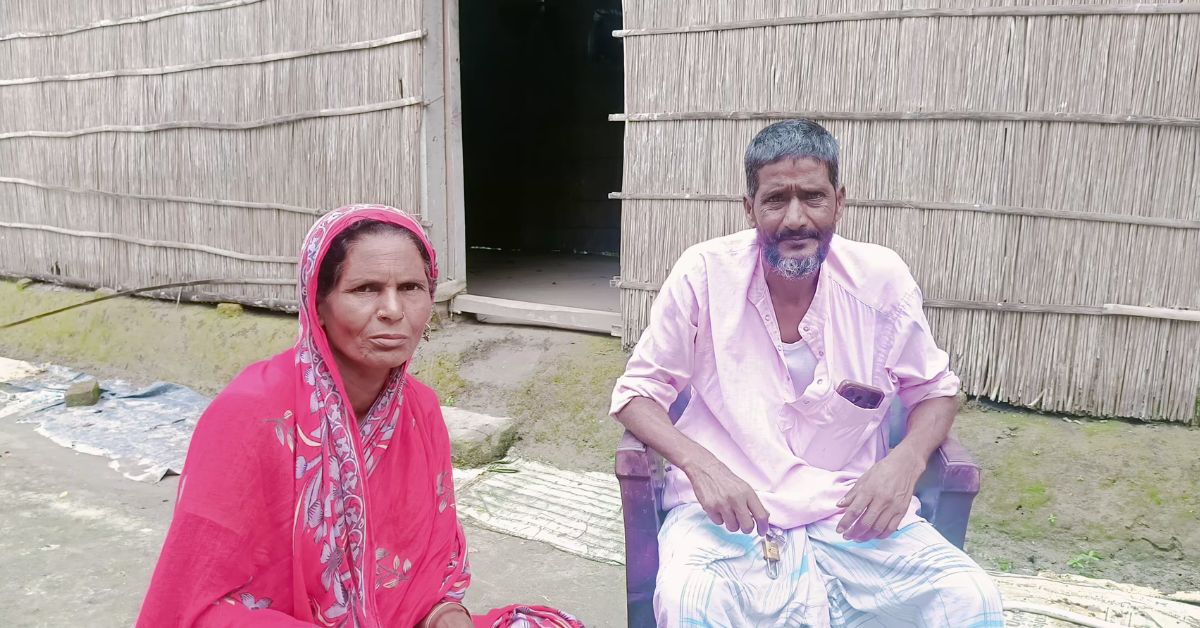
 Adori Bibi with her husband outside their home in Assam
Most importantly, the High Court concluded that Adori should be given another opportunity to prove her citizenship. It therefore set aside and quashed the December 2018 Foreigners Tribunal order and remanded the matter to the Tribunal for consideration after cross-examination. The Court expressly directed that she be allowed to adduce evidence in support of her claim and discharge the burden under Section 9 of the Foreigners Act.
The order may be read below:
The litigation gave her an opportunity to return to the Tribunal and place her evidence on record. What followed was a painstaking effort to reconstruct, through official records, the documentary chain connecting Adori to her father and her father to pre-1971 electoral records.
CJP takes up the case
This was where the legal intervention by Citizens for Justice and Peace became crucial. CJP’s legal team, led by Legal Member Dewan Abdur Rahim, with Legal Member Sohidur Rahman, worked on establishing the evidentiary chain required to answer the central question before the Tribunal: was Adori a foreigner who entered Assam after March 25, 1971, or was she an Indian citizen?
The answer could not rest merely on where Adori said she was born. Under the proceedings before the Foreigners Tribunal, she had to discharge the statutory burden under Section 9 of the Foreigners Act, 1946.
That meant proving the facts connecting her to her claimed Indian parentage through credible and legally admissible evidence. The evidence ultimately presented before the Tribunal was substantial. Adori examined herself, her brother Jabed Ali and Subhash Medhi, a Land Records Staff member of the Manikpur Revenue Circle. All three witnesses were cross-examined by the State. Ten documents were also exhibited in evidence.
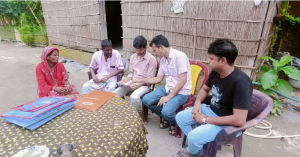 Team CJP Assam with Adori bibi and her husband
Reconstructing a citizenship through the records
At the centre of CJP’s case was a documentary trail stretching across decades. The 1965 electoral roll for Bhandara recorded Sahar Ali, son of Babar Ali, as a voter. The same name appeared in the 1970 electoral roll. These records were particularly significant because they placed Adori’s claimed father in the electoral record well before the March 25, 1971 cut-off that is central to citizenship proceedings in Assam. The Tribunal accepted these voter lists after they were duly proved by the Electoral Registration Officer, Bongaigaon, through a letter dated July 29, 2025.
But establishing the father’s presence in the pre-1971 electoral rolls was only one part of the legal chain. Adori also had to demonstrate that the Sahar Ali appearing in those records was in fact her father. This was where the later records became important.
A 1989 electoral roll from Suapata in Dhubri district recorded Sahar Ali, son of Babar Ali, along with other members of the family. The record therefore provided continuity between the earlier electoral entries and the family’s subsequent residence in Suapata.
The Tribunal then examined the land records. The Jamabandi relating to Dag No. 482 in Bhandara recorded the land in the names of Sahar Ali, Aduri Bibi and others, following inheritance from Jabeda Khatun Bibi, wife of Sahar Ali. Crucially, the Tribunal did not rely on the Jamabandi in isolation. Subhash Medhi, the revenue official examined as D.W.3, produced the original Chitha and Jamabandi Registers and thereby proved the record before the Tribunal.
The family evidence reinforced this connection. Adori’s brother, Jabed Ali, testified that he and Adori were children of the same mother, Jabeda Bibi. The Tribunal considered his evidence significant because he too had inherited the same property along with Adori and their father, Sahar Ali.
The case was not based on a single certificate or an isolated document. It was built through a chain: historical electoral records established Sahar Ali’s presence in Assam before the cut-off date; subsequent electoral and family records helped establish continuity; the Jamabandi connected Adori to Sahar Ali through inheritance; and witness testimony supported the family relationship.
What the Tribunal found
The Tribunal approached the case through two connected questions: whether Sahar Ali was an Indian citizen and whether Adori was in fact his daughter. It first found that Adori had successfully established her relationship with Sahar Ali. The Jamabandi and the testimony of the revenue official were central to that finding, while her brother’s evidence further supported the family connection.
It then considered the 1965 and 1970 electoral rolls, which recorded Sahar Ali as a voter. Since these records had been duly proved by the Electoral Registration Officer, the Tribunal accepted them and decided the issue of Sahar Ali’s citizenship in Adori’s favour.
The legal significance of the decision lies in what followed. Having established both the identity of her father and his citizenship, Adori was able to satisfy the statutory burden placed upon her under Section 9 of the Foreigners Act, 1946. The Tribunal therefore concluded that she had successfully discharged that burden and that she was not a foreigner but a citizen of India.
On February 17, 2026, Foreigners Tribunal No. 1, Bongaigaon formally held that Adori Khatun, daughter of Sahar Ali and wife of Nijamuddin, was not a foreigner. Copies of the order were directed to the District Commissioner and Superintendent of Police (B), Bongaigaon, for necessary action.
“From the above, what is discernible is that, O/P successfully establishes her relation with that of her father, Sahar Ali. Hence issue No. (iü) is decided in favour of the 0/P.
On the other hand, Ext-A and Ext-B which are the translated voter lists of ai 1965 and 1970 under 42 No. Abhayapuri (SC) LIA. respectively, where the name of Sohar Ali has been recorded as voter. These voter lists can be taken into consideration as because,these voter lists were dully proved by the ERO, Bongaigaon vide Letter No. BNEL 22/2015/405 dtd 29/07/25. Hence issue No.(i) is also decided in favour of the O/P.
Considering the above facts and circumstances stated above, it can be easily said that, O/P successfully discharged the statutory burden as incorporated U/S.9 of the Foreigners’ Act.1946, the fact that, O/P is not a foreigner but Citizen of India.”
The complete order may be read below:
A legal victory, but not the end of the struggle
The Tribunal’s order brought legal relief, but it did not erase the years of uncertainty that preceded it. For Adori, the declaration that she was an Indian citizen was not simply the conclusion of a court proceeding. It meant that years of being viewed through the suspicion of a citizenship case had finally come to an end.
When CJP representatives visited her home on September 2, 2026, State In-charge Nanda Ghosh, Legal Member Dewan Abdur Rahim, Legal Member Sohidur Rahman and office driver Asikul Hussain handed Adori a copy of the judgment. She held the order silently for several seconds. For years, the question hanging over her life had been whether the State would recognise her as belonging to the country in which she had been born and lived. Now she was holding a document that formally answered that question in her favour.
“I can breathe a little now,” she said.
But the family’s struggle is not yet over. Adori’s husband, Nijamuddin, continues to face his own citizenship proceedings, which remain pending before the Gauhati High Court. He earns a living through a small pan-tambaku shop, and the continuing litigation has placed an additional financial burden on a family that has already spent years struggling to survive.
Citizenship cannot become another form of displacement
Adori’s case illustrates the human cost of citizenship proceedings in Assam. The Aai River repeatedly displaced her family from their home. Poverty forced them to leave the state in search of work. And the Foreigners Tribunal proceedings placed her citizenship itself under threat. What ultimately protected her was not a single document, but the ability to reconstruct a decades-old history through official records and establish a credible evidentiary chain.
The Tribunal’s order is significant precisely because it recognises that chain. It records that Adori established her relationship with Sahar Ali and that the pre-1971 electoral records establishing his presence and citizenship were duly proved. On that basis, she was able to discharge the statutory burden under Section 9 and secure a finding that she is an Indian citizen.
For CJP, the victory is therefore about more than one individual order. It is about ensuring that people facing citizenship proceedings are able to access legal assistance, present their evidence and have their claims examined on their merits.
Adori’s story is a reminder that citizenship is not an abstract legal category. For people living on the margins, it determines whether they can remain secure in their homes, access rights and services, and live without the constant fear of being treated as outsiders. A river may take away a home. Poverty may force a family to move. But the machinery of citizenship determination must not become another force of displacement. In Adori Bibi’s case, sustained legal intervention helped ensure that it did not.
Related:
When a Spelling Error Can Cost Citizenship: Supreme Court stays deportation of five Assam women
From Forest Settlers to ‘Encroachers’: The eviction crisis in Assam’s Taungya Villages
CJP Assam: A journey without parallel, evolving & expanding rights jurisprudence
CJP scores big win! Citizenship restored to Mazirun Bewa, a widowed daily wage worker from Assam