In the name of Hindu business, BJP leader Nitesh Rane pushes economic boycott of Muslims At a gathering promoting Hindu entrepreneurship, Rane urges religiously segregated trade and threatens Muslims who attend the upcoming Nashik Kumbh Mela
28, Oct 2026 | CJP Team
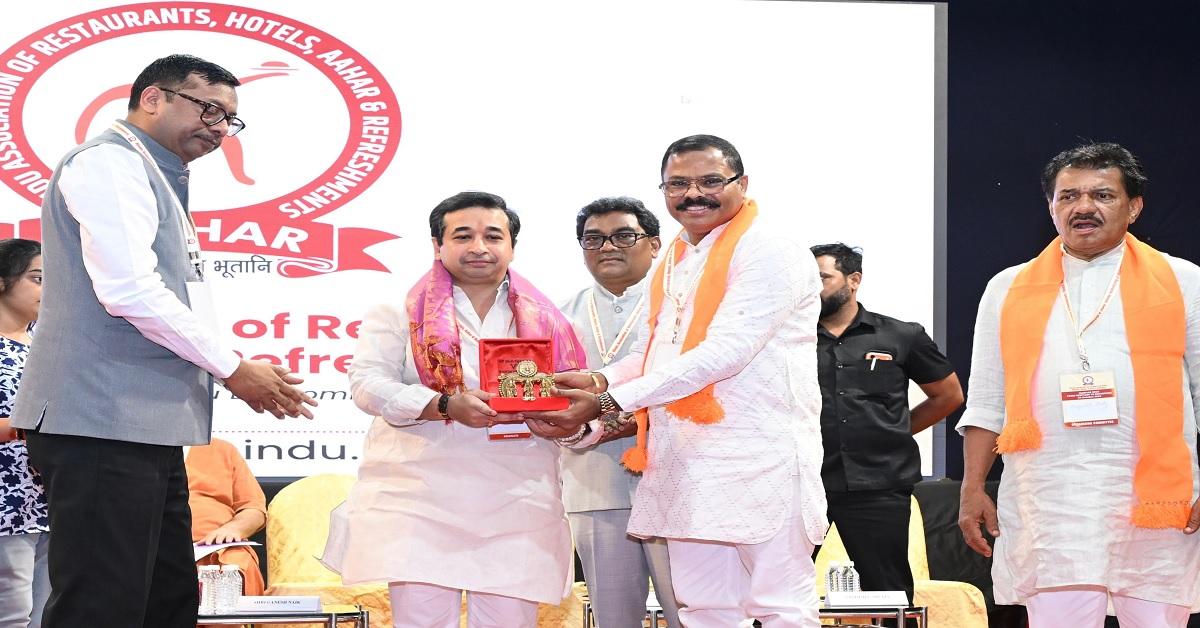
Maharashtra minister and BJP leader Nitesh Rane has turned a campaign ostensibly aimed at promoting Hindu businesses into an explicit appeal for the economic exclusion of Muslims. At a gathering in Navi Mumbai, Rane urged Hindus to buy only from Hindus, demanded that Muslim traders be barred from the upcoming Nashik Simhastha Kumbh Mela, and threatened Muslims who attend the gathering with violence. The message was not simply to support Hindu entrepreneurship, but to make religious identity the basis of economic participation and belonging.
“A Hindu should only buy from a Hindu. We should only do business with Hindus,” Rane declared at the launch of the HARHAR (Hindu Association of Restaurants, Hotels, Aahar & Refreshments) campaign in Jui Nagar. In a video shared on his official X account, he called on Hindus to ensure that the person they traded with was Hindu, presenting this religious test to strengthen a Hindu Rashtra.
CJP is dedicated to finding and bringing to light instances of Hate Speech, so that the persons propagating these venomous ideas can be unmasked and brought to justice. To learn more about our campaign against hate speech, please become a member. To support our initiatives, please donate now!
आज जुईनगर, नवी मुंबई येथे HARHAR (Hindu Association of Restaurants, Hotels, Aahar & Refreshments) या मोहिमेच्या शुभारंभ सोहळ्यास उपस्थित राहिलो.
हिंदू उद्योजकांना एकत्र आणून त्यांच्या व्यवसायाला आर्थिक बळ, व्यापक बाजारपेठ आणि नवी संधी उपलब्ध करून देणारा हा उपक्रम निश्चितच कौतुकास्पद आहे.
‘हिंदूंकडून खरेदी, हिंदू व्यापाराला प्रोत्साहन’ या संकल्पनेतून हिंदू उद्योजकता, भारतीय खाद्यसंस्कृती आणि स्वावलंबनाला अधिक बळ देऊया.
संघटित हिंदू समाज, सक्षम हिंदू उद्योजक आणि समृद्ध हिंदू अर्थव्यवस्था हेच आपले ध्येय!
HARHAR मोहिमेस मनःपूर्वक शुभेच्छा!
#HARHAR #HinduEntrepreneurs #HinduUnity #स्वावलंबीभारत #NiteshRane
— Nitesh Rane (@NiteshNRane) October 24, 2026
He then directed this call for economic exclusion towards the Nashik Kumbh Mela, demanding that Muslims not be allowed to set up shops at the gathering. His rhetoric escalated into an outright threat: “If Muslims come to the Kumbh Mela, they should not go back on their feet.”
This is not a call for self-reliance. It is a call for exclusion, backed by the threat of violence. A minister advocating that citizens refuse to trade with fellow citizens because of their religion, while warning of physical harm to those who attend a public religious gathering, raises concerns that cannot be brushed aside as political rhetoric or community mobilisation. In a separate video shared by news agency IANS, Rane referred to vandalism in France, claiming that Muslim-owned shops had been spared. He used this account to reinforce his demand that Hindus verify the religious identity of those with whom they conduct business.
“When you buy things, do business, or engage in trade, you must ensure that the person in front of you is a Hindu before moving forward,” he said. He also asserted that a country with a Hindu majority did not need any certificate to be a Hindu Rashtra.
Navi Mumbai, Maharashtra: Minister Nitesh Rane says, “During all those riots and vandalism, the moment they realized a shop belonged to a Muslim, they didn’t break it. They immediately moved to the next shop and continued their vandalism. When you buy things, do business, or engage in trade, you must ensure that the person in front of you is a Hindu before moving forward. That is why I am telling you this. This is how our Hindu Rashtra will be strengthened. In a country where 90% of the population is Hindu, we don’t need any certificate to be a Hindu Rashtra…”
(Source: Nitesh Rane PR Team)
— IANS (@ians_india) October 24, 2026
The logic is stark: Muslims are to be treated not as fellow citizens participating in the economy, but as people from whom Hindus must withdraw their custom, business and trust.
An economic boycott dressed up as entrepreneurship
HARHAR was presented as an initiative to bring Hindu entrepreneurs in the food and hospitality sectors together, expand their markets and strengthen their businesses. There is nothing objectionable about entrepreneurs organising around shared interests, promoting domestic products or preserving food traditions. But these legitimate objectives cannot be used to sanitise a campaign that explicitly calls for Muslims to be excluded from economic life.
As reported by The Free Press Journal, Swami Vigyananand, joint general secretary of the Vishwa Hindu Parishad (VHP) and founder of the World Hindu Foundation, identified food imports, the alleged dominance of Muslims in certain sectors and the popularity of foreign brands as obstacles to creating a Hindu food ecosystem. Restaurateur Sachin Shetty spoke of building a network of Hindu entrepreneurs and restoring Hindu dominance in the fruit supply chain. Although Shetty reportedly clarified that he did not want Muslim traders thrown out, the language of restoring religious dominance sits uneasily alongside the stated aim of building an inclusive and prosperous economy.
Rane, however, left little room for ambiguity. Hindu traders, he insisted, should sell only to Hindus, while Hindu consumers should purchase only from Hindu shopkeepers, including during Diwali. The issue is not whether Hindu businesses deserve support; they do. The issue is why that support must be built on the exclusion of Muslims.
Economic self-reliance is about strengthening domestic production, supporting small enterprises, improving supply chains and creating livelihoods. A religious boycott does none of this by definition. It instead seeks to turn everyday transactions into tests of religious loyalty, casting Muslim traders as people whose businesses should be avoided simply because they are Muslim.
Rane also invoked allegations of “love jihad”, “land jihad”, “halal jihad” and “corporate jihad”, claiming that money earned through business with Muslims was being used for “jihad” against Hindus. He urged people to stop buying from Muslims and portrayed ordinary commercial relationships as a potential source of danger. These sweeping allegations were offered as justification for collective economic punishment, without credible evidence presented at the gathering to establish the claims.
View this post on Instagram
The consequence of this rhetoric is to transform an ordinary act of buying or selling into a communal choice. A trader’s religion becomes a reason to distrust them; a customer’s religion becomes a condition for serving them. The economic boycott is presented as solidarity, while the people targeted by it are made to bear the cost of that solidarity.
When exclusion becomes a political objective
The demand to exclude Muslim vendors from the Nashik Kumbh Mela makes the stakes even clearer. Organisers and authorities may establish rules for licensing, sanitation, safety and the management of commercial spaces. But demanding a blanket ban on Muslim traders because of their religion raises fundamental questions about equal treatment and the right to earn a livelihood.
The threat that Muslims attending the Kumbh Mela should not return on their feet is especially grave. It goes beyond advocating a boycott or expressing hostility. It invokes physical violence against people based on religious identity. Coming from a serving minister, such language demands public scrutiny rather than being dismissed as a provocative flourish.
The constitutional implications are equally important. Articles 14 and 15 of the Constitution establish guarantees of equality before the law and protection against state discrimination on grounds including religion. Their application to specific private transactions or the rules governing a particular religious gathering depends on the circumstances. But the larger democratic principle is unmistakable: religious identity cannot be turned into a general licence to threaten citizens or demand their exclusion from public life.
What is being advanced in the name of Hindu entrepreneurship is a much more consequential proposition: that Hindus should withdraw economic support from Muslims, that Muslim traders should be excluded from a major religious gathering, and that Muslims who attend should face intimidation. This is not simply a debate about food culture or domestic industry. It is a demand to organise economic and public life along religious lines.
The question raised by Rane’s remarks is not whether Hindus should support Hindu entrepreneurs. It is whether that support should be weaponised into a campaign against Muslim livelihoods and accompanied by threats of violence. In a constitutional democracy, the answer must begin with a basic principle: no citizen should have to fear exclusion from economic life, or threats to their physical safety, because of their religion.
Related:
“Festivals Must Be Fun. Not Vehicles of Hate” | Teesta Setalvad
Dalit Class XI student dies by suicide after alleged casteist harassment in Coimbatore