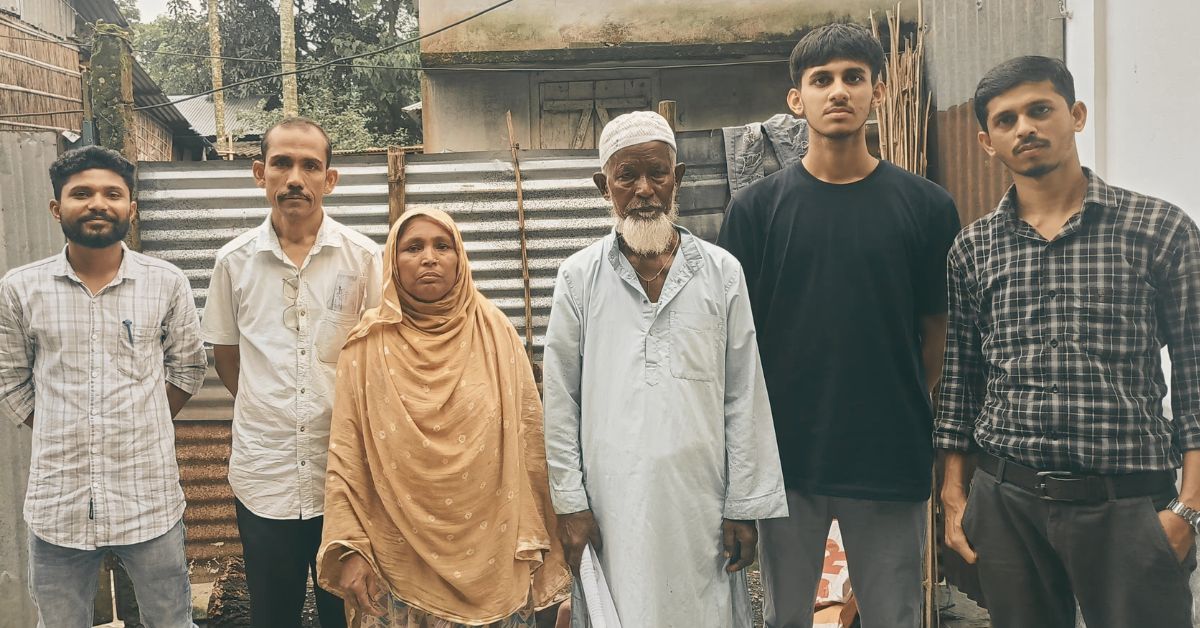
They Belong Here: An elderly couple’s victory for citizenship With CJP’s legal support, Dhubri’s Naseruddin Sheikh and Jakira Bibi are declared “Not Foreigners” by the Foreigners Tribunal
23, Jul 2026 | CJP Team
For most people, citizenship is an unquestioned part of life. It is something inherited through family, lived through generations and reflected in the ordinary acts of existence—being born in a place, growing up there, working there, voting there, raising children there and finally growing old there. But for many vulnerable people in Assam, citizenship can become something they are suddenly required to prove, sometimes after decades of living as members of the community they have always called home.
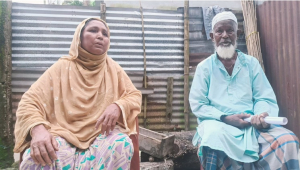 Jakira Bibi and Naseruddin Sheikh
For Naseruddin Sheikh and Jakira Bibi, an elderly couple from Shernagar village under Agomani Police Station in Dhubri district, that question arrived in the form of notices from the Foreigners Tribunal. The notices did not merely initiate legal proceedings; they brought an extraordinary degree of fear into the ordinary life of a family that had spent generations rooted in Assam.
The allegation against them was that they had entered India illegally from Bangladesh on or after March 25, 1971. The consequence of such an allegation is immense. For a person of limited means, an appearance before a Foreigners Tribunal can mean confronting a legal system that demands historical documents, family linkage, oral evidence and a coherent explanation of one’s identity and residence, often going back decades. The burden is particularly heavy for those who are elderly, poor, uneducated or physically unwell.
Every week, CJP’s dedicated team in Assam, comprising community volunteers, district volunteer motivators, and lawyers, provides vital paralegal support, counseling, and legal aid to many affected by the citizenship crisis in over 24 districts in Assam. Through our hands-on approach, 12,00,000 people successfully submitted completed NRC forms (2017-2019). We fight Foreigner Tribunal cases monthly at the district level. Through these concerted efforts, we have achieved an impressive success rate of 20 cases annually, with individuals successfully obtaining their Indian citizenship. This ground level data ensures informed interventions by CJP in our Constitutional Courts. Your support fuels this crucial work. Stand with us for Equal Rights for All #HelpCJPHelpAssam. Donate NOW!
Naseruddin was an ageing handcart puller whose life had been spent in physical labour. Jakira was an elderly woman suffering from several health problems who had spent her life caring for her family. Neither possessed the resources to comfortably navigate a prolonged legal battle.
The couple therefore faced something far larger than two legal cases. They faced the possibility that the country in which they been born and lived, could question their allegiance and their lives could suddenly become a question mark.
Their story, however, is also a story of legal intervention, documentary evidence and persistence. With the assistance of the intrepid para-legal and legal team of the Citizens for Justice and Peace (CJP), the couple was able to place their evidence before the Foreigners Tribunal. After examining the materials and testimony presented in the respective proceedings, the Tribunals ultimately declared both Naseruddin Sheikh and Jakira Bibi “Not Foreigner.”
The two orders are significant not only because they brought relief to an elderly couple but also because they demonstrate how citizenship-related proceedings can turn on the careful reconstruction of family history, legacy linkage and documentary continuity—and how access to quality and sensitive legal assistance can be critical when ordinary citizens are required to defend themselves against allegations that challenge their very belonging. The final order in Naseruddin’s case is dated May 8, 2025, while the order in Jakira’s case was pronounced on November 1, 2025. It took the Assam team of Citizens for Justice and Peace, that provided this quality legal aid, eight months in accessing the order of the Foreigners Tribunal.
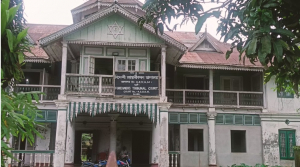 Foreigners Tribunal Court, Dhurbi
Naseruddin Sheikh: A man who spent his life pulling a handcart, now forced to defend his Indian identity
Naseruddin Sheikh is now close to 76 years old. His life has been shaped by hard work rather than privilege. Born on January 12, 1950, he belongs to Bidyadabri village in the Dhubri region and is the son of late Basaruddin Sheikh and grandson of Sukur Ali @ Khasar.
He never received an education and, from a young age, had to depend on physical labour for survival. For nearly three decades, he worked as a handcart puller in Agomani market, transporting vegetables, rice and other goods. At different times, he also worked as a daily wage labourer, taking whatever work was available to support his family.
His life was not one of comfort, but it was a life firmly rooted in the place he knew as home. Together with his wife, Jakira, he raised six children—three sons and three daughters. While he worked outside, she managed the household and cared for the family.
Today, Naseruddin’s body bears the consequences of decades of physical labour. Yet, even at an advanced age, he sometimes continues to pull his handcart because the economic circumstances of his family leave little room for retirement. It was against this background that the Foreigners Tribunal proceedings began.
The case against Naseruddin was registered as FT-9/113/GKJ/2019. The reference originated from the Superintendent of Police (Border), Dhubri, following a citizenship verification process and raised the question of whether Naseruddin was an illegal migrant or foreigner of the post-1971 stream or any other relevant stream. The Tribunal’s order records that Naseruddin appeared in response to notice, filed a written statement, produced documents and contested the allegation that he was a foreigner.
For Naseruddin, the proceedings were frightening not simply because of their legal implications but because of the practical reality of defending himself. A man whose daily existence depended upon manual labour was suddenly required to reconstruct his family history through documents and testimony. The cost of legal representation, travel to court and the loss of working days could have placed an unbearable burden upon him.
The legal system, however, required him to answer the allegation with evidence. That is where the intervention of CJP became crucial.
 CJP Team Assam along with Jakira Bibi and Naseruddin Sheikh
When the CJP team came to his door: After receiving the notice, Naseruddin did not know where to turn. He was confronted with a legal proceeding whose consequences he could not fully understand and whose financial demands he could not easily meet. It was at this point that he came into contact with CJP Community Volunteer Ilias Sarkar, who connected him with the wider CJP team. State In-Charge Nanda Ghosh, Advocate Iskandar Azad and Community Volunteer Habibul Bepari became involved in assisting the couple.
The team visited Naseruddin’s home, examined the available records and began working to understand the documentary history of his family. This intervention was important because citizenship proceedings of this nature often require something that is not easy for ordinary people to provide on their own: the ability to transform scattered documents from different periods into a legally coherent narrative.
A voter list from decades ago may establish the presence of an ancestor. A later electoral roll may establish continuity. A land deed may support residence or possession of property. A witness may explain the relationship between generations. None of these pieces necessarily tells the whole story in isolation. Their significance emerges when they are connected into a credible chain of evidence.
For Naseruddin, the legal task was therefore not simply to produce an Aadhaar card or an EPIC card. The more fundamental challenge was to demonstrate the historical continuity of his identity and his connection to his family and to India.
CJP took responsibility for assisting him in the proceedings, and Advocate Iskandar Azad represented him before the Tribunal. The support gave Naseruddin something that he had been missing since the notice arrived: the confidence that he would not have to face the legal process alone.
As Naseruddin later recalled, “After getting the notice we did not understand where to go. Even with papers, people become foreigners here. So the fear remains, but after you came we got courage.”
His words capture the psychological reality behind the legal case. The presence of legal assistance did not merely provide representation; it restored a measure of confidence to a man who had suddenly been made to question his own security in the country where he had spent his entire life.
The legal strategy: The central challenge in Naseruddin’s case was to establish his connection with his family lineage and demonstrate the continuity of his presence in India. The evidence presented before the Tribunal therefore went back across generations.
One of the important pieces of evidence was a 1966 electoral roll of Bhamandanga Part-II, in which the name of Gerpu Sheikh, son of Sukur Ali, was recorded. Naseruddin identified Gerpu Sheikh as his paternal uncle and Sukur Ali as his grandfather. The Tribunal also considered a 1966 electoral roll from Jaldhoya, where the name of Naseruddin’s father, Basiruddin, was recorded.
The importance of these records lay in their historical character. They were not documents created for the purpose of the present litigation; rather, they were old electoral records that predated the proceedings by several decades. Their evidentiary value, therefore, arose from the fact that they could potentially connect Naseruddin’s present identity to members of his family who were recorded as voters in the relevant period.
The case was further supported by electoral rolls from 1994, 1997, 2005, 2015 and 2022, reflecting the names of Naseruddin and his wife in successive electoral records. The Tribunal’s order records these documents as part of the 13 exhibits produced by Naseruddin in support of his claim.
The defence also relied upon Registered Deed No. 473 dated 24 January 1976, together with Naseruddin’s EPIC, PAN and Aadhaar documents. A licence issued by the Agomani Gaon Panchayat for operating a push cart and certificates issued by the relevant Gram Panchayat were also placed on record.
The evidence was not confined to documents. Naseruddin himself appeared as DW-1 and gave evidence regarding his birth, his father and grandfather, the family’s movements between Assam and West Bengal, his father’s death, his subsequent residence and his own connection with the places in which he lived. His relative Yashomuddin Munshi was also examined as a defence witness.
The Tribunal therefore had before it a combination of historical electoral records, later electoral continuity, land documentation, identity records and oral testimony. Legally, the importance of this combination lies in the way the evidence was intended to work together. The case was not based upon the proposition that any single document, by itself, conclusively established citizenship. Rather, the defence sought to establish a consistent narrative of family lineage and residence through multiple sources of evidence spanning different periods. That approach was central to the Tribunal’s assessment.
Why the evidence was found sufficient in Naseruddin’s case: The Tribunal’s reasoning is particularly important from a legal perspective because it did not simply list the documents and declare the case proved. It examined the documentary record alongside the oral evidence.
The Tribunal scrutinised the 1966 electoral roll of Bhamandanga Part-II and the corresponding electoral evidence from West Bengal. It considered the oral evidence concerning Gerpu Sheikh and Basiruddin, whom Naseruddin identified as members of his paternal family. The Tribunal also noted that Naseruddin’s own testimony supported his existence in India from his birth in 1950.
The Tribunal also considered Naseruddin’s account of his father’s movements between Assam and West Bengal. His evidence was that his father had moved to Jaldhoya in Cooch Behar in the mid-1950s, remained there for a period and had cast his vote in the West Bengal electoral roll, before returning to Assam and subsequently residing in the Bhamandanga area. Naseruddin further described the circumstances following his father’s death and his own later residence in Shernagar.
This is legally significant because the Tribunal was required to assess not only whether individual documents existed but whether the overall evidence formed a credible and consistent account. The Tribunal ultimately found that the historical electoral evidence, together with the oral testimony, supported the existence of Naseruddin in India from birth and established the parental linkage relied upon by him. The evidence of his defence witness was also considered in support of his version.
The significance of the decision, therefore, lies in the Tribunal’s acceptance of a cumulative evidentiary approach. Historical voter records, family linkage, oral testimony and subsequent documentary continuity were considered together rather than in isolation.
The final conclusion was unequivocal: Naseruddin did not appear to be a foreigner of the post-1971 stream or of any other stream, and the reference against him was answered in the negative. In practical terms, Naseruddin Sheikh was declared “Not Foreigner.”
For a man who had spent his entire life working with his hands, the order represented the end of an extraordinary legal ordeal. It meant that the elderly handcart puller who had always said, “I was born here, my father was born here, my grandfather was also born here,” had succeeded in placing before the Tribunal the evidence necessary to support that claim.
The complete order may be read below:
Jakira Bibi: When an ailing elderly woman had to defend the home she had always known
While Naseruddin fought his legal battle, his wife, Jakira Bibi, was facing a Foreigners Tribunal proceeding of her own. Jakira is above 60 years old and suffers from several health problems. Her life, like her husband’s, has been one of family responsibilities and modest means. She was born on July 12, 1964 in Shernagar village, the same region where her family had long been rooted.
Her father was Bataullah Sheikh, also referred to in the proceedings as Batasulla Sheikh, and her mother was Jelmoti Bibi. Her family history, as presented before the Tribunal, extended through historical electoral records and NRC legacy data.
Jakira’s case was registered as FT-9/112/GKJ/2019. The reference alleged that she had entered India illegally from Bangladesh on or after March 25, 1971. The order records that the reference originated from the Superintendent of Police (Border), Dhubri, and that Jakira contested the allegation, asserting that she was an Indian citizen by birth and that her parents and family were rooted in Assam.
For Jakira, the proceedings came with a particularly heavy physical burden. She was an elderly woman living with health problems, while her husband was himself an ageing daily wage worker. The prospect of travelling, collecting documents and participating in litigation was therefore not merely inconvenient—it was a serious hardship. But the evidence in her case was substantial.
Her defence sought to establish her identity through her parents, her family lineage and her own long history of residence and participation in the electoral process.
The evidence in Jakira’s case: The legal case presented on behalf of Jakira was built around a combination of historical electoral records, family linkage, land documentation and oral evidence. The Tribunal considered a 1958 electoral roll of Shernagar in which the names of Jakira’s parents, Batasullah Sheikh and Jelmoti Bibi, were recorded. The defence also relied upon a 1966 electoral roll, which reflected the name of her mother along with her stepfather, Goher Ali. Later electoral records from 1985, 1994, 1997, 2005, 2015 and 2022 were produced to demonstrate continuity of the family’s presence and Jakira’s own electoral history.
The defence further relied upon 1951 NRC legacy data, which was cited in support of the family linkage, as well as Registered Sale Deed No. 456 dated 20 January 1983, relating to ancestral land. Jakira’s own EPIC, PAN and Aadhaar documents were also placed on record. Importantly, the case did not rest solely upon documentary evidence. Jakira herself appeared as DW-1, while her elder brother Jahir Ali appeared as DW-2 to support the family linkage and her account of the family’s presence in India.
The Tribunal’s order records that Jakira produced as many as 16 exhibits in support of her claim, including historical and subsequent electoral rolls, the 1983 registered deed, identity documents and the identity documents of her brother. The evidentiary structure of the case is important.
The older electoral records were relevant to establishing the presence of Jakira’s parents and family in the earlier period. The later electoral records helped demonstrate continuity. The land deed supported the family’s connection to property in the area. Her own testimony and that of her brother addressed the relationship between the generations. Thus, as in Naseruddin’s case, the legal significance lay in the cumulative effect of the evidence.
The legal significance of Jakira’s victory: The Tribunal’s order makes an explicit reference to Section 9 of the Foreigners Act, 1946, observing that the burden was upon the proceedee to prove her nationality and that, accordingly, the liability of the prosecution was dispensed with.
In a Foreigners Tribunal proceeding, the legal question is not merely whether a person possesses contemporary identity documents. The person proceeded against must establish the case put forward regarding their nationality and status in accordance with the applicable legal framework. That makes historical evidence especially important when the allegation concerns illegal entry after the March 25, 1971 cut-off.
Jakira’s case therefore required her to establish more than her present-day identity. Her evidence sought to demonstrate her familial and historical connection to Assam, beginning with the electoral presence of her parents and continuing through her own life and electoral records.
The Tribunal examined the historical voter lists and the oral evidence of Jakira and her brother. It noted that her father and mother had cast votes in Assam and that the relevant electoral records supported the defence version. The Tribunal also considered the subsequent electoral rolls in which Jakira and her husband were recorded as voters.
The Tribunal further noted that the Election Office, Dhubri, had confirmed the authenticity of the exhibited electoral rolls. This was an important corroborative element because it strengthened the evidentiary reliability of the historical electoral records relied upon by the defence.
The Tribunal also considered the oral evidence of Jakira’s brother, Jahir Ali, regarding her paternal linkage. His testimony was treated as corroborating Jakira’s own evidence, and the Tribunal found that the parental linkage with Batasullah Sheikh had been established adequately.
The legal significance of this reasoning lies in the Tribunal’s reliance on multiple mutually supporting forms of evidence. The historical electoral records established the presence of the family; the later rolls demonstrated continuity; the land record supported the family’s connection to the area; and the oral evidence provided the relational bridge linking Jakira to her parents.
The Tribunal ultimately found that Jakira was a descendant of genuine Indian parents and that she had successfully discharged the burden placed upon her. She was declared “Not Foreigner.”
The complete order may be read below:
What triggered the proceedings against them?
The question of how a person first comes to be referred to a Foreigners Tribunal is an important part of every citizenship case. The legal battle before the Tribunal is only one stage of the process. Before that, there must be a basis for the initial reference and the decision to question the person’s nationality.
In the case of Jakira Bibi, the reference was originally forwarded by the Superintendent of Police (B), Dhubri, through SP (Border) I(M)DT Case No. 2389/98. The order records that the reference was made on the basis of a doubt regarding her nationality, with the purpose of determining whether she was or was not an illegal migrant. The matter was subsequently re-numbered before Foreigners Tribunal No. 2, Dhubri as F.T. Case No. 3494/GKJ/2011, under the provisions of the Foreigners Act, 1946, read with the Foreigners (Tribunals) Order, 1964.
In Naseruddin Sheikh’s case, the order provides a somewhat more specific description of the origin of the reference. It states that the case was originally forwarded by the Superintendent of Police (B), Dhubri, Assam, vide IM(D)T Case No. 2388/1998, on the basis of a report made by the Local Verification Officer for determination of his citizenship. The case was initially registered before the Foreigners Tribunal No. 2, Dhubri and was later transferred to the present Tribunal following the constitution of additional Tribunals.
The order further records that, upon consideration, the Tribunal found “sufficient grounds to proceed” and accordingly issued notice to Naseruddin, providing him an opportunity to show cause in respect of the matter. These details are significant because they bring the question of the “first cause of action” into focus.
In Naseruddin’s case, the order specifically refers to a Local Verification Officer’s report as the basis for the original reference for determination of his citizenship. In Jakira’s case, the order states that the reference arose from a doubt regarding her nationality. The documents, however, as quoted above, do not themselves set out the substantive contents of the Local Verification Officer’s report in Naseruddin’s case or explain in detail what specific material gave rise to the doubt regarding Jakira’s nationality.
Two Cases, One Common Lesson: Citizenship proceedings are often about reconstructing a life through evidence
The cases of Naseruddin Sheikh and Jakira Bibi are legally distinct proceedings, but their evidentiary journeys reveal a common pattern. In both cases, the defence had to reconstruct a family history that stretched back decades. In both, historical electoral rolls played an important role, electoral records helped demonstrate continuity, and oral testimony was used to establish family relationships and explain the documentary record. And in both, the evidence was considered not as isolated pieces but as part of a larger narrative of identity, ancestry and residence.
In citizenship proceedings, the strength of a case may lie not in one document but in the consistency between several independent sources of evidence. A historical electoral roll may establish the presence of a parent or grandparent. A later electoral roll may demonstrate continuity. A land document may reinforce residence and family connection. A witness may explain the relationship between individuals appearing in different records.
The value of legal representation, therefore, is not limited to arguing before the Tribunal. It also lies in identifying which documents matter, tracing family linkage, locating historical records and presenting them in a manner that allows the Tribunal to assess the evidence as a coherent whole. For Naseruddin and Jakira, the CJP team’s intervention helped transform a collection of old documents and family memories into a structured legal defence. That is where access to justice becomes particularly important.
The human cost behind the case numbers
Behind FT-9/113/GKJ/2019 and FT-9/112/GKJ/2019 were not merely two case files. There was an elderly man who had spent his life pulling a handcart to feed his family. There was an elderly woman who was already battling illness. There were six children whose parents were suddenly living under the shadow of a citizenship proceeding.
There was a family that had to search through decades of records to prove a history that had always been part of their everyday lives. The legal proceedings also reveal the disproportionate impact that such litigation can have on people living in poverty.
For Naseruddin, appearing in court could mean losing the day’s earnings. For Jakira, the physical strain of participating in proceedings was compounded by her health problems. For both, the financial cost of engaging a lawyer could have been beyond their means. This is why legal aid in citizenship proceedings is not simply a matter of convenience. It can determine whether a vulnerable person is able to meaningfully participate in the legal process.
A person may possess relevant documents but not know which ones are legally significant. They may have a family connection but lack the ability to explain it in the form required by a legal proceeding. They may have old electoral records but not understand how those records can establish a historical linkage. Legal assistance can bridge that gap. In Naseruddin and Jakira’s cases, that bridge ultimately helped them present their evidence before the Tribunal.
The day the order came home
On July 18, the CJP team visited the couple’s home to deliver copies of the order. The team included Advocate Iskandar Azad, Office Driver Asikul Hussain, Community Volunteers Ilias Sarkar (Rabbi), Habibul Bepari, Deep Ghosh and Ilias Rahman, along with State In-Charge Nanda Ghosh. This time, they did not arrive with another notice; they came carrying the order.
For the couple, the moment represented the end of months of uncertainty and fear. Naseruddin had feared that the proceedings might eventually lead to detention. Jakira had endured the physical and emotional burden of litigation despite her health problems. Together, they had lived through the uncertainty of not knowing whether the country they had always called home would continue to recognise them as belonging to it. When the order were placed in their hands, the relief was overwhelming.
Naseruddin recalled the terror he had experienced when the notice first arrived and how the support of CJP had given him the courage to continue. Jakira expressed her gratitude through tears, remembering how the team had come to their home, helped organise their documents and ensured that they had legal representation. Their words reveal something that legal orders alone cannot capture.
A favourable order may end a proceeding, but it cannot immediately erase the fear created by the proceeding itself. The couple had won, but the memory of having been forced to defend their belonging would remain.
Beyond Two Victories: The larger citizenship question
The legal victory of Naseruddin and Jakira is deeply significant to them and their family. But their cases also raise broader questions about how citizenship proceedings affect ordinary people, particularly those who live on the margins of society.
A person may have lived in a village for decades and still be required to reconstruct their family history through records that may be more than half a century old. Historical documents may contain variations in names or spellings. Families may have moved between districts or across state boundaries. Electoral records may exist in different places. Land may have been acquired, sold or requisitioned. All of these factors can make the process of establishing continuity complex.
The two cases demonstrate why citizenship proceedings cannot be viewed purely as administrative exercises. They involve questions of identity, family history, dignity and belonging. They also raise crucial questions of maintainability, accountability and mala fide by authorities, unused to being questioned on these foundational aspects.
The legal orders also demonstrate the importance of the evidentiary process. In both cases, the Tribunals considered the documentary record alongside oral evidence and assessed whether the evidence, taken as a whole, was sufficient to discharge the applicable burden.
In Naseruddin’s case, the Tribunal accepted the evidentiary chain connecting him to his paternal family and his presence in India. In Jakira’s case, the Tribunal accepted the evidence establishing her parental linkage and the family’s historical presence in Assam.
The outcomes therefore underline the importance of access to legal assistance, preservation of historical records and the careful presentation of evidence. At the same time, the emotional experiences of the couple remind us that the human consequences of citizenship proceedings extend far beyond the courtroom. For the poor and elderly, the process itself can become a source of profound anxiety. The question, therefore, is not only whether justice can ultimately be obtained. It is also whether vulnerable people have the support necessary to reach justice in the first place.
From Fear to Dignity: The meaning of “not foreigner”
For Naseruddin Sheikh and Jakira Bibi, being declared “Not Foreigner” means more than winning a legal case. It means that the fear and uncertainty they lived with after receiving the notices have finally come to an end.
The judgments have brought them relief and restored their sense of security. The evidence they collected, the family records they preserved and the testimony they gave were accepted by the Tribunals.
Naseruddin is still the elderly man who spent decades pulling a handcart in Agomani market. Jakira is still the woman who devoted her life to caring for her family. But now, they can return to their home without the fear that once followed them. Their story is about belonging, but it is also about the importance of having the chance to be heard and to present one’s evidence before the law. For both, the journey began with fear. It continued through old electoral rolls, land records, family documents and witness testimony, supported by legal assistance and the determination to prove their history. And it ended with two words that brought them immense relief: “Not Foreigner.”
or CJP, the victory of Naseruddin Sheikh and Jakira Bibi is not the end of the struggle, but a reminder of why access to justice and legal support remain so important for Assam’s poor and marginalised communities. The CJP team says it will continue to stand with those whose citizenship and dignity are challenged, with the hope that no Indian will ever have to face the fear of proving that they belong to their own country.
Today, Naseruddin and Jakira can finally smile without the shadow of the notices hanging over them. After a long journey of fear, uncertainty and legal struggle, they can return to their home with renewed confidence and say what they have always believed: “We are Indian.”
Related:
Another CJP Victory: Barpeta Tribunal declares Alam Khan ‘not a foreigner’
When a narrow reading of documents decide citizenship: GHC in Aminul Hoque
‘Fairness & reason ‘: SC rules that due process is a must for citizenship determination
Gauhati High Court upholds foreigner declaration, rejects mental illness plea
When a Spelling Error Can Cost Citizenship: Supreme Court stays deportation of five Assam women