Hindus, Muslims Unite to Protect Rajasthan Border Mosques In the face of an ongoing anti-encroachment drive known as Operation Sweep, residents across the border districts of Barmer and Jaisalmer have stepped in. Rising above the artificial religious divide, Hindu and Muslim neighbours are marching hand-in-hand to halt the selective demolition of Mosques in Rajasthan’s border districts of Barmer and Jaisalmer
29, Jun 2026 | CJP Team
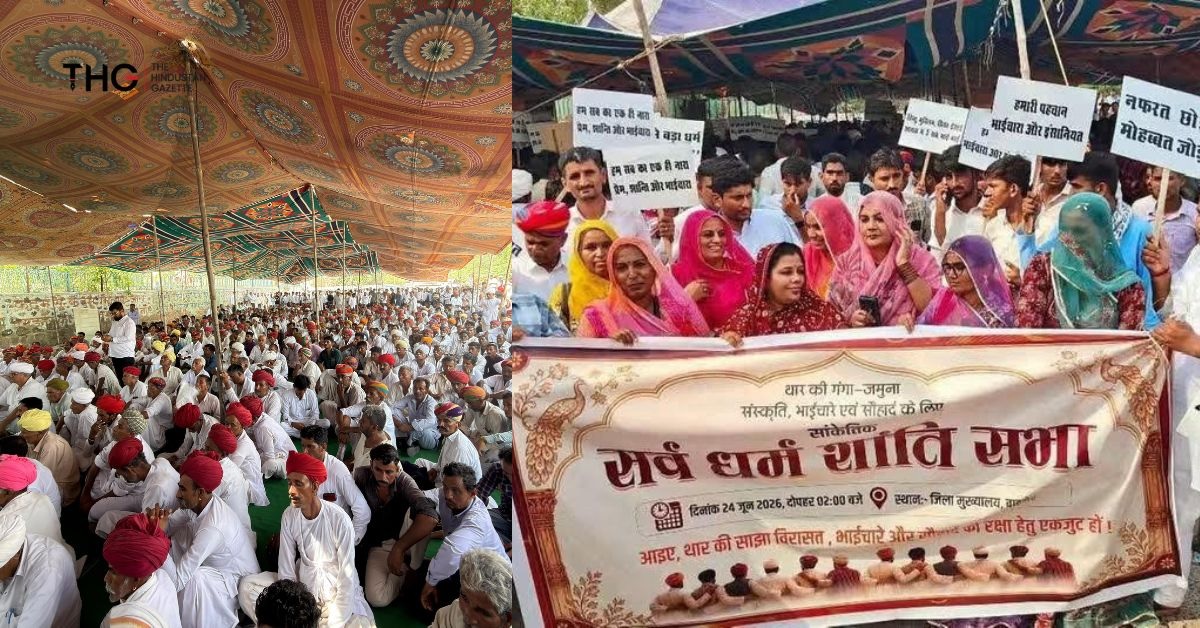
On June 27, 2026, widespread and joint interfaith protests were reported across the western border districts of Rajasthan, with specific focus on the administrative regions of Barmer and Jaisalmer. Local Hindu and Muslim residents organised collective demonstrations under the organised banner of the ‘Sarv Dharm Shanti Sabha’, which translates to the Peaceful Assembly of All Religions. These actions, sent a strong message across the country– political moves cannot fracture their deep-rooted, generations-old communal harmony
This grassroots movement emerged as a direct response to a vast administrative anti-encroachment campaign officially designated as “Operation Sweep.” The Rajasthan’s Bharatiya Janta Party (BJP)-ruled state government’s demolition drive had recently resulted in the demolition of several Islamic religious structures i.e. Mosques/Madrasas and the issuance of hundreds of legal eviction notices to such, reportedly without providing any reasonable opportunity of hearing. In response to these administrative actions, the assembled protesters submitted formal memorandums to local authorities, demanding an immediate suspension of the demolition drive and strict adherence to established legal processes, and the prevention of alleged selective communal targeting of minority religious sites.
Amidst the systematic hate leading to growing anger and despair, it is important to showcase a lived reality of camaraderie, equality and sharing which is the bedrock of the Indian Constitution and secularism. That way we not only hold on to every thread of hope, but effectively project these narratives, lest we lose our will to fight the good fight. As part of our #EverydayHarmony series, CJP brings you instances where Indians share and care, every single day… our food, our businesses, our homes and our friendships. This instances show how we Indians continue to reject hateful and divisive agendas even while street violence and social media are used as part of a sinister, hate-filled political agenda to tell us otherwise. Let’s reinforce India’s everyday lived reality, and through that collectively and aggressively, uphold and defend a unique pluralism, a diverse culture and truly secular values. Donate now to help us combat hate and prejudice!
सर्व धर्म शांति सभा, बाड़मेर।
“जहाँ सत्य, अहिंसा और धर्म का पग-पग लगता डेरा,
वो भारत देश है हमारा…”
सर्व धर्म शांति सभा में शामिल होकर आपसी भाईचारे, सामाजिक सौहार्द, संविधान के सम्मान और देश की एकता-अखंडता का संदेश दिया।
हमारी विविधता ही हमारी सबसे बड़ी ताकत है। सभी धर्मों, सभी… pic.twitter.com/1SqELVvewY— Ummeda Ram Beniwal (@UmmedaRamBaytu) June 26, 2026
Background
The tensions in the region originated from a large-scale anti-encroachment and security drive initiated by the Rajasthan government in coordination with border security agencies. This enforcement campaign, named “Operation Sweep,” that began on spans a massive 1,050-kilometer border belt that physically separates India from Pakistan. Pursuant to directions issued by the Union Home Ministry, a joint team comprising the district administration, police, and the Border Security Force (BSF) undertook an operation concerning “alleged illegal constructions within 15 kilometres of the India–Pakistan border in Rajasthan’s Barmer district”, from June 18, 2026 onwards.
Rajasthan Bulldozer Action: Barmer में Operation Clean के तहत Ind-Pak सीमा की मस्जिद पर गरजा बुलडोजर #Rajasthan #BulldozerAction #OperationClean #LatestNews pic.twitter.com/PZHZMN0FxK
— Punjab Kesari (@punjabkesari) June 22, 2026
The operation covers four major administrative districts that contain significant Muslim populations, namely Barmer, Jaisalmer, Bikaner, and Sri Ganganagar. The state government and the associated security apparatus classified the drive as a highly necessary procedural measure designed to clear unauthorised constructions and reinforce critical security infrastructure within a highly sensitive strategic military corridor. However, the execution of these orders quickly drew allegations of systemic bias from local communities.
According to precise data released on dated June 23, 2026 during a press conference by the Association for Protection of Civil Rights (APCR), approximately three hundred and fifty mosques and various Islamic religious structures situated across these four border districts were served with administrative demolition notices. Prior to the major public mobilisation, the regional enforcement drive had already resulted in the direct demolition of four separate mosques within the Barmer sector, alongside the destruction of an ancient mazaar, or shrine, in the Jaisalmer district. Local community activists and non-governmental organisations subsequently filed public complaints, asserting that the administration was selectively penalising Muslim places of worship while simultaneously ignoring similar documentation anomalies in the religious and residential structures of other communities.
Demolition of Mosques and Attack on Religious Freedom in India
23 JUNE 2026 | 3:30 PM | PRESS CLUB OF INDIA pic.twitter.com/D4RLnmwAY2— APCR-Association for Protection of Civil Rights (@apcrofindia) June 24, 2026
In direct response to the sudden executions of these demolition orders, community members from both major religious groups organised public demonstrations to systematically de-escalate potential communal friction and demand immediate legal interventions.
Peaceful public mobilisation across Barmer and Jaisalmer
According to the Maktoob Media, the major public assemblies were recorded in the village of Badbir within the Barmer district, as well as in multiple commercial and residential locations across Jaisalmer. Hundreds of local residents gathered collectively outside the Barmer District Magistrate’s office to conduct an interfaith peace assembly.
The primary objective of these localised rallies was to challenge the execution of the demolition orders through entirely peaceful, constitutional means rather than through civil disobedience. The gathered protesters formally submitted a collective memorandum addressed to the President of India, urgently requesting an immediate pause on the entire demolition drive until transparent, unbiased legal verifications could be executed by the judiciary.
Local community leader demands equal treatment
Surtaram Meghwal, a two-time elected Dalit Sarpanch of Paradia village, emerged as one of the primary figures directing the local public response and articulating the grievances of the unified communities. Meghwal openly challenged the statutory validity of the state’s actions, stating his belief that the demolitions were an extrajudicial exercise being carried out without following any due legal process. He argued that if mosques were being actively checked and demolished by the state, then temples should also be examined under the exact same legal standards to ensure absolute administrative fairness.
Rajasthan: In #Barmer, Advocate Surtaram Meghawal, the Sarpanch of Paradia village, publicly warned the BJP govt against what he described as the selective demolition of #mosques while sparing #temples.
He urged the govt to uphold the Raj Dharma advocated by former PM Atal… pic.twitter.com/cQDPoQB8yB
— MuslimMirror.com (@MuslimMirror) June 25, 2026
Meghwal further detailed the ground realities of the public mobilisation that took place in Badbir following the destruction of multiple religious sites. He communicated to Maktoob that the villagers protested against the demolition of these religious structures to oppose the government actions and convey their collective message peacefully. He noted that since the protest began, the region had witnessed even greater brotherhood with more citizens coming forward in mutual support and reflecting a shared belief that there was still ample time to resolve the administrative issue through dialogue. Addressing the underlying socio-political dynamic of the border region, Meghwal explicitly blamed external political factors for generating artificial friction.
He questioned the procedural fairness of the drive, asking why only mosques and religious structures of Muslims were being targeted and reiterated his stance as a two-time Sarpanch that Hindus and Muslims harbor no inherent issues with each other in the region. He concluded that institutional politics would not break the unity of the people of Rajasthan, as they would consistently stand in solidarity with their Muslim neighbors, as Maktoob Media reported
Dialogue over division
The events in Barmer and Jaisalmer are illustrative of how local leadership and resistance is the best and most effective anti-dote to what is perceived as targeted injustice. Such moves are effective and pre-emptive and preventive, an antidote to communal conflict. Hindu and Muslim residents in these districts have come together to hold joint protests, submitted memorandums to the authorities, and sought legal remedies through constitutional processes. Their actions reflected a shared belief that disputes should be addressed through dialogue, fairness, and the rule of law.
The interfaith assemblies also highlighted the long-standing bonds between the communities living in the border region. Despite facing difficult living conditions and administrative challenges, residents chose to stand together and protect the harmony that has existed in their villages for generations. While the legality of the demolition drive will ultimately be decided through judicial and administrative processes, the peaceful response of the local people demonstrated the value of maintaining communal harmony during times of uncertainty. The events serve as a reminder that equal application of the law, respect for due process, and continued dialogue between communities and public authorities are essential for preserving public trust and social harmony.
Related
When Citizens Say No: The quiet revolt against hate in India’s streets
Public Resistance and Democratic Assertion: India through protests, 2025