Census 2027: When a population count starts asking for more than just numbers Expanded questions on parents’ birthplace, religion, Aadhaar, voter ID, passports and bank accounts raise concerns over privacy, data use and overlap with the NPR
22, Sep 2026 | Tanya Arora
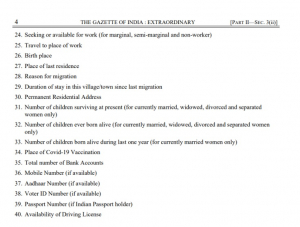
India’s next Census is no longer simply a question of how many people live in the country, where they live and what their socio-economic circumstances are. The questionnaire for Census 2027’s population enumeration phase asks households for an unusually wide range of personal and family information. Alongside conventional demographic and economic questions, enumerators will record details relating to respondents’ parents, spouses, nationality, permanent address, caste, digital literacy, COVID-19 vaccination, bank accounts and identity documents, including Aadhaar, voter ID, passport, driving licence and mobile numbers where available. The expansion has triggered a larger question about what a population census is supposed to do, and where the boundaries of such an exercise should lie.
Despite significant objections being raised to this overarching methodology that clearly aims, through the backdoor, to achieve more than a socio-economic number enumeration of the Indian people to guide policy thrusts, the union government has chosen this path. Earlier such attempts after the controversial 2019 amendments to the Citizenship Act, 1955 have been analysed here, here and here.
The Registrar General and Census Commissioner of India notified 40 questions for the population enumeration phase on August 14, 2026. The questionnaire contains several new or modified fields compared with the 2011 Census. The exercise is also significant because, for the first time since Independence, caste(s) beyond the Scheduled Caste and Scheduled Tribe categories is being included in the population Census.
That combination has made Census 2027 an exercise of enormous significance, but also one surrounded by questions about methodology, privacy, confidentiality and the eventual use of the information being collected.
As reported by The Hindu on September 9, former Deputy Registrar General of India K. Narayanan Unni questioned whether several of the newly introduced questions could generate meaningful statistical information at all. His concern was not simply about the volume of information being collected, but whether asking for personal identifiers and family details risks moving the Census away from its traditional statistical purpose.
A Census is supposed to count a population, not create an identity dossier
The basic purpose of a population census is to enumerate a population to understand its socio-economic status. The United Nations defines a population census as the comprehensive process of collecting, processing, analysing and disseminating demographic, economic and social information relating to all persons in a country at a specified point in time. The purpose is to produce reliable statistics at the smallest possible geographical level so that governments and societies can understand population patterns and implement policies that serve this population. That distinction matters because individual-level identifiers do not ordinarily constitute the statistical information that a Census ultimately publishes.
The United Nations Fundamental Principles of Official Statistics also place confidentiality at the centre of official data collection. Individual information collected by statistical agencies is supposed to remain confidential and be used exclusively for purposes of policy generation.
India’s Census framework has historically reflected this principle. Section 15 of the Census Act, 1948 protects Census records from inspection and provides that such records are not open to inspection or admissible in evidence.
The question now is whether the enlarged questionnaire changes the nature of the information being collected without sufficiently clarifying how that information will remain insulated from other government databases and administrative purposes.
The concern is particularly acute because the questionnaire does not merely ask how many people live in a household or what their occupation, education or migration status is. It asks for information capable of directly identifying individuals and linking them to existing administrative databases.
Aadhaar numbers connect to UIDAI records. Voter identification numbers connect to electoral rolls. Passport numbers connect to passport records. Mobile numbers connect to telecommunications records. Bank information exists within the financial system. The significance of collecting such information in a single household-level exercise is therefore fundamentally different from collecting anonymous demographic information for policy-statistical tabulation.
Why are parents’ details being collected?
Among the most striking additions are questions about the parents of each individual. The questionnaire seeks information about parents and includes details such as their names, religion and place of birth. The information can extend to the village level. The respondent is also asked about the spouse in the case of married persons. These questions raise practical concerns as well as questions about purpose.
In an ordinary household, the person answering the Census may not know the precise place of birth of their parents or grandparents. The problem becomes even more complicated in institutional households such as hostels, old-age homes and prisons. The changing nature of Indian migration makes the issue still more complicated. Millions of students, workers and other residents live away from their permanent homes. Children may be living in hostels or as paying guests. Domestic workers and other persons may be temporarily residing with households during the enumeration period.
A respondent cannot necessarily be expected to know the identity-document details, parental information or other personal particulars of every person who happens to be eligible for enumeration at that location. The more information a questionnaire demands, the greater the possibility that respondents will either be unable to answer accurately or will provide hurried or incomplete responses. This is what former Census officials have described as the problem of “respondent fatigue”.
Aadhaar, voter ID, passport and mobile numbers
The inclusion of identity numbers presents a different problem. The questionnaire asks for mobile number, Aadhaar number and voter ID number “if available”, while also seeking passport information for Indian passport holders and information about driving-licence availability. But what exactly does “if available” mean?
As The Hindu reported, it is unclear whether the phrase means that the number should be provided if it exists for the individual concerned, or whether it means that it should be produced if the respondent has it at the time of enumeration. That distinction could become important in large households. A person answering the Census may not possess the Aadhaar, voter ID or passport details of every member of the household. Elderly parents, domestic workers, visitors and people living temporarily in institutional accommodation may not have their documents immediately accessible.
There is also a more fundamental question: what statistical purpose is served by recording the actual identification number?
As former IIPS director K.S. James told The Wire, individual identifiers are not inherently useful for Census tabulation because they cannot themselves be meaningfully computed into conventional population statistics. In his view, such identifiers are more characteristic of an identification or population-registration exercise.
The NPR question
The most politically sensitive issue is the overlap between several Census questions and information that was previously sought for the National Population Register. Eight of the new or modified fields identified by The Indian Express as overlapping with the 2020 NPR schedule include nationality as declared, parents’ particulars, mobile number, Aadhaar, voter ID, passport and driving licence.
The National Population Register is a register of “usual residents”, rather than a register exclusively of citizens. Under the framework governing it, a usual resident broadly refers to a person who has resided in an area for at least six months or intends to remain there for at least six months. A foreign national who satisfies the residence criterion can therefore fall within the NPR.
The team of Citizens for Justice and Peace (cjp.org,in) had, in 2020 extensively researched the issue and here is a document to understand the difference between NPR and Census, relevant even today. It may be read here.
The legal framework also connects the Population Register to the preparation of the National Register of Indian Citizens. The Citizenship (Registration of Citizens and Issue of National Identity Cards) Rules, 2003 provide for verification of the Population Register in connection with preparation of the citizens’ register, including the possibility of marking cases in which citizenship is considered doubtful for further inquiry.
That legal architecture became particularly contentious when the government proposed updating the NPR alongside the Census process in 2019-20, shortly after the passage of the Citizenship Amendment Act and amid nationwide protests against the CAA-NPR-NRC framework. The political context has not disappeared.
The Indian Express reported that questions concerning parents’ place and date of birth had been among the most controversial elements of the earlier NPR exercise. The government at the time maintained that such information was optional and that people would not lose citizenship merely because they could not provide their parents’ birth details. The government also argued that the NPR was intended to create a comprehensive database of residents that could assist with policy formulation, welfare delivery and administrative efficiency. The present controversy is therefore not based solely on the similarity between two questionnaires. It is also shaped by the history of how the NPR was understood and contested.
The government’s position and the trust deficit
A comprehensive regularly conducted census (a socio-economic population database) is required to assist governments to craft policy on education, housing, transportation and health: this can be then broken down to plan schools, hospitals, housing, transport, welfare programmes and other public services.
However, the currently underway exercise, that includes questions that go beyond that limited purpose, has raised questions of both motive and application (use). Will the data be collected used solely for the purpose envisioned/mandated? To craft policies that respond to the socio-economic needs of the people?
As The Indian Express documented, the government’s assurances in 2019 and 2020 existed alongside previous official statements and the Citizenship Rules that established a legal connection between the Population Register and the process of preparing a citizens’ register. The NRC in Assam, which excluded roughly 19 lakh people, further intensified concerns about the consequences of citizenship verification. Consequently, questions about nationality, parents’ places of birth and identity documents are not being encountered in a political vacuum.
An information request that might appear administratively ordinary can carry very different implications when it is introduced against the background of previous debates over citizenship, migration and the NPR-NRC framework. This is why the central issue is not simply whether the government is legally entitled to ask a particular question. It is also whether citizens can clearly understand why the information is being collected, what it will be used for, who will have access to it, how long it will be retained and whether it can subsequently be linked to another government database.
The 1951 precedent
Former Census officials have also pointed to history. In a September 10 report, The Hindu noted that records from the 1951 Census demonstrate that Census information was used in the preparation of the National Register of Citizens at the time. The 1951 Census report of R.B. Vaghaiwalla, then Superintendent of Census Operations for Assam, Manipur and Tripura, described the NRC as having been prepared by transcribing important Census data from the Census slips. The report stated that the register was essentially a copy of the Census slips, with the same symbols and abbreviations. However, what is being ignored, omitted or missed is that the questions for the 1951 Census were those related to socio-economic status of citizens responding, nothing more. Ironically, this aspect is exactly the argument used by a vigilante bureaucracy in Assam not to accept presence in the 1951 NRC as adequate indication/ proof of citizenship!
This background underlies the need for specificity and confidentiality in 2026 Census data collection particularly important.
Caste Census: historic opportunity, unresolved methodology
The other defining feature of Census 2027 is caste enumeration. India has not conducted a full caste census since 1931. Census 2027 will therefore generate data of enormous potential importance for understanding social and economic inequalities. But the methodology has itself become controversial.
The questionnaire asks respondents to identify their caste, but unlike a standardised list-based system, the field is largely open-ended for castes beyond SC and ST categories. The problem is not merely technical. The experience of the 2011 Socio-Economic and Caste Census demonstrates the consequences of an unstandardised approach. That exercise produced more than 46 lakh reported caste names, including variations involving castes, sub-castes, clans and surnames. The Union government subsequently told the Supreme Court that the raw caste data had technical problems and had not been released. The government’s own earlier submissions to the Supreme Court have therefore become relevant to the current debate.
In 2021, the Centre had argued that caste enumeration, particularly of OBCs, was administratively complex and that the existing data contained serious problems of completeness and accuracy. Yet experts quoted by The Indian Express and The Hindu have questioned why the lessons of the 2011 exercise have not been incorporated into the 2027 methodology. Former IIPS director K.S. James suggested that a hierarchical system combining recognised state and central caste lists with an option for respondents to provide additional information could make the data more usable.
Sociologist Satish Deshpande went further, arguing that an open-ended system risks generating a proliferation of spelling variations and caste names that could make the resulting data difficult to analyse. These expert assessments identify a serious methodological question: if caste data is being collected precisely because it is expected to inform public policy, affirmative action and social-justice measures, then the method of collection must be capable of producing data that can actually be classified and analysed.
The OBC question
Another unresolved issue is the treatment of Other Backward Classes. The questionnaire includes Scheduled Caste, Scheduled Tribe and caste fields, but does not provide OBC as a separately identified category in the manner critics had expected.
Congress leaders Mallikarjun Kharge and Rahul Gandhi subsequently wrote to Prime Minister Narendra Modi seeking changes to the questionnaire, arguing that the methodology could undermine the accuracy and usefulness of caste data. Congress leader Jairam Ramesh has also criticised the absence of a pre-prepared caste list and contrasted it with the approach used in caste surveys in Bihar and Telangana.
These are political claims and should be understood as such. The underlying methodological question, however, can be assessed independently: whether an open-ended caste field without adequate standardisation will produce reliable, comparable and policy-useful data.
That question is especially important because caste statistics are not merely academic numbers. They can influence the design of welfare schemes, reservation policies, educational interventions and other measures intended to address structural inequality.
A questionnaire that may become too long to be accurate
There is another, less politically dramatic problem: time. The population enumeration schedule contains 40 questions, many of which must be answered for every individual in a household. Adding questions about parents, spouses, identity documents, bank accounts, vaccination history and other personal details increases the amount of information that enumerators must collect and record.
Former Census officials told The Hindu that this could increase respondent fatigue, particularly when enumerators are required to work through lengthy questionnaires with multiple members of a household. The burden will fall heavily on enumerators, many of whom are government schoolteachers.
If a questionnaire takes substantially longer to complete, the consequences are not necessarily limited to inconvenience. Fatigue can affect accuracy. Respondents may become impatient. Enumerators may rush. Questions may be misunderstood. Answers may be guessed or left incomplete. A Census can therefore undermine its own statistical objectives by trying to collect too much information. The issue is particularly important in a country as large and diverse as India, where the credibility of population data depends upon consistent enumeration across hundreds of millions of people.
Migration creates another risk
The decision to advance population enumeration in Uttar Pradesh, Punjab, Uttarakhand and Goa because of their forthcoming elections has raised another concern: under-enumeration of migrants. As The Hindu reported, former Census official K. Narayanan Unni warned that conducting enumeration earlier in these States could affect migrant workers who move between their place of work and home State.
India follows a de facto method of enumeration, under which people are generally counted where they are physically present during the Census period. Traditionally, March 1 has been used as the reference date partly because migration patterns are relatively lower around that period.
If enumeration is advanced in some States because of elections, migrant workers may return to their home States to vote and potentially miss enumeration at their place of work. If enumeration has already concluded in the home State, there is a possibility that some migrants could be missed at both locations. That is a data-quality problem rather than merely an administrative inconvenience.
The Census is intended to provide a comprehensive picture of India’s population. Even relatively small levels of under-enumeration can affect the accuracy of demographic estimates, particularly for populations that are already mobile or difficult to reach.
Digital Census, digital vulnerabilities
Census 2027 is also being presented as India’s first fully digital Census, incorporating online self-enumeration and digital tools. Technology can make a national enumeration faster and potentially more efficient. But digitisation also changes the nature of the risks.
The more sensitive information that is digitised, the more consequential a data breach becomes. The Internet Freedom Foundation has raised concerns about the combination of Aadhaar, voter ID, passport and mobile numbers with caste, religion, language, migration history and other demographic information. Its argument is that these identifiers could potentially make it possible to connect Census information with other government databases. That concern is particularly significant because the value of a database to an attacker is not necessarily determined by any single field. It can arise from the ability to combine fields.
A database containing caste, religion, economic status, family relationships, migration history and unique identifiers would reveal substantially more about an individual than any one of those datasets considered separately.
Reports concerning the 2023 CoWIN data leak, for instance, demonstrated the potential consequences of vulnerabilities involving sensitive personal information. A breach of Census information could have consequences extending well beyond identity theft. Sensitive caste, religious and demographic information could potentially be used for discrimination, profiling, fraud or targeted harassment.
The legal framework is itself in transition
There is also a timing problem involving India’s data-protection regime. The Internet Freedom Foundation has pointed out that the Digital Personal Data Protection Act, 2023 and its implementing framework do not provide a fully operational safeguard during the entire Census process in the way one might expect from a mature data-protection regime.
The organisation has specifically questioned the interaction between the Census Act’s compulsory nature and emerging data-protection safeguards. Section 8(2) of the Census Act makes persons legally bound to answer notified questions, while Section 11 provides penalties for refusal or obstruction. That makes the nature of consent particularly complicated.
The Census and the compact of trust
At its core, the Census is an exercise in trust. The State asks citizens to provide information about themselves and their families on the understanding that the information will serve a socio-economic indicator of the status of the population. That compact becomes more fragile when the questionnaire starts asking for information that appears capable of connecting an individual to multiple existing databases.
The danger in collecting excessive information is not confined to what the database is intended to do today. Large databases acquire value precisely because they can be used for purposes that may not have been contemplated when the information was initially collected. That is why purpose limitation and data minimisation are fundamental principles of responsible data governance.
If the objective is to understand India’s population, the government should be able to explain why each additional identifier is necessary to generate that understanding. If an Aadhaar number does not produce a demographic statistic, its collection requires a separate justification. If a passport number does not contribute to population tabulation, the government must explain the purpose for which it is being recorded. If parents’ precise places of birth are necessary for a statistical exercise, that purpose should be made explicit. The same standard should apply to mobile numbers, voter IDs and other identifiers. The larger the database, the stronger the justification must be for every additional category of information.
The fundamental question facing Census 2027 is consequently not merely how much information the State can collect. It is how much information a democratic State should collect for a stated purpose, and what protections must exist to ensure that information does not acquire a different purpose later. A population census is meant to tell the country who lives in it, how people live, where they live and what their circumstances are. It should not leave citizens wondering whether, in the process of counting them, the State is also building a much more detailed map of who they are.
Related:
Ensure transparency and inclusion in the 2027 Census: CCG
To count or not to count, delays and India’s decadal Census
Caste Census Survey Result: 63% OBCs, 19% SCs and 1.68% STs constitute Bihar’s total population
The Whys behind a caste-based census point to an urgent imperative