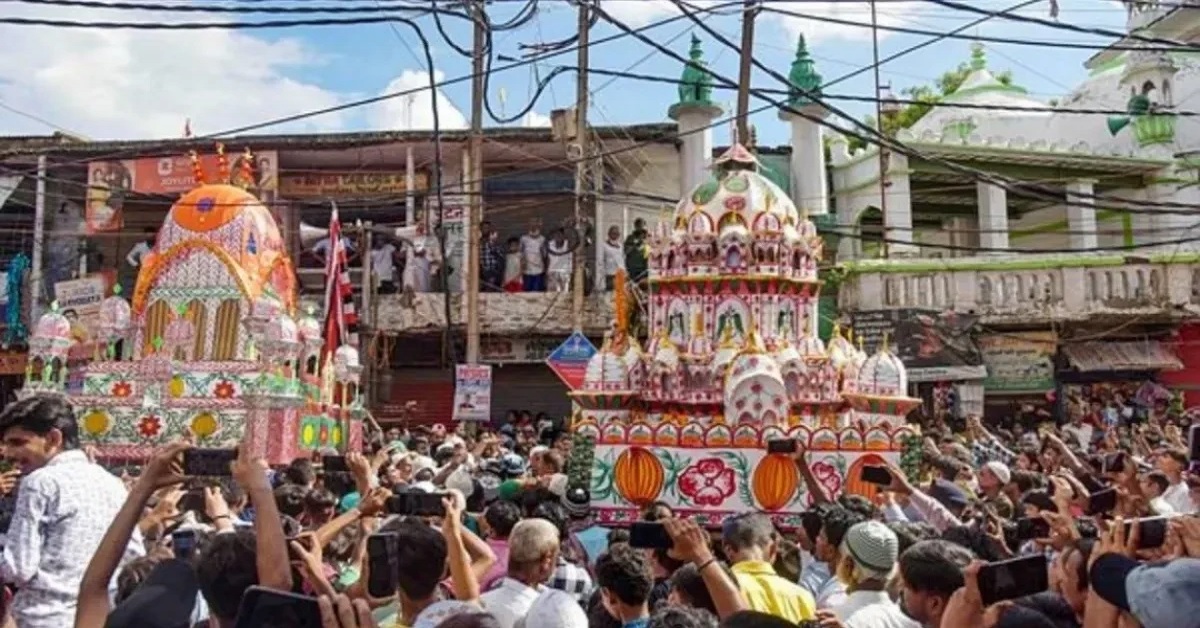
Centuries-old Muharram Heritage: Hindus lead Tazias, Sikhs serve water Across India, Muharram saw enduring interfaith traditions, from Dalit Hindu Tazia observances in Uttar Pradesh to generational Hindu Tazia-making in Bihar
30, Jun 2026 | CJP Team
Throughout June 2026, the month of Muharram was observed across the length and breadth of India with deep religious devotion, solemn dignity, and widespread peaceful participation, beyond the traditional mourning processions and the profound expressions of grief that characterise this sacred period, several towns and villages across the country witnessed extraordinary examples of inter-faith harmony.
In these places, people from diverse backgrounds and different faiths stepped forward to actively participate in local customs that have been preserved for generations.
Amidst the systematic hate leading to growing anger and despair, it is important to showcase a lived reality of camaraderie, equality and sharing which is the bedrock of the Indian Constitution and secularism. That way we not only hold on to every thread of hope, but effectively project these narratives, lest we lose our will to fight the good fight. As part of our #EverydayHarmony series, CJP brings you instances where Indians share and care, every single day… our food, our businesses, our homes and our friendships. This instances show how we Indians continue to reject hateful and divisive agendas even while street violence and social media are used as part of a sinister, hate-filled political agenda to tell us otherwise. Let’s reinforce India’s everyday lived reality, and through that collectively and aggressively, uphold and defend a unique pluralism, a diverse culture and truly secular values. Donate now to help us combat hate and prejudice!
Uttar Pradesh: a Dalit family’s 35-year-old Muharram tradition in Balrampur
In Chahatwa village, under the Gumdi Gram Panchayat in the Shridattganj block of Balrampur district, Uttar Pradesh, a unique tradition has been alive for over 35 years. Here, a Dalit Hindu family prepares and installs a Tazia every single year for Muharram. The tradition started with the family elder, Asharam. It was later passed down to his son, Shiv Prasad, and is now being carried forward by his grandson, Kamal Kanojia. Three generations of this family have kept the practice going without a single break, making it a key part of the village’s Muharram activities.
The dedication of the family has been covered by local journalists and media platforms, showing how a personal family promise turned into a symbol of community unity.
35 साल से मुहर्रम पर ताजिया रख रहा बलरामपुर का दलित परिवार, बना सांप्रदायिक सौहार्द की मिसाल –#BreakingNews #Muharram #Dalit https://t.co/MrNL20PFiT
— Journo Mirror (@JournoMirror) June 29, 2026
According to Kamal Kanojia, the practice started because of a personal milestone. Decades ago, the elders made a vow to honour a special family wish. When that wish came true, they promised to install a Tazia every year during the holy month of Muharram. Since then, the family has followed this custom with deep faith, as reported by Dainik Bhaskar.
Every year, the Kanojia family works together to build the Tazia. Once it is ready, people from nearby villages visit Chahatwa to see it and pay their respects. What began as a private family vow has grown into a major regional event that brings different communities together.
Asharam often tells visitors that the family believes this tradition brings peace, blessings, and well-being to their home. His son, Shiv Prasad, agrees, noting that the family saw good changes in their farming, business, and daily life after starting this practice. For them, continuing the custom is a way to respect their elders’ faith and keep the village’s identity alive. Local neighbours say the family is a living example of how mutual respect keeps harmony alive in rural areas, as reported
Bihar: a century-old legacy led by a Hindu family in east Champaran
In Bihar’s East Champaran district, the village of Patahi has followed a unique Muharram tradition for more than a century. As soon as the month of Muharram begins, the entire village gets ready. The most unique part of the procession is that it is led by members of the Singh family, who are Hindus.
For generations, this family has held the responsibility of leading the Tazia procession through the village streets. The community spirit of this annual event has been recorded on video, showing the close bonds between the neighbours.
During Muharram, the courtyard of Shiv Shankar Singh’s house becomes the main centre for preparations. Family members gather to build and decorate the Tazia before taking it out through the village. As the procession moves along, participants perform traditional lathi (bamboo staff) displays to remember the historic events of Karbala. Shah Mohammed, a resident of nearby Padumker village, remembers watching the Singh family lead the procession every year of his life. Other locals also see the family as an essential part of the town’s history, as reported
When asked how it all started, current members of the Singh family say the exact details have been lost over time. However, they know the practice dates back to their great-grandfather, Devi Singh, during British rule. Back then, official permits were needed for public processions, and the license for this Muharram event was issued directly in the name of the Singh family.
Today, the younger generation hopes to keep this tradition alive for years to come. One family member shared that while people may follow different religions in private, when they stand together for the procession, they represent the true spirit of India.
Bihar: crafting traditions in Gaya’s Atri village
In Atri village of Bihar’s Gaya district, community cooperation is visible through local art. During Muharram this year, five out of the seven Tazias in the village’s main procession were built and carried by local Hindu families. According to village elders, these families are simply following a practice they inherited from their ancestors. Making a Tazia takes time, patience, and team effort. Families spend several days shaping bamboo frames, cutting colored paper, and assembling the decorative structures.
Even though the event marks an important chapter in Islamic history, participation in Atri goes beyond just one community. Residents describe it as a normal, long-standing social tradition rather than something unusual. For these families, building the Tazia is a shared responsibility passed down from one generation to the next.
Madhya Pradesh: five generations of devotion in Vidisha
In the town of Vidisha, Madhya Pradesh, the Kushwaha family is central to the annual Muharram activities. For decades, this Hindu family has served at the shrine of Bawdi Waale Baba, which sits right across from a Hanuman temple in Khai Mohalla. Because the shrine and the temple face each other, people regularly visit both places to pay respects, showing the shared heritage of the town.
Every year during Muharram, the Kushwahas manage the arrangements for the Baba’s procession. Today, the fifth generation of the family is continuing this work with deep dedication. The sacred symbol of the Baba is carried on the head of the oldest male member of the family. Decorated with fresh flowers and garlands, the symbol is carried through the main market, drawing thousands of people from Vidisha and nearby areas.
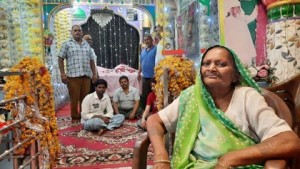 The Hindu family has been taking out Baba’s procession for 5 generations: Source (ETV Bharat)
“I have seen my elders serving Baba since I was a child, and the same tradition continues today. There was a time when our family was very poor, but our service never stopped. With Baba’s blessings, our family prospered, and today our children and grandchildren are carrying on this legacy.” — Chhoti Bai Kushwaha, oldest family member. As a report in ETV.
Bihar: a century of unity in Gurdaspur, Begusarai
While news stories about unity often focus on big cities, the small village of Gurdaspur in Bihar’s Begusarai district has spent nearly a century showing how brotherhood works in daily life. The Hindu and Muslim residents of this village, which has about 500 families, celebrate Muharram together as one large family.
For nearly 100 years, a small village in Bihar has quietly done what the rest of the country still struggles to achieve.
Every Muharram, Hindus and Muslims come together to keep an extraordinary tradition alive.
The story of Gurdaspur, Begusarai, is one every Indian should… pic.twitter.com/XabdDJDlVK
— FOEJ Media (@FoejMedia) June 26, 2026
The foundation of this tradition was laid by the late Bal Govind Mahto. Decades ago, he became the President of the Muharram Committee and took care of all the arrangements. From the first day of Muharram to the tenth day (Ashura), he managed the rituals and got the official permits for the procession. When he grew old, he handed the responsibility to his grandson, Vishnudev Mahto, who served the committee for nearly 30 years. Today, his nephew, Pankaj Kumar Mahto, carries on the work.
Evolution of the Gurdaspur Muharram committee Leadership
The ritual side of this tradition has also been kept alive by a local woman named Kushma Devi. The daughter of Bal Govind Mahto, she performed the Muharram rituals with care for years. When her health declined, she passed the duties to her daughter, Urmila Devi. Today, along with her daily housework, Urmila Devi performs all the traditional ceremonies from the first to the tenth of Muharram according to local customs.
Assam and Jammu & Kashmir: regional expressions of solidarity
Further east, in the tea town of Margherita in Assam, Muharram draws many different communities together. The annual procession sees active participation from local Muslim families, Assamese Hindus, Bengali residents, and tribal communities living near the tea estates. The procession moves through the green landscape with local instruments, making the day a shared reflection on justice and regional unity.
Meanwhile, in Srinagar, Jammu & Kashmir, Muharram focuses on community service and mutual support. Along with the traditional mourning processions, people from different communities work together to set up Sabeels (free stalls offering water, milk, and tea) for the public.
Joint blood donation camps are also organised across the city, where youth from various backgrounds donate blood side by side to honor the message of humanity.
Shared traditions passed across generations
The long-standing Muharram traditions across India show that harmony is kept alive through the simple, daily actions of regular families. Whether it is the Kanojia family in Uttar Pradesh keeping a 35-year vow, the Singh family in East Champaran holding a century-old license, the Kushwahas in Vidisha managing a shrine, or the Mahto family in Begusarai leading a committee, these practices continue because of mutual respect.
By treating these customs as a shared responsibility, these villages have kept close ties over the years. Passed down from parents to children, these old rituals continue to thrive, showing that respect and humanity are the true elements of their shared culture. Given the high voltage hate generated by politicians and political outfits holding power, this simple yet powerful assertion by ordinary Indians stands out. And sends a strong message.
Related
Hindus, Muslims Unite to Protect Rajasthan Border Mosques
When Citizens Say No: The quiet revolt against hate in India’s streets