Between Harmony and Hostility: How Bakri Eid passed across India in 2026 This year’s Eid-ul-Adha was shaped as much by administrative regulation and communal tension as by faith, charity and celebration
29, May 2026 | CJP Team
Bakri Eid in India this year unfolded under the shadow of extraordinary scrutiny. Across several states, Eid-ul-Adha was not merely a religious festival marked by prayer, sacrifice, and charity. It became a site of negotiation — between communities, between faith and state regulation, between constitutional rights and majoritarian sensitivities, and increasingly, between ordinary neighbourhood coexistence and organised political mobilisation.
In many places, the festival passed peacefully. Families gathered after morning namaz, meat was distributed among relatives and poorer households, and local communities quietly adjusted practices to avoid confrontation. But in several cities and towns, Bakri Eid also became the centre of communal disputes over goats, housing societies, slaughter spaces, public prayer, and even the visibility of Muslim religious life itself.
The result was a festival that revealed two India’s simultaneously: one still capable of accommodation and coexistence, and another where Muslim festivals are increasingly subjected to suspicion, policing, and political contestation. Authorities across the country remained on high alert in the days leading up to Eid-ul-Adha. Police deployments were increased, livestock transportation was monitored, housing societies issued restrictions, and state governments reiterated cattle slaughter regulations. The atmosphere reflected the growing politicisation of Bakri Eid itself.
The festival under regulation
One of the clearest patterns this year was the extent to which Eid celebrations became governed through administrative control and legal regulation. As Moneycontrol reported in a detailed nationwide survey of cattle slaughter laws ahead of Bakri Eid, state governments issued extensive advisories and intensified enforcement drives around livestock transport, slaughterhouses, and sacrificial practices.
The report highlighted how India’s fragmented legal landscape around cattle slaughter shaped Eid observances differently across states. Maharashtra strictly enforced provisions under the Maharashtra Animal Preservation Act, which bans slaughter of cows, bulls, and bullocks. Uttar Pradesh and Gujarat continued to enforce some of the country’s harshest anti-cow slaughter laws, with penalties extending to life imprisonment in certain circumstances. Assam intensified enforcement under the Assam Cattle Preservation Act, while Karnataka reiterated provisions under its stringent 2020 anti-cattle slaughter legislation.
In Delhi, minister Kapil Mishra publicly warned that sacrifice of prohibited bovine species would invite criminal prosecution. Rapid response teams were formed across districts to monitor transport and slaughter activities.
Municipal corporations and local administrations across cities also insisted that qurbani be conducted only at officially designated spaces. In Mumbai, the Brihanmumbai Municipal Corporation reportedly designated 109 authorised slaughter locations and discouraged sacrifice in residential societies and chawls.
Increasingly, the question was no longer merely what Muslims could sacrifice during Eid, but where, how visibly, and under whose permission.
Pandharpur and the other possibility
Yet even amid this tense atmosphere, there were moments that reflected a very different social reality. Perhaps the most striking example came from Pandharpur in Maharashtra. As reported by Hindustan Times, the town’s Muslim community voluntarily decided to defer goat sacrifice because Bakri Eid coincided with Adhik Maas Ekadashi, an occasion of deep significance for devotees of Lord Vitthal.
Members of the Muslim community told reporters that they wanted to honour the sentiments of Hindu pilgrims visiting the temple town. Some residents reportedly said that Muslims in Pandharpur had long-standing emotional and spiritual connections with the town’s religious culture and had similarly deferred sacrifice in previous years when such overlaps occurred. The symbolism mattered. At a time when Muslim religious practices were being intensely scrutinised elsewhere, Pandharpur offered a reminder that coexistence in India has historically depended less on legal coercion and more on negotiated accommodation and everyday mutual recognition. The story received wide attention precisely because it contrasted so sharply with the hostility unfolding elsewhere.
Mira Road: From housing dispute to communal flashpoint
The most widely discussed communal tensions around Bakri Eid this year emerged from Mira Road near Mumbai. What began as a disagreement by a few inside a housing society over goats being kept ahead of Eid soon escalated into a much larger communal controversy involving right-wing groups, police intervention, counter-protests, and allegations of deliberate provocation.
Detailed report by SabrangIndia may be read here.
Tensions erupted at Poonam Cluster Society after some residents objected to goats being housed within the premises. Muslim residents maintained that they had obtained municipal permission and pointed out that the practice had existed for years within the society. The dispute quickly moved beyond internal society negotiations.
As provided in our report, fringe elements associated with organisations such as the Bajrang Dal and Vishwa Hindu Parishad entered the scene. What followed was an escalation marked by religious sloganeering, clashes, and eventually one of the most disturbing incidents reported during this year’s Eid period: attempts to bring pigs into the housing society as a counter-protest to the legally valid presence of goats.
The symbolism was unmistakable. And yet, what happened afterward was equally important.
Three days later, the same society celebrated Eid peacefully under police protection. In a follow-up report, Hindustan Times quoted residents insisting that “outsiders” had aggravated what was initially a manageable internal disagreement.
Residents described years of communal coexistence inside the society. Muslim families explained that the temporary goat sheds had existed for years with proper drainage and regular cleaning arrangements. Hindu and Muslim neighbours reportedly exchanged Eid greetings despite the violence of previous days.
The Mira Road episode therefore became more than a local dispute. It illustrated how quickly ordinary disagreements over shared residential space can now be communalised through organised intervention and political mobilisation. At the same time, it also revealed the persistence of local social relationships that continue to resist complete polarisation.
Kalyan and the politics of religious space
Another major point of friction emerged in Kalyan, Maharashtra. As reported by The Hindu, police-imposed restrictions on animal sacrifice inside several housing societies and heavily barricaded the area around the historic Durgadi Fort complex during Eid prayers.
The site is politically and communally sensitive because a temple and mosque exist in close proximity within the fort complex. According to the report, temporary restrictions on temple access during Eid prayers led to protests by members of both Shiv Sena factions and Hindu organisations. Groups gathered nearby to recite the Hanuman Chalisa after prayers concluded, while demonstrations were organised around allegations that Hindu devotees were being prevented from entering the temple.
The issue carried deep historical resonance. The Hindu noted that the Durgadi Fort dispute has remained politically charged since the 1980s and is closely linked to the legacy of Shiv Sena strongman Anand Dighe. Bakri Eid here became not just a religious event but a symbolic battleground over ownership of public and sacred space.
Political language and “new Hindutva”
The tensions surrounding Bakri Eid also triggered overt political commentary. Shiv Sena (UBT) MP Sanjay Raut accused certain groups of attempting to communalise the festival through what he described as “new Hindutva.” According to reports published by News The Truth, Raut argued that Maharashtra historically represented a culture of coexistence and criticised what he viewed as selective outrage around Muslim animal sacrifice while remaining silent on sacrifices associated with other traditions.
His remarks reflected a broader political argument emerging this year: that opposition to Bakri Eid practices was no longer being framed merely through animal welfare or civic regulation, but increasingly through majoritarian identity politics. At the same time, Hindu nationalist groups repeatedly framed their protests around language of “public hygiene,” “society rules,” “religious sensitivity,” and “illegal sacrifice.”
The conflict was therefore rarely articulated openly as anti-Muslim hostility. Instead, it often appeared through the bureaucratic and civic vocabulary of regulation, sanitation, legality, and public order.
Varanasi and the economics of Eid
The tensions surrounding Bakri Eid were not only communal or political. They were also economic. In Varanasi, authorities sealed the city’s decades-old Benia Bagh goat market just days before Eid, triggering panic among traders. According to reports carried by Indian Express, the market — one of eastern Uttar Pradesh’s largest seasonal livestock bazaars — had functioned for nearly four decades before authorities abruptly shut it down citing sanitation complaints and overcrowding.
Traders alleged that they were given little warning and faced devastating losses after travelling from multiple districts with goats purchased on credit.
Several traders reportedly said they had mortgaged valuables and borrowed money at high interest rates to participate in Eid livestock trade and now feared financial ruin if they could not sell their animals.
The closure highlighted another dimension of Eid increasingly overlooked in public discourse: the festival sustains a vast informal economy involving livestock farmers, transport workers, traders, butchers, leather workers, and local markets. Administrative crackdowns therefore carry not only symbolic implications, but material consequences for livelihoods as well.
Prayer, surveillance, and preventive policing
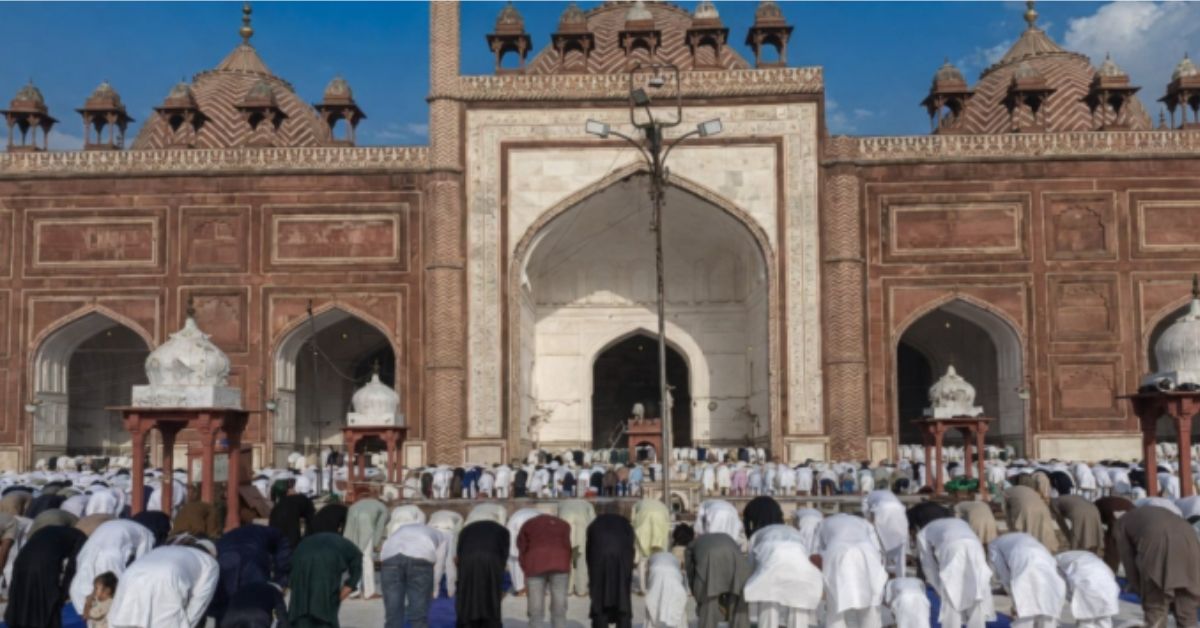
Even public prayer itself became contested in some areas. Reports circulated from Agra that Hindu nationalist leaders planned protests over temporary free entry arrangements at the Taj Mahal for Eid namaz. Police responded by placing several individuals under house arrest to prevent escalation. Elsewhere, social media videos documented protests around Eid prayers and public recitations of the Hanuman Chalisa near Muslim gatherings.
The visible police presence across cities became one of the defining features of Bakri Eid this year. In Mira Road alone, dozens of police personnel were reportedly stationed around sensitive housing societies to prevent further escalation.
The scale of preventive policing reflected both administrative caution and the extent to which Muslim festivals are increasingly treated as potential law-and-order situations.
The festival that revealed the country
Bakri Eid in India this year cannot be reduced either to a story of communal harmony or one of inevitable communal conflict. Both realities existed simultaneously.
There were stories of accommodation: Muslims in Pandharpur postponing sacrifice to respect Ekadashi; local communities negotiating solutions quietly; residents insisting that coexistence mattered more than provocation; neighbours exchanging Eid greetings despite recent tensions.
But there were also unmistakable signs of a changing political climate: housing societies policing Muslim practices; right-wing mobilisation around goats and sacrifice; counter-protests involving pigs; increasing restrictions on where Muslims may pray or perform qurbani; administrative language increasingly framing Eid through surveillance and control.
The deeper significance of Bakri Eid this year lay not merely in the incidents themselves, but in what they revealed about the condition of public life in India.
Questions that once belonged largely to the private domain of religious observance — where goats may be kept, where sacrifice may occur, whether namaz may be offered in a particular place — are now increasingly contested in public and political arenas. And yet, despite everything, the festival still passed. Families prayed. Communities negotiated fragile peace. And in many places, ordinary people continued to protect coexistence even when political actors attempted to fracture it. Bakri Eid in 2026 therefore became a portrait of contemporary India itself: anxious, polarised, heavily policed — but still, in countless everyday ways, struggling to hold together.
Image: News 18
Related:
Have Hindus always been Vegetarian?
No ‘Pakistan conspiracy’ in Noida labour unrest: Fact-finding report