After 9 Years, BSF personnel sentenced for rape and acid attack of Chakma woman in Mizoram A district court in Mizoram sentenced two BSF personnel for 20 years of rigorous imprisonment for the gang rape and acid attack of a Chakma tribal woman
26, Jun 2026 | CJP Team
After nearly nine years, on June 12, 2026, a district court in Mizoram sentenced two Border Security Force (BSF) personnel to 20 years of rigorous imprisonment for the gang rape and acid attack of a Chakma tribal woman. The case also involved the disappearance and death of her companion, Rangobi, whose decomposed body was recovered from a nearby area days after the incident. However, the court acquitted the accused of the murder charges relating to Rangobi’s death.
Former Chief Justice of India (CJI) J S Verma, also later former Chairperson of the National Human Rights Commission, had, 15 years after his retirement in 1998, noted that law enforcement agencies are among the biggest violators of human rights in the country. A 2013 Committee Report he led described rape as a calculated expression of power and subjugation, and acknowledged that brutalities by armed forces in border areas had led to deep disenchantment among residents. It also noted that persistent sexual assault on women in conflict and border areas was causing further alienation[1][2]
The present case, therefore, is significant for it is one of the rare instances where conviction and trial for human rights violation by security forces came through an ordinary civilian criminal court.
That it took nearly nine years, however, raises serious questions about institutional resistance during investigation, accountability within armed and paramilitary forces, and the barriers survivors face in accessing justice.
Silsuri, the village where the crime took place, is among the most remote villages in the country, which necessitates thinking of how many such cases go unreported in the border and conflict areas of the country. Rape already carries deep social stigma. In remote locations, that stigma is compounded by geographic isolation, weak institutional reach, and the near-impunity that armed and paramilitary forces often operate under.
Background of the Case
The case dates to July 16, 2017 where the victim along with her friend Rangbai, had gone toward Gaskata River in the village of Silsuri to collect crabs. Silsuri is a remote settlement along the India-Bangladesh border with no access to proper roads and communication and where the Border Security Forces (BSF) operate.
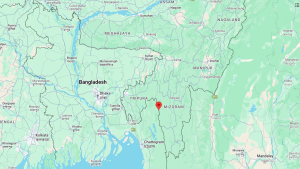
 Silsuri on the India-Bangladesh border is one of the remotest villages with no proper roads or communication networks.
Photo Credit: @mizoraminsta on Instagram
The incident came to light after the brother of the victim lodged a First Information Report (FIR) at the Marpara police station on July 18, 2017 alleging that his sister victim who had gone towards the Gaskata river along with her friend was apprehended by two unknown persons, subjected to gang rape, and thereafter attacked with a corrosive substance causing grievous injuries to her face.
According to the victim, she and her companion had met two BSF personnel, in uniform, while passing the BSF camp and that Rangobi spoke with them for about an hour. Subsequently, her friend had gone aside to answer the call of nature and asked the victim to proceed ahead when the same BSF personnel, not in uniform, appeared and committed gang rape upon her one after another. She was then attacked with a corrosive substance.
The victim suffered burns to her face, swelling of the eyelids, and abrasions across her body, including her vaginal wall. She lost vision in one eye and was left permanently disfigured.
Rangabi was never seen alive again. Her decomposed body was recovered from a jungle area near the site of the crime on July 27, 2017 during active search operations.
First Media Reports and Investigation
One of the first media reports of the incident can be traced to Newslaundry’s coverage on July 25, 2017 which described the crime as a ‘new low’ for the BSF and noted that the acid was poured on the victim’s face specifically to prevent identification.
Advocates of North East Network have written extensively on the vulnerability of women and other genders in the north-eastern states and pointed out how after such crimes, the army (or security personnel) routinely attempts to cover its tracks, in some cases, deliberately excluding the accused from identification parades, or conducting them so late as to render them unreliable. Similarly, according to Amnesty International, security forces frequently refuse to provide essential records to police investigators, such as duty rosters of personnel involved in operations, records of weapons and ammunition used. Accused personnel are also often not made available for questioning.
The present case followed a similar pattern. Following the registration of the FIR, investigators faced significant difficulties in securing the arrest of the suspects and in obtaining their biological samples. According to a report in The Hindustan Times in 2017, “authorities of the 181st battalion of the BSF had earlier not allowed the arrest of the two constables.”
As the investigation progressed, the Test Identification Parade (‘TIP’) was conducted by a judicial magistrate where the two accused were identified by the victim. Subsequently, the accused persons were arrested on 6 September 2017, and medically examined. On September 7, 2017, the Telegraph reported that the victim could not identify the accused earlier as “the acid had impaired her vision for over a month.”
The accused persons were released on bail on December 15, 2017. The charge sheet was finally filed on July 17, 2018– a year after the incident.
The Trial
Charges were framed on December 10, 2018, and the recording of evidence began on February 14, 2019. The trial then dragged on for over seven years where the trial court examined the testimonies of the victim, 18 prosecution witnesses (PWs), and 2 defence witnesses before delivering the judgment earlier this month on June 12.
In India, criminal trials are notoriously slow. Several recommendations to set up timelines have been made in the past to expedite trial in rape cases. However, according to studies the average time for deposition of the survivor itself was eight-and-a-half months, which continued beyond fifteen months in some cases. The timelines therefore remain unrealistic, and the justice is marked by enervating long trials attributed to structural problems. A seven-year trial in the present case meant the victim had to remain engaged with the legal process for nearly a decade after the assault, and re-live the trauma. For a woman from a remote village in Mizoram, with limited resources and institutional support, that is an enormous burden.
Another challenge was that the accused persons remained out on bail for most of that period. The charge sheet was filed a year after the incident, charges were framed over a year after that, and the trial itself stretched across seven more years. The case is significant precisely because it survived that attrition and the victim stayed involved and engaged through the process.
Prosecution’s Case
The medical examinations of the victim revealed multiple bruises on her hips, chest, and legs, along with abrasions on the vaginal wall. Doctors opined that these findings were consistent with recent forceful sexual intercourse. The victim sustained extensive chemical burns on her forehead, eyes, nose, and cheeks and these injuries resulted in severe swelling, an inability to open her eyes, and a permanent loss of vision in her left eye.
Because the victim had bathed and changed her clothes before the examination, no seminal stains or spermatozoa were detected on her clothes, vaginal swabs, or vaginal smears. Forensic analysis of tissue samples from the right knee and face of Rangabi, as well as the victim’s clothing, detected the presence of a corrosive base (alkaline substance) rather than acid. The FSL expert clarified that both acids and bases cause severe burns and that a base is not a byproduct of tissue decomposition, indicating it was intentionally applied.
Blood stains were detected on analysis of the clothing worn by the victim at the time of the. However, forensic testing determined that the blood stains on the victim’s clothing did not match the blood samples of either accused persons.
The evidence regarding the deceased friend, Rangobi, was limited by the highly decomposed state of her body. Due to this, the medical officer was unable to determine the exact cause of death. Forensic analysis of her tissue samples, however, confirmed damage from a corrosive base, which the prosecution argued linked her death to the same perpetrators who attacked the victim.
The prosecution’s core argument rested on the statements of the survivor under Sections 161 and 164 of CrPC which they described as consistent, cogent, and credible. The prosecution invoked settled legal principles that the sole testimony of a prosecutrix, if found reliable and trustworthy, is sufficient to sustain a conviction even without independent corroboration
The prosecution argued that the identity of the perpetrators was firmly established during the TIP conducted by a judicial magistrate, who testified that the process was regular and legal. Medical findings were presented to lend strong corroboration to the victim’s account. The prosecution also explained the lack of seminal stains or matched blood by noting that the victim had bathed and changed her clothes before the examination, which is not fatal to the case when ocular testimony is reliable.
The prosecution linked the accused to the death of the second victim, Rangobi, as the survivor were last seen together proceeding to the jungle where they encountered the accused. The prosecution argued that since the accused failed to provide a plausible explanation for why Rangobi went missing and was later found dead after meeting them, the court should draw an adverse inference against them
The Case of the Defence
During their examination, both accused persons denied all incriminating evidence, and stated they had no knowledge of the incident, and claimed they were falsely implicated after being photographed by the police without explanation.
According to the two defence witnesses, one, the Post Commander at Prasad Company in Silsuri and second, a Constable at the same company, both accused persons remained in the barrack to rest after lunch. They however admitted that the accused had left the camp earlier that day for about 45-50 minutes to collect a tiffin from another camp 900 metres away. They emphasised that the camp was secured with barbed wire and had only one entry and exit gate.
The defence counsel cited official entry and exit registers from the BSF camp, which recorded their presence and argued that the distance between the camp and the crime scene was considerable, and it would have been humanly and logistically impossible for the accused to travel there, commit the crimes, and return within the timeframe recorded in official logs.
The defence contended that the prosecution’s case was based entirely on weak circumstantial evidence and there were no eyewitness accounts or direct evidence placing the accused at the scene of the occurrence. Reliance was placed on forensic examination which showed that bloodstains found on the victim’s clothing did not match the blood samples of either accused person. The counsel argued that photographs of the accused were taken and shown to the victim prior to the TIP, leading to a high likelihood of pre-identification and tutoring.
The defence maintained that the prosecution failed to meet the legal threshold of proving the case beyond a reasonable doubt, emphasizing that the gravity of an accusation cannot substitute the requirement of strict proof.
The Court subsequently decided on six questions, whether (i) the accused persons committed gang rape upon victim; (ii) the accused persons committed rape causing grievous bodily harm or injury to the victim; (iii) the accused persons caused grievous injuries to the victim by throwing a corrosive substance on her; (iv) the accused persons are responsible for the death of Rangobi; (v) the identity of the accused persons as the perpetrators of the offences has been proved beyond reasonable doubt; and (vi) the prosecution has proved the charges against the accused beyond reasonable doubt.
What Did the Court Decide?
On the first question, the court found the testimony of the victim cogent and consistent and the TIP test duly conducted. The Court relied on State of Punjab v. Gurmit Singh (1996), where the Supreme Court held that the testimony of a rape victim stands on a higher pedestal than that of an injured witness and does not require corroboration as a matter of rule; and Budhsen v. State Uttar Pradesh (1996), where it was held that TIP serves to corroborate the testimony of a witness; to uphold the charge under Section 376D of the Indian Penal Code. The Court also found medical evidence of injury on private parts and acid burns credible. Regarding absence of conclusive forensic evidence, reliance was placed on State of HP v. Raghubir Singh (1993) where it was held that absence of medical corroboration is not fatal when ocular testimony is reliable to uphold the conviction.
The judgment reads:
“The presence of the accused in the vicinity stands admitted and they have failed to offer any plausible explanation regarding their identification by the victim. Their failure to furnish any plausible explanation regarding the incriminating circumstances appearing against them in their statements u/s 313 Cr.P.C permits an adverse inference. Such failure permits the Court to draw an adverse inference.” (Para 10.7)
On the second question, the Court found the injuries sustained by the survivor including injuries on her private parts consistent with forcible sexual assault, and acid burns to the face, loss of vision in one eye, permanent disfigurement to affirm the charge under Section 376 (2) (m). The Court said that the corrosive substance was used in the course of and in close proximity to the rape, and was a part of the criminal transaction sufficient to bring the acid attack within the aggravated category of the rape charge.
On the third question, following the precedents in State of Uttar Pradesh v. Naresh (2011) and Laxmi v. Union of India (2014), the Court found Section 326A of the IPC established. The judgment reads:
“The defence has failed to rebut the prosecution evidence or to probabilise any alternative version explaining the injuries sustained by the victim. The absence of recovery of the exact chemical substance or other corroborative material is not fatal when the ocular and medical evidence clearly establish the nature of the act and its consequences.” (Para 12.5)
On the fourth question, regarding death of Rangobi, the Court found that the prosecution’s case on murder rested substantially on the ‘last seen’ theory, which according to it, was a weak piece of evidence. That Rangabi was last seen in the company of or in the vicinity of the accused was circumstantial evidence and not sufficient. The court applied the test for circumstantial evidence established in Sharad Birdhichand Sarda v. State of Maharashtra (1984) that requires the chain of circumstances to be complete and exclude every hypothesis other than the guilt of the accused. On murder, this requirement was not met.
The Court acknowledged that while the accused’s failure to explain their movements raised suspicion, it relied on Kali Ram v. State of HP (1973) to say that where two views are possible, the one favourable to the accused must be adopted. Suspicion, however strong, is not proof.
The TIP was a critical evidentiary step to answer the fifth question. The Court found that the accused were not previously known to the victim and therefore the TIP identification was significant. The court relied upon the precedents established in State of Maharashtra v. Suresh (2000) and Malkhansingh v. State of Madhya Pradesh (2003) to rely upon the corroboratory value of TIP.
Reliance was also placed on Budhsen v. State of Uttar Pradesh (2003) where the Supreme Court held that the TIP is conducted to test and strengthen the trustworthiness of the identification made by the witness in court and Dana Yadav v. State of Bihar (2002), where the court reiterated that while TIP is not substantive evidence in itself, it lends assurance to the testimony of witnesses regarding identity.
The court found the TIP in this case to have been validly conducted, and treated it as substantial corroboration of the survivor’s in-court identification. The judgment reads:
“Further, the presence of the accused in the vicinity stands admitted and the surrounding circumstances lend additional assurance to their identification. The accused have failed to furnish any plausible explanation as to why they were identified by the victim, which permits an adverse inference against them.” (Para 14.8)
Lastly, the Court found that the prosecution has partly proved charges beyond the doubt, except on the charge under section 302 of IPC relating to the death of Rangobi.
Sentencing
On June 16, the Court sentenced the accused persons for 20 years for gang rape (376D), 10 years for rape causing grievous harm (376(2)(m)), 12 years for acid attack (326A), all running concurrently. The accused persons were also asked to pay a fine of Rs 60,000 each.
In addition to the fine imposed, the victim was entitled to compensation under the Victim Compensation Scheme as per Section 357A Cr.P.C. The Mamit District Legal Services Authority was directed to take appropriate steps in this regard.
The Broader Pattern of Violence Committed by the Uniformed Personnel
The pattern of violence by uniformed personnel, both military and paramilitary has persisted across decades and geographies, and one that has almost never resulted in criminal accountability. The present case, therefore, is crucial.
At the India-Bangladesh border alone, between 2000 and 2023, 4,585 people were victims of border violence, of whom 1,299 were killed. Sexual violence runs alongside this.
In 2016, a BSF personnel allegedly shot dead a 25-year-old woman at a border location in Tripura after she resisted rape.
In 2018, a 26-year-old woman committed suicide by consuming poison after a BSF Jawan allegedly raped her on the pretext of marriage.
In 2021, a BSF sub-inspector was arrested on Thursday for allegedly raping a 30-year-old Bangladeshi woman on the pretext of interrogation inside a camp of the force at Gaighata in North 24 Parganas.
In 2022, two personnel of the BSF were arrested by the West Bengal police for the gang-rape of a woman under Bagda police station at Jeetpur border outpost along the India-Bangladesh border; in the same year, 3 BSF personnel, arrested for gang raping a woman in Rajasthan.
In 2023, a BSF inspector was suspended over allegations of rape of a woman constable at a border outpost in Kishanganj area in West Bengal.
These are only the reported cases.
The BSF Act provides the force with significant legal insulation. Section 47 of the BSF Act, 1968 reads:
“47. Civil offences not triable by a Security Force Court.—A person subject to this Act who commits an offence of murder or of culpable homicide not amounting to murder against, or of rape in relation to, a person not subject to this Act shall not be deemed to be guilty of an offence against this Act and shall not be tried by a Security Force Court, unless he commits any of the said offences,—
(a) while on active duty; or
(b) at any place outside India; or
(c) at any place specified by the Central Government by notification in this behalf”
For the Indian Army operating in disturbed areas, the Armed Forces (Special Powers) Act, 1958 (AFSPA) compounds this further and the consequences have been devastating. The mass rape of at least 23 women Kunan Poshpora by personnel of the Rajputana Rifles during a cordon-and-search operation remains unresolved to this day. The Independent People’s Tribunal documented the rape of 100 women, including minors and the elderly. The Indian government rejected the allegations as fabricated; while major international human rights bodies found credible evidence that the rapes had occurred.
For more on the Kunan Poshpra incident read this coverage by SabrangIndia.
The response to these crimes has come from women themselves.
In 2004, following the alleged rape and murder of Thangjam Manorama by Assam Rifles personnel in Manipur, twelve elderly women staged a naked protest outside the Assam Rifles headquarters. Their placards read, “Come Indian Army Rape Us.” In 2005, a committee under Justice B.P. Jeevan Reddy recommended AFSPA’s outright repeal, describing it as “a symbol of oppression.”
The Mizoram conviction by a civilian court is significant because it breaks, however partially, from the pattern of institutional apathy. It cannot, however, undo decades of impunity, which still continues.
The judgement delivered by Sylvie Zomuanpuii Ralte, Addl. District & Sessions Judge, dated June 6, 2026 may be read here.
Judgements cited by the Sessions Court while ordering conviction include:
State of Punjab v. Gurmit Singh (1996) may be read here
Budhsen v. State Uttar Pradesh (1970) may be read here
State of HP v. Raghubir Singh (1993) may be read here
State of Uttar Pradesh v. Naresh (2011) may be read here
Laxmi v. Union of India (2015) may be read here
Sharad Birdhichand Sarda v. State of Maharashtra (1984) may be read here
Kali Ram v. State of HP (1973) may be read here
State of Maharashtra v. Suresh (1999) may be read here
Malkhansingh v. State of Madhya Pradesh (2003) may be read here
Dana Yadav v. State of Bihar (2002), may be read here
(The legal research team of CJP consists of lawyers and interns; this judgement primer has been worked on by Tanishka Shah)
Related:
Revisiting the Justice Verma Committee report of 2013: #JusticeForRapeVictims
The story I never got to tell – of rape and torture by the Indian army
NHRC issues notice to MoD for compensating victim of Army’s “indiscriminate” firing
Will Army Court Martial Captain who allegedly took money to stage Shopian ‘encounter’?
[1] The JS Verma Committee had been set up in December 2012 following the Nirbhaya gang rape in New Delhi and after intense hearings submitted its landmark report on January 23, 2013. The report ensured sweeping reforms in Indian criminal law, expanding the definitions of sexual violence, prioritising victim survivor rights and increasing accountability for state institutions.
[2] https://cjp.org.in/india-needs-safe-public-spaces-for-women-a-re-look-at-the-justice-verma-committee-report-2013/