With calls for economic boycott of Muslims, are we at the precipice of a genocide? Othering, ridicule and exclusion are just precursors to violence
31, Mar 2022 | CJP Team
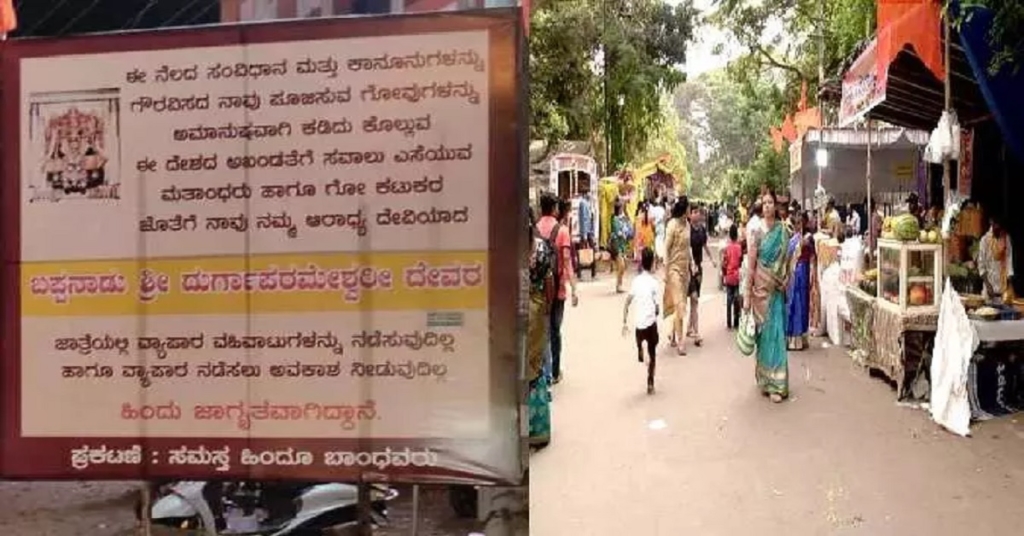
Followed by the Hijab controversy, the Muslim minority are now being banned from conducting business at temple fairs in Karnataka. What first started in Marikamba temple in Shivamogga has now been followed suit by other temples in Dakshina Kannada, Hassan, Tumukur, Chikkamagalur and other districts.
Reportedly, banners have been put up outside some of these temples urging them not to lease stalls to Muslims. According to The Print, “Hindutva organisations including the Vishva Hindu Parishad (VHP), Hindu Jagarana Vedike, and the Bajrang Dal have been submitting memorandums to temple authorities, municipal officials, and town councils, calling for a ban on Muslims setting up shops and stalls.”
The issue came to light when it was raised during zero hour in the State Assembly by Congress Member of Legislative Assembly (MLA) UT Khader on March 23, 2022. The Karnataka State government made a statement in defence of the said ban by citing Rule 31, sub-rule 12, of the Karnataka Religious institutions and Charitable Endowment Rule 2002, which bans the leasing of land or buildings near temples to non-Hindus.
As per Rule 31(12) of the Hindu Religious Institutions and Charitable Endowments Rules 2002, “No property, including land, building or sites situated near the institution (temple) shall be leased out to non-Hindus.”
Citing the Karnataka Religious institutions and Charitable Endowment Act, 2002, State Law Minister, JC Madhuswamy reportedly stated in the Assembly, “If these recent incidents of banning Muslim traders have occurred outside the premises of the religious institutions, we will rectify them. Otherwise, as per norms, no other community is allowed to set up shop on the premises.”
What seems like a defence to JC Madhuswamy’s statement, Karnataka Chief Minister Basavaraj Bommai reportedly stated, “During such jathras (religious fairs), there are a lot of shops that are sub-leased. These people who take up the lease from the temple management board would do it for money. This is something that the government cannot interfere in. When it is such cases, we will look into the laws as well as the facts of the case.”
In sharp contrast to the stance of his party in Karnataka and elsewhere and the ruling government on the issue, BJP leader AH Vishwanath has spoken sharply and vociferously against these brazen attempts to not just deny Muslims their livelihood but on the political moves to create social divisions and schisms. The former Congress leader who is now a Member of Legislative Council (MLC) said, “No God or religion preaches these kinds of things. Religions are inclusive and not exclusive”, adding to this he has stated, “This is a very sorry state of affairs. The government must take action or there will be a reaction from the people. People need livelihoods to feed themselves and cloth themselves and if there is no means of livelihood then what is the point of democracy, religion, caste — throw it all away. When there is no means to buy food, what are we searching for in this world”
With a brazen confidence, a serial hate offender with a history of making misogynistic statements, and even encouraging violence against women as witnessed during the infamous Magalore pub attack in 2009, Sri Rama Sene chief Pramod Muthalik said that the ban would continue until Muslims stopped eating beef, reported The Telegraph.
Leaving no stone unturned to inculpate the Opposition, the BJP led state government argued in the Assembly that the said rules banning lease of land or buildings near temples to non-Hindus were framed in 2002 when the Congress was in power.
Explaining the raison d’etre behind framing these rules in 2002, former chief minister SM Krishna who was with the Congress reportedly stated, “While non-Hindus were not allowed to do business near temples, Hindus were also not allowed to do business near mosques or churches. This was done to help vendors of respective faiths and not on religious lines.”
What is of particular concern however, is that there appears to be a pattern behind such calls for socio-economic boycott that have taken a particular turn in Karnataka, a state that goes to the polls next year. Other parts of India and within Karnataka too, have been a series of incidents reported that show that Muslim vendors and traders are not just being banned from temple fairs but are also being illegally kept out of streets that lead to the temples. This is a serious and calculated assault on their livelihood and a direct violation of Articles 14, 15(1) and 15(2) of the Constitution.
What is the Religious Institutions and Charitable Endowment Act, 1997, and how was it erroneously applied?
As explained in the (said) legislation’s statement of objects and reasons, the State Government of Karnataka decided to enact a new law to replace several local Acts to bring about “uniformity” in the matter of regulating all Charitable Endowments and Hindu Religious Institutions in the state. This was in 1997.
A similar law had been enacted in a few other states decades earlier. For example, in Tamil Nadu (1959), Madras (1951) and Andhra Pradesh (1987) for the same purpose, i.e. for the administration and regulation of temples and the endowed properties attached thereto.
A close reading of the Karnataka law, reveals its intention, to ensure better administration, protection and preservation of temples and the endowed properties attached thereto, so that the substantial assets donated by believers as part of ritual charity –in good faith– do not get misused.
Significantly, Rule 31 of the Karnataka Hindu Religious Institutions and Charitable Endowments Rules, 2002 only talks about the terms of the lease and renewal of immovable property of a notified institution that comes under the Act. Sub-rule 12 under Rule 31 imposes the restriction for the long-term leasing of an immovable property – land, building or area which is located near a Hindu institution or temple to non-Hindus.
The People’s Union for Civil Liberties (PUCL) Karnataka has written to both Karnataka CM Bommai and Governor Thawar Chand Gehlot stating, “(It is) a deliberate misinterpretation of the provision, as Rule 31 only deals with long-term leases of immovable property owned by a temple (up to 30 years for land, and five years for shops and buildings). It does not deal with the short-term licences which would be used to allot stalls or spaces to vendors during a festival. The matter in question here is not of leasing out immovable property but allocation of such short-term licenses for temporary instalment can be dismantled.”
Bangalore based advocates Arvind Narain and Shujayathulla, both Presidents of PUCL Karnataka and Robin Christopher, general secretary, have in this representation pointed out a distinction between a lease and a licence. Moreover, the PUCL representation calls out the boycott for its unconstitutionality.
“The boycott calls are sought to be given a fig leaf of legitimacy by referring to Rule 31(12) of the 2002 Rules of the Karnataka Hindu Religious Institutions and Charitable Endowments Act, 1997, which state that no property, including land, building or sites situated near the institution shall be leased out to non-Hindus. However as Senior advocate Chander Uday Singh pointed out this is a deliberate misinterpretation of the provision as Rule 31 only deals with long-term leases of immoveable property owned by a temple. It does not deal with the short-term licences which would be used to allot stalls or spaces to vendors during a festival. Rule 7 also specifically prohibits sub-lease, leading one to the conclusion that the contract temple authorities enter into with traders can only be a licensing agreement.
However, going beyond the question of whether the temple actions are justified by the rule 31(2) cited by the Hon’ble law minister, the larger questions is the constitutionality of the same. Both economic boycott and calling for economic boycott is violative of the constitutional promise of non-discrimination enacted in Article 15. Article 15, explicitly prohibits discrimination on grounds of religion, besides race, caste, sex or place of birth. Article 15(2) further proclaims that no citizen be subject to any ‘restriction’ with regard to ‘access to shops’, ‘maintained wholly or partly out of State funds or dedicated to the use of the general public’.
The representation also states that, “A lease is akin to a permanent transfer of rights as far as property is concerned. So, the concept of sub-leasing exists. A licence is a temporary transfer of property. You do not acquire any ownership rights under a licence.” Therefore, the said boycott of Muslim vendors is not justified under the law.
Recalling that Dr BR Ambedkar was a vociferous opponent of social and economic boycotts noting that it was a form of ‘tyranny of the majority’. In Ambedkar’s words, “The method of open violence pales before it, for it has the most far reaching and deadening effect.” It is more dangerous because it passes as a lawful method consistent with the theory of freedom of contract. Warning that such a trend as seen in Karnataka and other parts of India could lead to widespread exclusion even crimes against humanity like in Rwanda and Hitler’s Germany, PUCL calls on the government of Karnataka to:
- Immediately withdraw of all such decisions Immediately withdraw the decisions, and ensure that Muslims and persons of all religious communities are provided an equal space and opportunity to carry out their businesses during all days of the festivals;
- Immediately initiate criminal action against the organizations pressurizing and attempting to cause an economic boycott of Muslim businesses;
- Ensure that immediate measures are taken to restore and maintain communal harmony across Karnataka as required by the Communal Harmony Guidelines, 2008 issued by the Ministry of Home Affairs, including keeping organizations that undermine communal harmony under scrutiny and taking appropriate action against them;
- Clarify that the statements made by elected representatives erroneously interpreting the Karnataka Hindu Religious Institutions and Charitable Endowments Act, 1997 to legitimize the unconstitutional act of discrimination on grounds of religion.
The entire PUCL representation may be read here:
Where the Muslim minority is similarly discriminated against in other states of India
Uttar Pradesh
In Uttar Pradesh, right-wing Hindutva groups are often seen harassing and taking away the livelihood of Muslim minorities. During the State Assembly elections, Muslim vendors were forced to shut down their small daily-wage works, beaten and harassed by the said groups. While some were forced to change their stalls’ names, some faced intimidation and violence. In January 2021, mass gathering were openly called upon by Swami Anand Swaroop in a Hindu Sabha Meerut wherein hereportedlyasked the people to “boycott Muslims from social, economic and political bases so far that they themselves get converted to Hindu.”In another instance, Legislator Suresh Tiwari from Deoria town in the northern state of Uttar Pradeshreportedly said amidst the crushing economy during the pandemic, “Keep one thing in mind. I am telling everyone openly. There is no need to buy vegetables from ‘miyans’ [Muslims].”
Delhi
On March 23, 2022, previous participants in the infamous at Dharma Sansad in Haridwar, Uttarakhand in December 2021, Swami Jitendranand Saraswati and Vinod Sharma, were seen addressing a crowd of persons watching the film ‘The Kashmir Files’. He not only attempted to spread anti-Muslim sentiments and accused Muslims of dividing the country. This right-wing proponent spread this hate in front of young children addressing them to pick up arms to protect themselves.On March 22, 2022, a video of Vinod Sharma’s aides went viral on social media asking audience to boycott Muslim vendors and break their economic backbone. Around this time, a hotel in Delhi, the capital, denied accommodation to Kashmiri man on a hypothetical idea of ‘Kashmiri a crime” created by ‘Kashmir files’ movie.
Haryana
In Haryana, 23 “upper” caste persons have been booked for calling for an all-out boycott of more than 150 Dalit families. In Chhatar village, a Panchyat (council/gathering) dominated by the “upper” castes was called, in which it was collectively decided to boycott the ration (food supplies) and access to free movement (transport) to Dalit families living there. This was nothing short of coercive pressure on the Dalit community to withdraw a case filed against atrocities and abuse.SabrangIndia had reportedthis case of “upper” castes’abuse of the Dalit community.
Chhattisgarh
In Surguja district, there has been mass gatherings of Hindutva group taking an oath of communal discrimination.
Madhya Pradesh
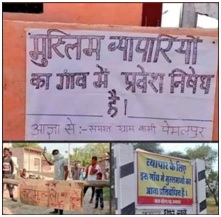
In Pelampur, banners have been reportedlydisplayed banning entrance to the Muslim vendors inside the village.
Violation of Constitutional provisions
What is both crucialand interesting to note is that –be it Karnataka or elsewhere –the granting of such short-term licenses to Muslim traders was never an issue until now. Since 2002, no Muslim traders have everbeen prohibited from setting up stalls near Hindu pilgrimage sites or during festivals. This brazenly exclusionary and violent trend is clearly linked to the rise of the right-wing in politics; a trend made more dangerous by the fact that this surge in majoritarianism is used to reap electoral benefits. A meek Election Commission has not enforced its statutory powers to ensure non-partisan campaigning and a far from assertive judiciary has not stepped in either.
In a nutshell, the said call for boycott and boycott both violate fundamental rights conferred under articles 14, 15, 19 and 21 of the Constitution of India.
Articles 21, 14 and 15 both guarantee that every person has the right to life, equality and non-discrimination. Article 19 ensures freedom of movement and the right to undertake economic activity. While Article 14 says that the State shall not deny to any person equality before the law or the equal protection of the laws within the territory of India, Article 15 prohibits discrimination on grounds only of religion, race, caste, sex, place of birth. Further under article 15(2), no citizen shall be subject to any restriction or condition with regards to access to shops or the used of roads and places of public resort maintained out of state funds or made for the use of general public, merely on the basis of religion, race, caste, sex, place of birth or any of them.
- Equality before law—The State shall not deny to any person equality before the law or the equal protection of the laws within the territory of India.
- Prohibition of discrimination on grounds of religion, race, caste, sex or place of birth—(1) The State shall not discriminate against any citizen on grounds only of religion, race, caste, sex, place of birth or any of them.
(2) No citizen shall, on grounds only of religion, race, caste, sex, place of birth or any of them, be subject to any disability, liability, restriction or condition with regard to— (a) access to shops, public restaurants, hotels and places of public entertainment; or (b) the use of wells, tanks, bathing ghats, roads and places of public resort maintained wholly or partly out of State funds or dedicated to the use of the general public.
The said boycott also violates the freedom of the Muslim citizens to carry on any occupation, trade or business as provided under article 19 of the Constitution.
- Protection of certain rights regarding freedom of speech, etc.—(1) All citizens shall have the right— (g) to practise any profession, or to carry on any occupation, trade or business.
The economic boycott of Muslim citizens also violates their right to life under Article 21.
- Protection of life and personal liberty—No person shall be deprived of his life or personal liberty except according to procedure established by law.
In the case of Maneka Gandhi v. Union of India1978 [AIR 597, 1978 SCR (2) 621], the Supreme Court had held that the right to life is not merely a physical right but includes within its ambit the right to live with human dignity. Elaborating on the same the Court in Francis Coralie v. Union Territory of Delhi1981 [AIR 746, 1981 SCR (2) 516]observed:
“The right to live includes the right to live with human dignity and all that goes along with it, viz., the bare necessities of life such as adequate nutrition, clothing and shelter over the head and facilities for reading writing and expressing oneself in diverse forms, freely moving about and mixing and mingling with fellow human beings and must include the right to basic necessities the basic necessities of life and also the right to carry on functions and activities as constitute the bare minimum expression of human self.”
The systematic targeting of the Muslim minorities over the time by politically powerful, right -wing Hindutva groups is also endangering their rights conferred under article 15 and 29 of the Constitution. While article 25 provides freedom of conscience and the right to profess, practise and propagate religion to all persons, article 29 protects the interests of minorities by giving them the right to conserve their language, script or culture of its own.
- Freedom of conscience and free profession, practice and propagation of religion—(1) Subject to public order, morality and health and to the other provisions of this Part, all persons are equally entitled to freedom of conscience and the right freely to profess, practise and propagate religion. (2) Nothing in this article shall affect the operation of any existing law or prevent the State from making any law— (a) regulating or restricting any economic, financial, political or other secular activity which may be associated with religious practice; (b) providing for social welfare and reform or the throwing open of Hindu religious institutions of a public character to all classes and sections of Hindus.
- Protection of interests of minorities—(1) Any section of the citizens residing in the territory of India or any part thereof having a distinct language, script or culture of its own shall have the right to conserve the same.
Moreover, as per the Directive Principles of State Policy, the Constitution aims to create a socio-economic condition for the citizen of India to lead a good life. Under Article 38, the Constitution directs the state to promote social and economic welfare of the people and Article 39 the Constitution directs the State to formulate policies that secure people’s right to adequate means of livelihood.
- State to secure a social order for the promotion of welfare of the people—1 [(1)] The State shall strive to promote the welfare of the people by securing and protecting as effectively as it may a social order in which justice, social, economic and political, shall inform all the institutions of the national life. 2 [(2) The State shall, in particular, strive to minimise the inequalities in income, and endeavour to eliminate inequalities in status, facilities and opportunities, not only amongst individuals but also amongst groups of people residing in different areas or engaged in different vocations.
- Certain principles of policy to be followed by the State.—The State shall, in particular, direct its policy towards securing— (a) that the citizens, men and women equally, have the right to an adequate means of livelihood; (b) that the ownership and control of the material resources of the community are so distributed as best to subserve the common good; (c) that the operation of the economic system does not result in the concentration of wealth and means of production to the common detriment;………
Legal precedents
In a recent and similar case(TM Rabbani vs. G Vaani Mohan & Ors), in December 2021, the Supreme Court had stayed a similar rule existing in Andhra Pradesh. The Court has stated, “We direct that none of the tenants/shop holders shall be excluded from participating in the auction or from the grant of leases including in the shopping complex on the ground of their religion.” The Court admitted that “it was impermissible for the State to either exclude the license holders from participating in the auction or from being granted leases, including in the shopping complex constructed by the State on the ground of religion”.
The special leave petition had been filed in Supreme Court against the order of Andhra Pradesh High Court who ruled against the Muslim minorities stating“…… the alleged acts of non-Hindus would cause serious inconvenience to worship deity by Hindus, as such to protect the interest of Hindu worshippers of deity and to avoid any amount of inconvenience or any prejudice to their interest; the State issued such rules inconsonance with the Act itself. Hence, we find no force in the argument of the learned counsel for the petitioners and the same is hereby rejected. We are of the confirmed view that such discrimination permitting Hindus only, debarring non-Hindus to participate in the auction of leasehold rights or license in respect of the shops and plots belonging to the respondent No.3 does not amount to violation of fundamental right guaranteed under Article 14 of the Constitution of India.”
The Order of the SC and other related orders of the Andhra Pradesh High Court may all be read here.
The atmosphere in India has become quite hostile towards the Muslim minorites who are being constantly targeted with impunity, especially in states with BJP-led governments. Multiple and repeated instances of Hate Speech, Mob Lynchings and other kinds of exclusion and violence have spiralled. Things are made worse with the authorities taking no strict actions being taken against the human rights violators and hate offenders.
Recently, (BJP) General Secretary, CT Ravi –with decades long record for provocative speech —joined the right-wing groups’ hate call to boycott ‘Halal’ meat which has been equated with Muslim dietary habits, and called all Halal food ‘economic jihad’. Adopting a right-wing tactic to associate Muslims with words like Jihad/Jehad (Holy War), he has reportedly said, “Halal is an economic Jehad. It means that it is used like a Jehad so that Muslims should not do business with others. It has been imposed. When they think that Halal meat should be used, what is wrong in saying that it should not be used?”
While past years have seen some positive rulings emanating from India’s top court, the non-implementation of directions, renders even these without teeth. In 2016, Activist Lawyer Tehseen Poonawalla along with few others had filed a Writ Petition in the Supreme Court [Tehseen Poonawalla vs. UOI &Ors (2018) 9 SCC 501]troubled by the increasing incidents of cow-vigilantism in the country where private citizens violently punish people who they suspect of consuming beef.
The Court had condemned the widespread acts of mob lynching and violence in the country. While prescribing a bunch of guidelines to curb such unlawful activities, the Court had observed,
“It is our constitutional duty to take a call to protect lives and human rights. There cannot be a right higher than the right to live with dignity and further to be treated with humanness that the law provides. What the law provides may be taken away by lawful means; that is the fundamental concept of law. No one is entitled to shake the said foundation. No citizen can assault the human dignity of another, for such an action would comatose the majesty of law. In a civilized society, it is the fear of law that prevents crimes. Commencing from the legal space of democratic Athens till the legal system of modern societies today, the law makers try to prevent crimes and make the people aware of the same but some persons who develop masterly skill to transgress the law jostle in the streets that eventually leads to an atmosphere which witnesses bloodshed and tears. When the preventive measures face failure, the crime takes place and then there have to be remedial and punitive measures. Steps to be taken at every stage for implementation of law are extremely important. Hence, the guidelines are necessary to be prescribed.”
Drawing a perfect analogy to India’s current predicament, activist and author, Mr. Pieter Friedrich has rightly said, “In 1933, the Nazis said,Don’t buy from Jews. In 2022, the Nazi-inspired Hindu nationalists say,Don’t buy from Muslims. Economic boycott is the path to genocide. Fascism in India must be stopped.”
Image Courtesy:news9live.com
Related:
Don’t stop at Muslim-owned dhabas, VHP, Bajrang Dal warn buses in Gujarat
CJP moves NCM over hate crimes against Muslims in Madhya Pradesh
Why is iD dosa batter giving communal trolls indigestion?
Hate Watch: Hindutva group raises slogans outside Muslim-owned shop in Gujarat