A family’s roots in Assam since 1933, yet a citizenship battle: Sakina Bibi wins before Foreigners Tribunal Supported by CJP, Sakina Bibi established her ancestral links through decades of land and electoral records
23, Nov 2026 | CJP Team
For generations, families living in Assam’s border districts have had to contend with a troubling reality: their belonging to the land they have inhabited for decades can be called into question through allegations of foreign nationality. In districts such as Dhubri, situated along the India-Bangladesh international border, the consequences of such suspicion have been particularly severe for economically and socially marginalised communities. An allegation of being a foreigner can transform an ordinary person’s life into a prolonged struggle involving legal proceedings, the retrieval of decades-old government records and the seemingly impossible task of proving an identity that has never been in doubt within their family.
For those with limited education, financial resources or access to legal assistance, appearing before a Foreigners Tribunal can be an especially daunting experience. What is ostensibly a legal proceeding to determine nationality can become a deeply unsettling battle to preserve one’s dignity, security and place in society.
The experience of Sakina Bibi, a resident of Shernagar village in Assam’s Dhubri district, illustrates the human consequences of this process. A woman whose family history in Assam could be traced through records dating back to 1933, Sakina was nevertheless required to defend herself against an allegation that she had illegally entered India from Bangladesh on or after March 25, 1971.
After years of pursuing documents, establishing ancestral links and contesting the allegations before the Foreigners Tribunal, Sakina finally received a favourable order. On April 29, 2026, the Foreigners Tribunal No. 9, Dhubri, held that she was not a foreigner or illegal migrant of any stream and answered the reference against the State.
Her victory was the culmination of a painstaking legal effort, supported by her family and the Citizens for Justice and Peace (CJP) team.
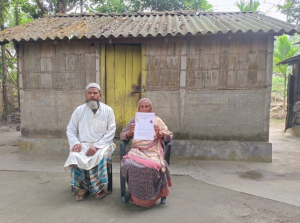
Sakina Bibi sitting with her husband, outside their home in Assam; holding up the FT Order
A police notice that turned an ordinary life upside down
Sakina was born on July 1, 1971, in Malipara village under Tarabari Police Station in the erstwhile Barpeta district of Assam. Her parents were Gafur Ali and Rahaton Nessa, and her paternal grandfather was Chelimuddin, also referred to as Chelim. She grew up in Malipara before marrying Nur Islam, son of Monser Ali, a resident of Shernagar village under Agomani Police Station in Dhubri district.
The couple has five children, three sons and two daughters. Nur Islam works as a daily-wage labourer and occasionally travels to different parts of the state in search of employment to support the family. Their modest means have always made it difficult to meet even ordinary household expenses. For this family, however, the greatest uncertainty arrived in the form of an official notice from the Border Branch of Agomani Police Station.
The notice alleged that Sakina had entered India illegally from Bangladesh on or after March 25, 1971, and required her to establish her nationality before the Foreigners Tribunal in Dhubri. The reference originated from Police Reference IM(DT) Case No. 5740/98, following which the matter was registered before the Tribunal as FT-9/120/GKJ/2019, State of Assam versus Sakina Bibi.
The allegation came as a devastating shock. Neither Sakina nor her husband had the educational background or financial means to understand the complexities of citizenship proceedings. They were unfamiliar with the legal requirements, the documentary standards expected by the Tribunal and the administrative procedures involved in obtaining old government records.
Sakina had spent most of her life in and around her village. Her husband, meanwhile, was frequently away seeking work. The prospect of having to travel between government offices, retrieve decades-old documents and defend herself before a judicial forum was overwhelming.
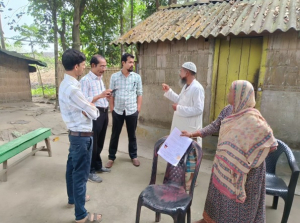
It was in 2022, when the CJP team organised a meeting in Agomani, that Sakina and her husband came into contact with the organisation. The distress of the couple was immediately apparent. Nur Islam was holding the police notice, struggling to understand what it meant for his family, while Sakina sat quietly behind her veil, listening to the conversation. Like countless families facing similar proceedings, they needed more than an explanation of the notice. They needed sustained assistance to navigate the legal system and establish the documentary history of their family.
Reconstructing a family’s history through decades of records
CJP Assam Team with Sakina Bibi and her husband outside their home in Assam
The first task undertaken with the CJP team’s assistance was to examine the documents available with Sakina’s family. The objective was to establish her parental lineage, trace her father’s presence in Assam and demonstrate the continuity of her family’s residence through official records. What emerged was a substantial documentary history.
Sakina’s family possessed records relating to ancestral landholdings, land settlement and revenue payments, some of which predated India’s Independence. Her father’s name, Gafur Ali, was also recorded in the National Register of Citizens (NRC) of 1951 at village Chengelidia under Tarabari Police Station in the then Barpeta district, Assam, under Legacy Data Code 120-0037-7809.
The family’s documentary trail extended even further back. An Annual Kheraj Patta relating to land at Chengelidia, issued by the Deputy Commissioner/Settlement Officer on September 4, 1933, recorded an ancestral connection to the land. Another land patta, issued on October 30, 1948, provided further evidence of the family’s historical presence. Subsequent land settlement records, pattas and revenue payment receipts continued to document the family’s relationship with the land over the years. These records were particularly significant because the family’s history was not confined to a single village or district.
Sakina’s father, Gafur Ali, her paternal grandfather, Chelimuddin, and other family members had lived in Chengelidia. However, repeated changes in the course of the Brahmaputra and the resulting riverbank erosion forced the family to relocate to neighbouring Malipara, within the same broader area of Barpeta district.
The relocation was not a matter of choice. The erosion of their dwelling and the loss of their original place of residence compelled the family to move. Yet, despite this displacement, the family’s connection with Assam continued, and important records of their landholdings and residence were preserved. The Tribunal’s order subsequently took note of this history. It referred to the evidence that the family had shifted from Chengelidia to Malipara after the Brahmaputra eroded their dwelling, and considered the documentary and oral evidence establishing the continuity of the family’s presence in the state.
The records were not limited to land documents. Electoral rolls provided another important link in tracing the family’s history. The names of Sakina’s family members appeared in electoral records dating back to 1966 and 1970 under the 54 Chenga Legislative Assembly Constituency. Her father’s presence in the electoral records, along with that of other family members, helped establish the family’s longstanding association with the area. Subsequent electoral rolls of 1997 and 2005 recorded her brother Sarbesh Ali and other family members at Malipara under the 47 Chenga Legislative Assembly Constituency.
Following her marriage, Sakina moved to Shernagar in Dhubri district. Her name was subsequently enrolled in the electoral rolls under the 25 Golakganj Legislative Assembly Constituency. The 1997 and 2005 electoral records, together with her Electoral Photo Identity Card (EPIC), demonstrated that she had continued to exercise her voting rights in her matrimonial village.
Taken together, the records helped establish two important aspects of Sakina’s case: her parental family’s longstanding presence in Assam and her own subsequent residence and electoral registration in Dhubri following marriage.
Retrieving old records: A battle beyond the courtroom
Having documents in one’s possession, however, is not the same as being able to establish their evidentiary value before a Foreigners Tribunal. The family’s records were scattered across different administrative offices in Barpeta and Dhubri. Some required certified copies, while others had to be verified against the original government records maintained by the relevant departments. Electoral records had to be traced through the concerned election authorities, and old land records required coordination with revenue and settlement offices.
This meant approaching multiple government departments, making repeated applications and following up with officials to ensure that the documents could be properly authenticated and produced during the proceedings.
For Sakina and her family, every such exercise involved considerable hardship. Their livelihood depended largely on daily-wage work. Travelling between Barpeta and Dhubri meant additional expenses and the loss of working days, placing an already financially vulnerable family under further pressure.
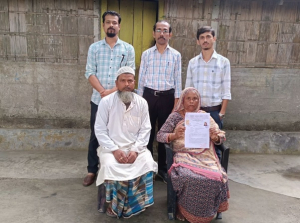
CJP Assam Team with Sakina Bibi and her husband outside their home in Assam
CJP’s volunteers in Barpeta assisted the family in navigating the concerned government offices and obtaining the necessary documents. The team in Dhubri also extended assistance in tracing and organising the records. Every available document was examined carefully to identify the connections between Sakina, her father and the earlier generations of her family.
The work involved more than collecting papers. The documentary trail had to be arranged in a manner that demonstrated the relationship between the persons named in the records, the continuity of residence and the family’s historical presence in Assam. The family’s ancestral land records, revenue payment receipts, electoral rolls, NRC entry and other identity documents gradually came together to form the evidentiary foundation of Sakina’s defence.
Before the Foreigners Tribunal: Establishing parental linkage and ancestral presence
Sakina appeared before the Foreigners Tribunal No. 9, Dhubri, through her advocate. The proceedings were registered as FT-9/120/GKJ/2019. The original reference had been forwarded by the Superintendent of Police (Border), Dhubri, as IM(DT) Case No. 5740/98, raising doubts about her nationality and seeking a determination of whether she was an illegal migrant. The reference had initially been registered before Foreigners Tribunal No. 2, Dhubri, as Case No. 2317/GKJ/2009, before being transferred and renumbered following the constitution of additional Foreigners Tribunals.
In response to the notice, Sakina appeared before the Tribunal on October 1, 2022, along with her advocate and sought time to file her written statement. On December 21, 2022, she submitted her written statement, denying the allegations and asserting that she was an Indian citizen by birth, having been born in Malipara village in Barpeta district.
Her defence was supported by a substantial body of documentary and oral evidence. Sakina examined herself as Defence Witness 1 (DW-1) and produced 26 documents, marked as Exhibits A to Z, to establish her nationality and ancestral linkage. Her brother, Sarbesh Ali, was also examined as Defence Witness 2 (DW-2) to corroborate her account of their family history and establish her relationship with their father, Gafur Ali.
The documents included certified copies of electoral rolls from Chengelidia for 1966 and 1970, subsequent electoral records from Malipara for 1997 and 2005, ancestral land pattas, several land revenue payment receipts, electoral records from Shernagar, Sakina’s EPIC and PAN card, her brother’s EPIC and Aadhaar card, and a Panchayat certificate dated April 24, 2015. The evidentiary significance of these records lay not merely in their number but in the connections they established across generations.
The land records were particularly important. An Annual Kheraj Patta bearing Patta No. 58, relating to land measuring 15B-0K-10 Lecha at Chengelidia, had been issued on September 4, 1933. Another patta, bearing No. 143, related to land measuring 14B-3K-17 Lecha and was issued on October 30, 1948. Further land settlement records and revenue receipts documented the family’s continued dealings with the revenue authorities over the subsequent decades.
The Tribunal also considered evidence relating to the transfer and continuation of the family’s landholdings. A witness, Kaseruddin Ahmed (DW-4), was examined to verify the ancestral land records. His testimony, together with the relevant government records, supported the claim that the land had been held by members of Sakina’s family for generations.
A Circle Officer’s order dated June 27, 1993, was also placed before the Tribunal. It recorded the incorporation of the names of Jobbar Ali, Sattar Ali, Jafar Ali and Sarbesh Ali in place of Abdul Gafur following his death. The related Jamabandi and Chitha records further corroborated the family’s connection with the ancestral land. The Tribunal considered these records alongside the revenue payment receipts and found that they adequately substantiated the historical landholding and the family’s presence in Chengelidia.
The importance of oral testimony: Her brother corroborates the family history
One of the most significant aspects of Sakina’s defence was the testimony of her brother, Sarbesh Ali. He appeared before the Tribunal as DW-2 and was examined and cross-examined during the proceedings. His testimony established that Sakina was his younger sister, that she had been born in Malipara village under Tarabari Police Station in Barpeta district, and that their father was Gafur Ali. He also explained the family’s earlier residence in Chengelidia and the circumstances that forced them to relocate to Malipara following the erosion of their dwelling by the Brahmaputra.
Sarbesh Ali further testified that their father had regularly exercised his voting rights in Chengelidia and that he himself continued to vote in Malipara. He confirmed that Sakina had married Nur Islam of Shernagar village in Dhubri district and had continued to exercise her voting rights in her matrimonial village.
This testimony was crucial because it connected the historical records of the family to Sakina herself. The electoral rolls and land documents established the presence of her ancestors, while her brother’s deposition helped establish the parental relationship through which she traced her claim. The Tribunal specifically noted that the testimony of DW-2 remained unchallenged in any material respect. Despite cross-examination by the learned Assistant Government Pleader appearing for the State, the evidence could not be discredited.
The Tribunal held that the oral evidence of Sakina and her brother was reliable and that the parental linkage with Gafur Ali had been adequately established. It also considered the evidence of Dinesh Chandra Das, Secretary of the concerned Gram Panchayat, who appeared as DW-3 in connection with the Panchayat certificate. However, the Tribunal found that the issue register produced to substantiate the certificate did not establish its contents and, therefore, did not attach probative value to that certificate.
Importantly, the Tribunal did not allow this evidentiary limitation to undermine the other material placed on record. It found that the parental linkage had independently been established through the consistent oral testimonies of DW-1 and DW-2, supported by the land and electoral records.
What the Foreigners Tribunal found: Records dating back to 1933 establish the family’s presence in Assam
In its order dated April 29, 2026, Member Kirti Kamal Das of Foreigners Tribunal No. 9, Dhubri, examined the documentary and oral evidence to determine whether Sakina was an Indian citizen or a foreigner within the meaning of Section 2(a) of the Foreigners Act, 1946.
The Tribunal considered the question of parental linkage central to the determination. It found that Sakina had successfully established her relationship with Gafur Ali through cogent and admissible evidence, particularly the testimony of her brother, Sarbesh Ali.
The Tribunal also examined the ancestral land records and found that Gafur Ali’s family history in Assam could be traced to a period preceding 1933. The 1933 land patta, the subsequent settlement records, revenue receipts and the testimony of the witness who verified the land documents collectively supported this conclusion.
The electoral records provided further corroboration. The certified voter lists from 1966 and 1970 established that Sakina’s parents and other ancestors had been residing in Chengelidia and exercising their voting rights in Assam under the then 54 Chenga Legislative Assembly Constituency. The subsequent electoral rolls from 1997 and 2005 established the continued presence of her brother and other family members in Malipara. The Tribunal also considered the records showing Sakina’s registration as a voter in Shernagar following her marriage.
It observed that the records demonstrated her parents’ regular participation in elections in Chengelidia and her own registration as a voter in her matrimonial village. Verification reports received from the respective Election Offices in Dhubri and Barpeta did not disclose anything adverse concerning the electoral records.
On an overall consideration of the evidence, the Tribunal concluded that Gafur Ali’s presence in India could be safely traced to a period preceding 1933. It further held that the evidence established that he was an original inhabitant of Assam and had not illegally entered India, as alleged by the State. The Tribunal also made an important observation about the evidentiary quality of the documents produced by Sakina. It found them reliable, trustworthy and acceptable, noting that they had been issued by the appropriate authorities and possessed adequate evidentiary value.
The legal question before the Tribunal also involved the burden of proof under Section 9 of the Foreigners Act, 1946. The provision places the burden of proving that a person is not a foreigner on the person against whom the question arises. Accordingly, Sakina had to discharge this burden through the evidence produced in her defence. The Tribunal found that she had done so. It observed that Sakina had successfully established her parental linkage with Gafur Ali through cogent and admissible evidence. Since her father’s existence and ancestral presence in Assam had been established through records dating back to 1933, the allegation that her family had illegally entered India after March 25, 1971, could not be sustained.
In its concluding findings, the Tribunal held that Sakina had discharged the burden placed upon her under Section 9 of the Foreigners Act, 1946, and that she could not be declared a foreigner under any of the streams recognised under the law. The reference was accordingly answered in the negative.
The operative conclusion of the order was unambiguous: Sakina Bibi was not a foreigner or illegal migrant of any stream.
The judgment reaches home: A moment of relief after years of uncertainty
For Sakina, the favourable order marked the end of a long and exhausting legal battle. But the family still had to receive the judgment copy that formally recorded the outcome of the proceedings. On November 16, 2026, representatives of Citizens for Justice and Peace visited Sakina’s home in Shernagar village to hand over a copy of the Tribunal’s judgment. The CJP team included Assam State Incharge Nanda Ghosh, community volunteer Illias Sarkar (Rabbi), legal team member Ishkender Azad and office car driver Ashikul Hussain.
The moment was filled with emotion. As Sakina and her husband received the judgment copy, the years of anxiety, uncertainty and struggle gave way to immense relief and happiness. For a family that had spent years trying to establish a fact that had always been part of its lived history, holding the order in their hands was deeply meaningful. The family also expressed its gratitude towards CJP and everyone who had stood by them throughout the proceedings.
The legal battle had demanded persistence at every stage: identifying the relevant records, travelling between districts, approaching government offices, obtaining certified documents, establishing ancestral relationships and presenting the evidence before the Tribunal. It was a collective effort involving Sakina, her family, CJP’s volunteers and the legal team.
Beyond one favourable order: The human cost of proving citizenship
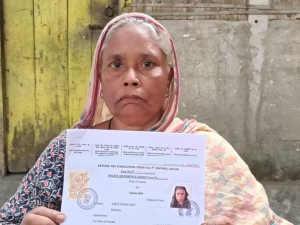
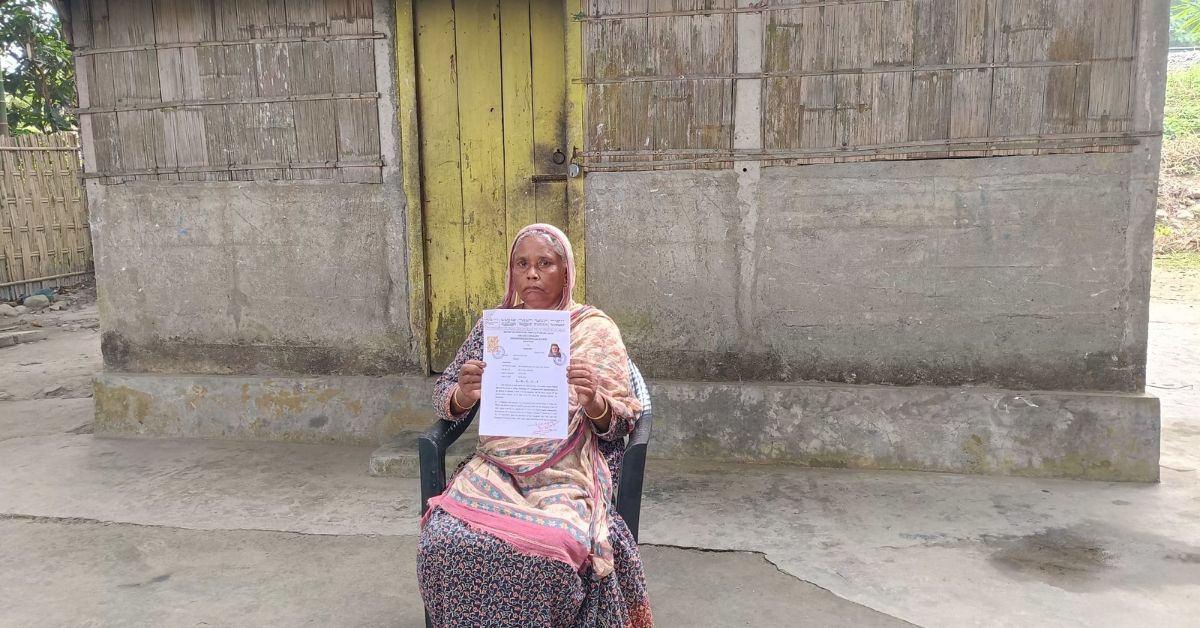
This is Sakina Bibi
Sakina’s case is not simply a story of a favourable Foreigners Tribunal order. It also draws attention to the enormous personal and administrative burden imposed on individuals who are required to establish their citizenship through documentary evidence.
Her family possessed records that could trace their history in Assam to 1933. There were land settlement documents, revenue payment receipts, electoral records, an NRC entry and oral testimony establishing the relationship between generations of the family. Yet, the existence of these records did not spare Sakina from being subjected to years of legal proceedings.
The case also demonstrates how displacement caused by natural processes such as riverbank erosion can complicate the documentary histories of ordinary families. Sakina’s family had moved from Chengelidia to Malipara because the Brahmaputra had eroded their dwelling. Their relocation did not sever their connection with Assam, but establishing that continuity before the Tribunal required painstaking reconstruction of their family history.
For families dependent on daily-wage employment, the demand to repeatedly travel between districts, approach government departments and retrieve decades-old records carries a substantial financial and physical cost. The difficulties are compounded when those facing proceedings have limited education and little familiarity with legal institutions.
The Tribunal’s findings in Sakina’s case also underline the importance of considering documentary evidence alongside oral testimony. Her brother’s deposition was not incidental. It helped establish the parental relationship connecting Sakina to the historical land and electoral records. The Tribunal assessed this testimony together with the documentary material and found that the State had been unable to discredit the evidence. Ultimately, the order recognised what the family’s records and testimony had consistently demonstrated: Sakina’s father and ancestors had deep and longstanding roots in Assam, and her own claim through that lineage was established.
For Sakina Bibi, the struggle was about much more than a legal classification. It was about the right to live without the constant threat of being treated as an outsider in the place she had always called home. Her story is a reminder that behind every reference before a Foreigners Tribunal is an individual, a family and often generations of history. The process of determining citizenship must recognise the human lives involved, the practical barriers they face and the consequences that prolonged uncertainty can have on their dignity and security.
Sakina did not acquire a new identity through the Tribunal’s order. She fought to have her existing identity recognised.
And when the judgment copy finally reached her home on November 16, 2026, it carried the outcome of years of perseverance: a formal recognition that she was not the foreigner she had been accused of being, but a woman whose family’s presence in Assam could be traced through generations of records.
The complete order may be read below:
Related:
CJP flags gaps in Maharashtra UCC consultation, submits recommendations for a gender-just civil code
Assam NRC: Neither rejection slips for the excluded nor identity cards for those included
When Belonging Must Be Proved: Assam’s Kashem Ali wins long citizenship battle
CJP helps secure Ajabha Khatun’s release after 772 days in Assam’s Matia detention camp