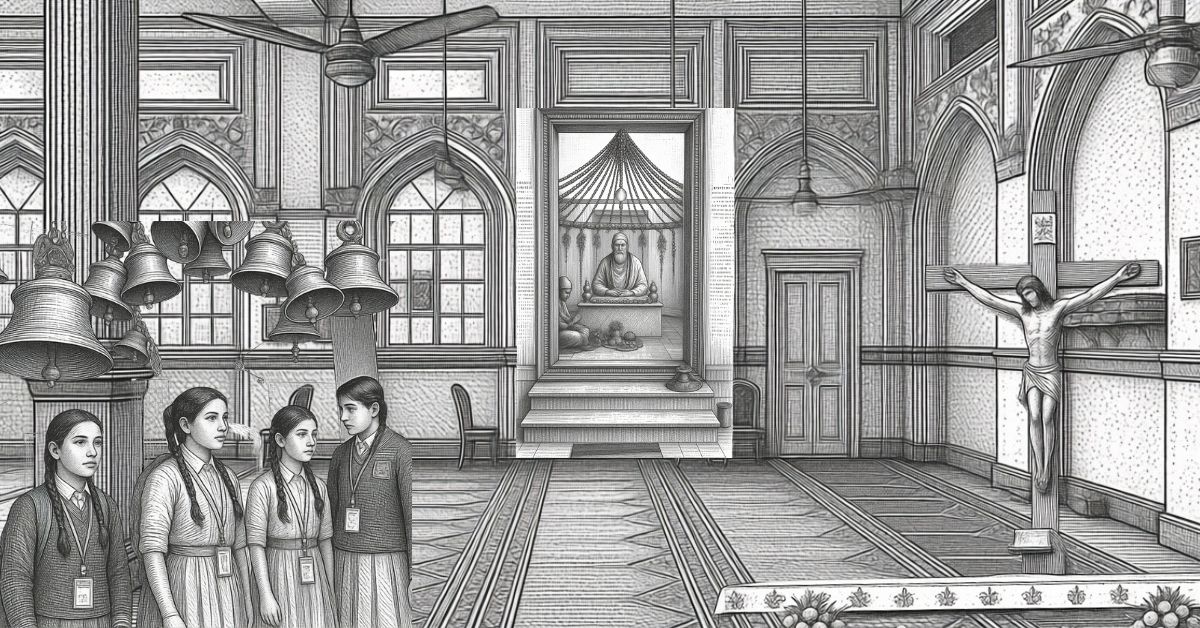
Khoj students in Varanasi engage in activities to challenge prejudice Interfaith visits, games and classroom discussions to challenge learned prejudices the Khoj way
22, May 2026 | CJP Team
Khoj Students Tour Temples, Mosque and Church
Fifty-three students from two schools in Varanasi—one predominantly Hindu and the other predominantly Muslim—visited various religious sites across the city on February 10, 2026.
In Varanasi, also known as Kashi—a city regarded as the spiritual centre of the Hindu, Buddhist, and Jain faiths and home to many Christians and Muslims—students from grades 7 and 8 at Harsh Inter College and United Public School toured the Ravidas Temple, Nadesar Jama Masjid, St Mary’s Cathedral, Shooltankeshwar Temple, and the Kiran Society, a disability care and training centre.
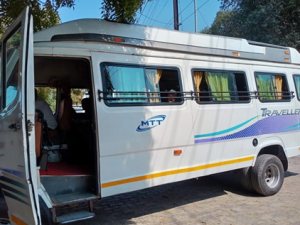
This unique and explorative journey imbues respect for difference and a genuine appreciation of diversity. The trip, organised by the Citizens for Justice and Peace under their Khoj programme, strives to foster communal harmony and constitutional values of brotherhood among young people. Khoj has been carrying out similar such visits in different locales, cities and states since 1998.
Among the 53 students on the trip, girls outnumbered boys, with 33 girls and 20 boys participating. The students were also accompanied by four teachers and two principals from their respective schools, alongside four CJP staff members.
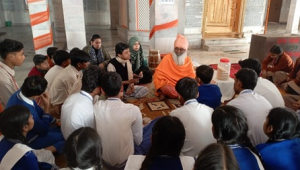
At each place of worship, students talked directly with religious leaders who addressed questions on faith, equality, and coexistence.
This approach and methodology is unique to the Khoj pedagogy that is centred on the emotive and cognitive world of the young, at every stage seeking to give them agency. The ability to query and dialogue on issues of complexity and concern is a quality nurtured and encouraged in all Khoj’s modular interventions.
A detailed understanding of Khoj’s four decade old journey can be gleaned here, here and here.
The students first visited the Ravidas Temple, where Mahant Sant Bablu Maharaj spoke about the 15th-century Bhakti saint’s opposition to caste discrimination, telling the students “love and humanity are the true form of God”. [1]
This temple is located at the iconic Raj Ghat in Varanasi and continues to attract hundreds of visitors each year. Varanasi also hosts another temple that marks the birthplace of this revered reformer saint (Sir Gobardhan, Varanasi) that is also an important cultural-historical site for Dalits, Ravidasis, Adidarmis and Ramdasia Sikhs.
The students listened keenly as Mahant Sant Bablu Maharaj recounted how Sant Ravidas, born into a family of cobblers, was once barred from entering a temple by a priest who insisted that those of the Shudra caste could not cross its threshold.
The Mahant told the children that Sant Ravidas challenged this directly, saying, “Pandit ji, God created all of us as one. It is humans who divided religion in the world after coming here, so how can you stop us from entering the temple?”
One student was moved to ask the Mahant the meaning of what he meant when he said, “If the mind is pure, then the Ganga is in your bowl.” The Mahant explained that this means if one’s heart is clean and pure, God is present everywhere, and one receives the same spiritual benefit as bathing in the Ganga without having to leave home — that purity of mind, above all else, is what truly matters.
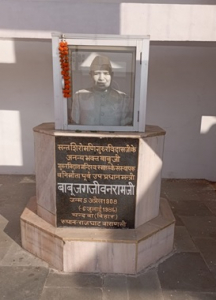
The temple at Raj Ghat where the Khoj team visited is built in white marble by former Deputy Prime Minister Babu Jagjivan Ram and visibly displays symbols of Hinduism, Islam, Sikhism, Christianity, and Buddhism on its dome.
A Class 7 student at Harsh Inter College, was particularly struck by this and showed appreciation for the gesture made on the roof of the Ravidas Temple.
Furthermore, this temple is also a reminder of spaces created by pioneers who broke away from the shackles of caste inequity to speak of equity and dignity for all.
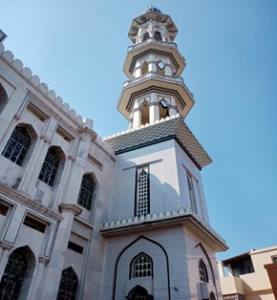
Next stop in this unique Khoj trip was the iconic Nadesar Jama Masjid with its awe-inspiring 90 feet tall minaret, where Mufti Banaras Abdul Batin Nomani answered questions from students about religious hatred and other contemporary issues prevalent in today’s society.
Shahar Mufti Nomani is an enlightened religious scholar who has engaged in peace building between communities and actively spoke for reason and calm during any moments of intra-community conflict.
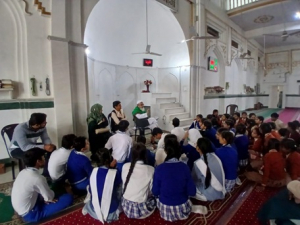
Speaking on inter-religious harmony to his young visitors, the Mufti told them that certain political groups deliberately manufacture communal conflict for their own gain and that no religion teaches hatred. To illustrate this, he cited a saying of the Prophet Mohammed, “If you show mercy to those who are on the earth, He who is in heaven will show mercy to you”.
He also explained that “those who are on the earth” is a term that means all of humanity, which includes people of every faith and further extends to animals as well. If God has commanded mercy toward all living beings, who are we to cause suffering to anyone?” he thoughtfully asked the children.
The children had no shortage of questions for Mufti Nomani. A Class 7 student from United Public School asked why idols are worshipped in temples but not in mosques. The Mufti patiently explained that every religion has its own way of worship — just as namaz cannot be performed in a temple and puja cannot be done in a church, idol worship is not part of mosque practice. In Islam, Allah is understood to be formless and without shape, and so there is no idol to worship.
Another student from United Public School asked why girls are not allowed to offer namaz in the mosque. The Mufti clarified that this is not a religious prohibition — women can and do pray in mosques, including in Mecca and Medina during Hajj, where men and women pray together. Where women are advised to pray at home in India, he said, it is out of concern for their safety, not because religion or a worldly rule forbids their presence in a mosque.
Perhaps the most searching question came from a Class 7 student from Harsh Inter College, who asked: “There is so much hatred in our country because of religion. If religion did not exist, there would be no conflict. Why is religion there?” The Mufti replied that religion is as necessary to human beings as food, sleep, and rest — it teaches people how to distinguish right from wrong and how to connect with God.
The Khoj programme, headed by Dr. Muniza Khan also asked the children whether the country should be run by religion or the Constitution. While most children said the Constitution, one student suggested religion. The Mufti explained that when India’s Constitution was drafted, it was decided that the country would be governed not by religion but by a secular framework — one that gives every person the freedom to practise their own faith, without any religion being imposed on others.
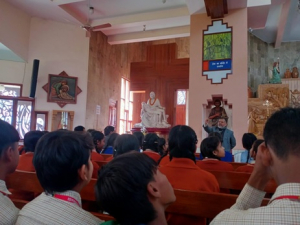
After this, the children stopped over at the historic St. Mary’s Cathedral, a 200-year-old church that still stands tall. Its unique architecture resembles that of a temple, and its walls carry verses from the Gita and the symbol of Om. The cathedral, originally built in 1854, has undergone many changes since then and now remains a symbol of Varanasi’s syncretic culture.
Here, Father Philip Dennis spoke about Jesus Christ’s message of repentance and universal love for one’s neighbour, regardless of caste or religion.
The Father told the children that Jesus Christ gave the message of repentance, love for God, and love for one’s neighbour. Jesus taught that a person should repent for their sins and love their neighbours as they love themselves. He further explained that “neighbour” here means anyone—regardless of religion or caste.
Most Christians worship Jesus as the Son of God. The birthday of Jesus is celebrated every year on 25 December, but today, what is needed is that we understand the teachings of Jesus Christ and act upon them, said the Father. After looking around at the Bible-based pictures and statues in the church, the children began asking questions, and the Father answered them with humour and stories.
A girl student asked him directly why women are not made priests in the church. Father Dennis acknowledged that the tradition arose from a belief that women were weak — a belief, he said, that has no place today. Women have proven themselves in every field and are no less capable than men in any regard, he told her.
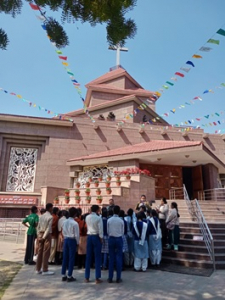
The Father then guided the children through the entire building, explaining the significance of its distinctive triangular structure and sharing the story of Jesus Christ — his teachings, his struggles, and why he was crucified.
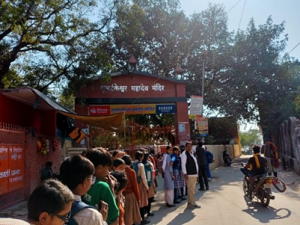
The next stop for the curious visitors was the ancient but practising Shooltankeshwar temple, 15 kilometres away from the city in the south, located at a spot where the Ganga enters Varanasi. Earlier known as the Madhaveshvar Mahadev temple after Rishi Madhav, priests recount how he had established this as a spot of worship to Lord Shiva.
For a Class 7 student, this was the most resonant stop of the day: “The place I liked the most was the temple of Lord Shiva in Madhopur, where I was taken to worship the god I believe in.” Even Mr. V. B. Singh, a teacher at Harsh Inter College who accompanied the group, found the visit deeply meaningful. “I am from Banaras and have travelled to many places,” he said, “but I had never been to Shooltankeshwar Temple before.”
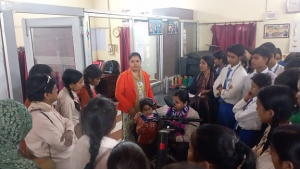
After visiting Shooltankeshwar Temple on the Ganga’s banks, students travelled to Kiran Society, where they saw how children and adults with disabilities receive treatment and engage themselves in farming and making decorative items and toys. An experience both students and teachers alike described as deeply inspiring.
The Kiran Society left a particularly strong impression on several students. A Class 7 student at Harsh Inter College, said that while the trip included many significant religious sites, the place where she learned the most was Kiran Society. “There were disabled children there who had made many kinds of drawings. That taught me that one should never give up — if you have skill, you have everything.”
Her classmate Rimjhim Gupta was equally moved, noting the care and cleanliness of the facility as a reminder that maintaining such standards is a form of respect in itself.
Mr. V. B. Singh echoed these sentiments: “We were taken to Kiran Center, where we saw how children who are not mentally healthy are treated and how they are made self-reliant through education and skill training.”
Principal Upendra Singh Yadav of Harsh Inter College was similarly touched: “At Kiran Center, children who do not have hands or legs are still living their lives — and I was also very impressed by the things made by the children there.”
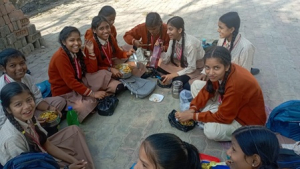
A defining moment of the day came when students from both schools sat together to eat lunch by the Ganga. The girls, in particular, were very enthusiastic throughout, singing on the bus, dancing, and running freely at open sites.
The Khoj field trip was eagerly awaited by students who found the trip and its exposure both engaging and challenging. While the timings for the pick-up and start of the trip was 7 a.m., some of the children had arrived as early as 6:30 a.m.! Students tell our Khoj teacher volunteers that when they are on trips with us, they not only enjoy themselves but also learn a lot.
A class 7 student, who admitted that unfamiliarity with churches and mosques meant she connected less immediately with those spaces, recognised the value of the exposure: “Educational trips like this should continue because they give us a lot of knowledge.” It is precisely this honest, evolving engagement — acknowledging both comfort and unfamiliarity — that makes the Khoj methodology so distinctive.
Speaking about the educational trip organised by the Khoj programme, another class 7 student from the United Public School, says, “I really enjoyed the trip and learned a lot. We went to temples, mosques, and churches, places we had never even heard about before. I also have Hindu friends. Whenever I felt like going to a temple, I used to think how I would go, what people would say, or whether someone would drive me away or say something. But on Khoj’s educational trip, we were taken to religious places of all faiths and were told about those religions. I also went to a temple. I learned a lot about the importance of all religions. Thank you, Khoj Classes.”
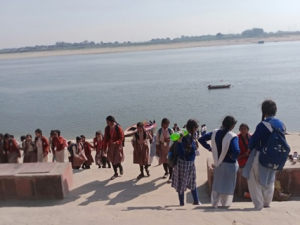
The spontaneous assessment by the principal of the Harsh Inter College, Upendra Singh Yadav, is encouraging. He said that in today’s atmosphere, such exposure to different faiths is very important.
Principal Yadav, noting that students from Harsh Inter College were on their third Khoj educational trip — having previously visited a Temple, Mosque, Gurdwara, Buddhist temple, Jain temple, Kabir Math, and Sarnath — remarked that visible change had accumulated over time.
“Children are now learning about each other’s religions and cultures,” he said. “Activities like these should continue so that the discrimination and anger that are growing among people today, especially around religion and caste, can be ended. Children should not develop a mind-set of fighting over religion and caste. Humanity should come first.”
This trip, organisers noted, represents a positive step towards fostering values of fraternity and communal harmony among the next generation.
Khoj innovations create learning through play: International Women’s Day
On the occasion of International Women’s Day, March 8, 2026, students at Ma Annapurna School participated in a gender sensitisation activity specially designed by the Khoj team, called “Erasing Gender Bias Through Play”.
The activity, a reimagined version of the traditional Snakes and Ladders board game, served the purpose of “teaching” children from Grades 5, 6, and 7 about equality, discrimination, and their constitutional rights.
The ladders on the board represent progressive values, whereas the snakes symbolise harmful gender stereotypes and discriminatory social practices.
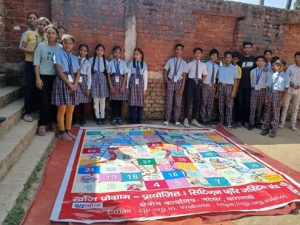
Landing on a ladder square results in the player reading out messages such as “Boys and girls can do all the work equally” or “Parents should help turn a daughter’s dreams into reality” among many others. This serves as an enabler and makes them climb upwards in the game.
Landing on a square with a snake, on the other hand, confronted players with regressive attitudes: “Why educate a girl? After all, the dowry will have to be paid for her anyway.” or “The son is the support in old age, while the daughter is our burden”: immediately, the player slides downwards.
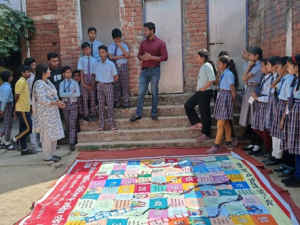
Each square on the board is meant to start conversations. Facilitators paused the game whenever a child landed on a significant square to hold open discussions about the statement, encouraging students to think critically about gender roles in their homes and communities.
Children were also informed about the constitutional guarantee of equal rights for all citizens and the gap between that guarantee and lived social reality.
The activity brought about honest responses from students. One child pointed out that girls aged seventeen or eighteen are often married off without their consent and that when these young women struggle with unfamiliar domestic demands at their in-laws’ homes, it creates issues between families.
Another student described how girls are routinely pulled away from their studies to complete household chores, only to be interrupted again when they return to their books, until their education quietly slips away and their ambitions go unrealised.
This exercise represents an effort to introduce gender awareness at an early age through using play as an entry point into conversations that are often considered difficult or taboo.
Annual Sports and Culture Event
Earlier this year in January, girls from Khoj were actively encouraged to participate in the annual sports festival and cultural programme, jointly hosted by Harsh Inter College and Dream India School, Konia.
The sports festival featured twelve events, ranging from traditional outdoor games such as Kabaddi, Kho-Kho, and Tug of War to indoor activities like Carrom and Chess. Children also competed in lighter, joyful events including Musical Chair, Balloon Race, Wooden Horse Race, and Jute Bag Race, ensuring participation across all age groups and abilities.
The annual cultural function saw CJP and Khoj staff organise three powerful acts, a play on Savitribai Phule, a short play promoting communal harmony, and a tribute to India’s freedom fighters.
The school added several other performances, including plays on Hindu-Muslim unity, girl’s education, Shrawan Kumar, Krishna-Sudama, and Jhansi ki Rani, alongside patriotic songs and a variety of dances.
This event brought together large crowds of enthusiastic parents and students. For Khoj, this event served as a platform to push for an inclusive participation in both athletics and the arts.
Student Feedback: It matters what the young think about Khoj
Khoj is not about completing a syllabus. Its engagement also requires conversations with stakeholders, the children, teachers and school management on the sessions held or completed.
This year, a staff meeting that took place during the last few weeks of April 2026 revealed tangible differences made by Khoj classes in the perception of children towards religion, caste and human equality.
Harsh Inter College teacher Mr. V. B. Singh says that Khoj Class is a very good initiative to bring change in children and end discrimination. It has been running for quite some time at Harsh Inter College. We are also seeing changes in the children.
Students expressed views on subjects and topics that they did not engage with before Khoj intervened; they articulated thoughts on social discrimination that go well beyond their standard school curriculum.
Teachers shared that children who not long ago identified simply the terms “Hindu” and “Muslim” with religions have been introduced to the concepts of Christianity, Sikhism, and Buddhism as well.
It has been especially evident among the 6th and 7th grade students, who have started to critically analyse the issues of discrimination towards different castes and religions as well as gender-based discrimination. Some children, after three years in the programme, now assert that humanity matters more than religious identity.
United Public School class 7 student Faizan says that we have learnt a lot from Khoj Classes, and a lot has changed within us. For example, the hatred that used to exist about religion and colour is no longer there. Earlier we used to think, “He is not from our religion, so why should we talk to him?” or “Why should we sit next to him?” But since Khoj Classes started, we have learnt many things, including that humanity is the biggest religion and that all religions are good. Religion comes later, but humanity comes first.
One of the students mentioned that the classes taught them to reject religious intolerance, including caste-based discrimination within Hindu communities, such as that directed at groups that find themselves in the lower ranks of the caste hierarchy.
While another reflected that religious conflicts among Hindus, Muslims, Sikhs, and Christians could be resolved if people chose to prioritise humanity over religious identity, even temporarily.
A third student stated that all human blood is the same and that judging people by religion or caste is fundamentally wrong.
Beyond values, students also talked about the programme’s unconventional teaching methods. They remarked that Khoj introduced them to games they had never encountered before and had never imagined existing. These games served as an important method in teaching students about coexistence and conduct.
Several students expressed that the three-year period during which they have been learning with Khoj has provided them with knowledge about various issues that they would likely not have encountered otherwise.
The discussion made clear the programme’s growing impact not only as a rare educational space where children are free to question and challenge learned social prejudices but also as one where they can build a vocabulary to spot and then, reject discrimination in their communities.
(The programme research team of CJP also consists of interns; this resource has been worked on by Ishan Bhatnagar)
[1] Ravidas was born in 1433 at Varanasi, Uttar Pradesh in a Dalit (Chamar caste) family and travelled around preaching the values of humanity across India. He openly denounced all the Brahmanical scriptures like Vedas, Puranas, Smritis, Upanishads as these promoted the hegemony of Brahmins and justified the social inequality and exploitation of the masses. He threw a challenge to Brahmins of his time by worshipping God despite being from the untouchable community, which wasn’t allowed to read/write, forget worshipping God. He saw a dream of “Begumpura” (city without sorrow) almost 500 years before Martin Luther King’s ‘I have a dream’!
Related:
Khoj: Educating Young Minds To Question The World Around Them
This Is How Khoj Educates Students About Justice And Equality