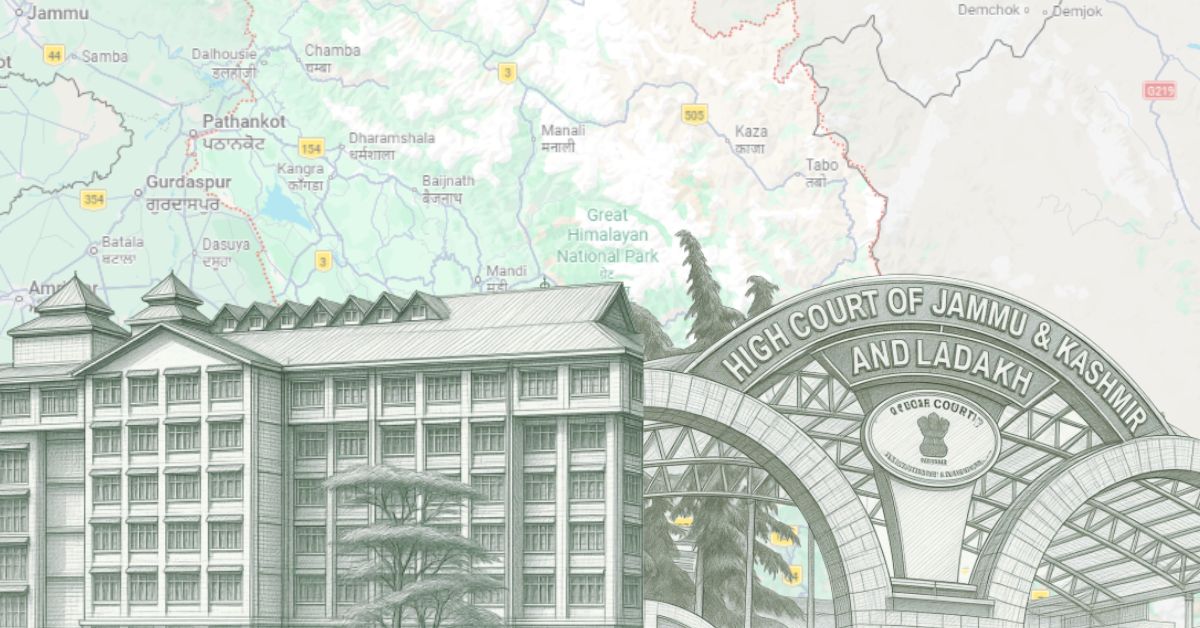
Himalayan Courts: New turns in environmental jurisprudence Part III examines how Himalayan High Courts have strengthened the language of environmental protection even as their rulings weaken ecological safeguards
22, May 2026 | A Legal Researcher
Part III of a Four-Part Series
The Himalayas hold the headwaters of the Ganga, Yamuna, Sutlej, Beas, Ravi and Chenab, sustaining vast populations downstream. But this is also a young, unstable and seismically active terrain. Glaciers such as Gangotri and Yamunotri are retreating, exposing loose moraine and weakening slopes. Cloudbursts, landslides and debris flows, as seen in Kedarnath in 2013, are therefore not isolated events but warnings from a fragile system. A small slope cutting, tunnel, or river diversion can disturb water channels; dry village springs, or trigger downstream flooding. Despite this, the region has seen rapid hydropower and infrastructure expansion, involving blasting, tunnelling, river diversion and construction across some of India’s most vulnerable mountain valleys.
These pressures have turned the Himalayan High Courts into something they were never designed to be: the last line of ecological defence. Litigants arrive with public interest petitions seeking to stop dams, protect panchayat authority over local resources, and enforce constitutional environmental rights. The question this study asks is not whether these courts occasionally issue protective orders. They do. The question is whether protection is the pattern or the exception. When ecological harm is demonstrated, do these courts hold the line? Or do they find ways to accommodate the project, the corporation, the state plan? By examining judgments the three High Courts — Uttarakhand, Himachal Pradesh, and Jammu & Kashmir, and Ladakh, the third part of a three-part series maps the architecture of environmental jurisprudence in the mountains and identifies where that architecture cracks under pressure.[1]
The Architecture of Eco-Centric Protection
The Uttarakhand Eco-Centric Doctrinal Expansion (2016-2018)
There are moments in judicial history when a court steps outside its accustomed vocabulary and speaks a different language. The Uttarakhand High Court between 2016 and 2018 was such a moment. The court produced a trilogy of rulings that received criticism for attempting to restate the environmental jurisprudence. They were attempts to reimagine the legal relationship between the state, the citizen, and the natural world. What makes them significant is not just what they held, but what they asked: if a river sustains life, should it not have standing in court?
In Mohd. Salim v. State of Uttarakhand (2017), the court confronted the familiar issue of municipal pollution and encroachment along the Ganga and Yamuna. What it produced was anything but familiar. A Division Bench of Justices Rajiv Sharma and Alok Singh declared these rivers, along with all their tributaries, streams, and torrents, to be legal persons and living entities. This was not metaphor. The Bench exercised its parens patriae jurisdiction to appoint the Director of the Namami Gange project, the Chief Secretary of Uttarakhand, and the Advocate General as guardians acting in loco parentis. The reasoning was stark: rivers breathe. They sustain communities from the glaciers to the sea. To treat them as property is to miss their essence. The court anchored this in Article 21, reading the right to life as extending to the life that the rivers themselves embody.[2]
Critics have called this approach radical. It was. The traditional legal model treats a river as a thing over which the state has sovereign control, the citizen has riparian rights, and the corporation has extraction permits. Each of these legal relationships assumes the river’s continued existence. None of them guarantees it. By making the river itself a rights-holder, the court inverted the burden of justification.
The doctrinal expansion continued in Lalit Miglani v. State of Uttarakhand (2017), where the same Bench extended legal personhood to the broader ecosystem. Gangotri and Yamunotri glaciers gained rights. So did the air, meadows, forests, wetlands, grasslands, springs, and waterfalls of the state. The court did not stop at declaration. It deployed continuing mandamus to direct twenty-one hydroelectric projects on the Ganga’s mainstream to install functional Sewage Treatment Plants within six months. It ordered the Comptroller and Auditor General to conduct a special financial and compliance audit of all centrally financed Ganga rejuvenation schemes, with the report to be placed directly before the President of India. These were not hortatory observations. They were operational commands backed by the contempt power of the court.[3]
In Narayan Dutt Bhatt v. Union of India (2018), the court extended legal personhood to the entire animal kingdom. Confronted with the cruelty of commercial horse-carts at the Indo-Nepal border, Justices Rajiv Sharma and Lokpal Singh held that the right to life under Article 21 protects all animals, avian and aquatic. Every citizen of Uttarakhand was declared a guardian in loco parentis. The implications were again, radical. For centuries, animals have been property under Indian law. The Prevention of Cruelty to Animals Act treats them as objects of human benevolence. This judgment treated them as subjects of rights. The shift from property to person is not merely semantic. It determines who bears the burden in court. A property owner can do what they please with their property, subject to regulation. A guardian must act in the best interests of the ward. The legal grammar changed from permission to duty.[4]
The Rishikesh White-Water Rafting Industry case (2018) demonstrated how this eco-centric framework operated in practice. Faced with water pollution, public intoxication, and unregulated adventure sports licensing along the Ganga, the court halted all rafting operations. The Bench explicitly subordinated the importance of regional tourism economy to the importance of ecological health of the river. Commercial activities could resume only when the state implemented a comprehensive, protective regulatory policy. This was the precautionary principle in its purest form: when the ecological stakes are high, activity stops first and proof of safety comes later. The court refused to let commerce continue while regulators deliberated.
The Uttarakhand High Court maintained structural oversight during ecological crises. The Forest Fires Suo Moto Line (2024-2026), initiated by Chief Justice G. Narendar and Justice Subhash Upadhyay, responded to recurring forest fires not with a single order but with sustained administrative reform. The court ordered the state to fill all long-standing vacancies in the Forest Department within six months. It mandated year-round environmental monitoring instead of seasonal tracking. It empowered gram panchayats by establishing village-level fire committees. These orders recognized that environmental protection is not a one-time judicial intervention. It is an ongoing institutional commitment. Forests do not burn because of a single cause. They burn because of cumulative neglect, which includes underfunded departments, absent personnel, and local communities excluded from management. The court addressed the root causes.[5]
The Himachal Pradesh Community-Centric Protective Model
The Himachal Pradesh High Court demonstrated its protective capacity long before the contemporary era. In General Public of Saproon Valley (1991), the court directed the state to constitute a scientific committee to assess the environmental impact of heavy vehicular traffic through the Solan district and required notification to all project-affected persons before issuing any mining licenses or tree-felling permits. This was three decades before environmental impact assessment became a statutory requirement. The court was operating from first principles: if a project alters the environment, those who live in that environment must know before, not after. The Saproon Valley order established a template that the court would return to repeatedly: protection begins with procedure, and procedure begins with the community.[6]
The Suo Moto Stone-Crusher PIL Line concerning Bathan and Thural (2019) draws from this community-centric model. Chief Justice Mohammed Rafiq and Justice Sandeep Sharma converted letters from rural residents into public interest litigation. The Neugal River was being destroyed by illegal stone-crushing operations that caused severe slope instability and riverbed erosion. The court’s intervention was swift and targeted. It protected the authority of Gram Panchayat issued No-Objection Certificates against administrative coercion by state industry departments. It enforced strict compliance from the State Pollution Control Board. The precautionary principle was applied at the licensing stage, preventing industrial operations from creating an environmental fait accompli. The court understood what many environmental judgments miss i.e., once a crusher is installed, once a riverbed is mined, once a slope is destabilized, the harm is done. Prevention is the only remedy that works in geographies that are as sensitive as the Himalayas.[7]
The Gram Panchayats Bhatanwali, Patalia and Behral v. Union of India (2026) extended this procedural protection to federal land-use planning. Local panchayats challenged an Eco-Sensitive Zone notification around the Col. Sherjung National Park in Simbalbara, Sirmaur district. The Ministry of Environment, Forest and Climate Change had omitted required field surveys, land-use inventories, and joint committee formation as mandated by its own 2011 guidelines. Justices Vivek Singh Thakur and Ranjan Sharma quashed the notification. The ruling was technically procedural, but its ecological impact was substantive. A poorly drawn notification that ignores ground realities is worse than no notification at all. It creates legal confusion, invites non-compliance, and discredits the entire regulatory regime. By enforcing proper procedure, the court protected not just the local panchayats but the integrity of the Eco-Sensitive Zone concept itself.[8]
Another PIL concerning illegal mining in Bageshwar district demonstrated that the Uttarakhand High Court could still act decisively when the harm was visible and immediate. The court took suo moto cognizance and directed the District Magistrate to personally verify illegal mining operations. It constituted a joint committee for ground-level inspection. These were not complex legal questions requiring nuanced balancing. They were straightforward violations of existing law that administrative agencies had failed to prevent. And the court acted swiftly.[9]
Jammu and Kashmir: Continuity in Wetland and Alpine Protection
The Jammu and Kashmir and Ladakh High Court has demonstrated continuity in its protective stance over environment. Its protective oversight of Dal Lake has spanned more than two decades, surviving the major constitutional reorganization of August 2019 and the transition from state to Union Territory. Successive Division Benches led by Chief Justices Pankaj Mithal, Arun Palli, and N. Kotiswar Singh have maintained seamless oversight of one of the most threatened urban water bodies in the world. When the Master Plan 2035 proposed reducing the 200-meter environmental exclusion zone around Dal Lake to a variable 20-to-100-meter limit, the court intervened directly. In September 2024, it ordered that no new permanent construction would be allowed within the original buffer zones. The warning was explicit: unregulated development could undo twenty years of conservation effort in a single construction season.[10]
This continuity extends to Wular Lake, where a dedicated litigation line ran from 2021 to 2024. The Wular Lake Conservation and Management Authority had proven ineffective. Illegal encroachments continued. Municipal garbage dumping persisted. Dredging operations moved at glacial speed. In August 2024, Justice Rajnesh Oswal rebuked the authority for failing to meet its objectives and wasting public funds. The court’s frustration was palpable. Public money had been provided by the central government specifically for lake restoration. The authority had absorbed it without producing results. The court’s intervention here was not about legal innovation. It was about institutional accountability. Environmental protection requires institutions that function. When they do not, the court must either reform them or replace their functions with its own oversight.[11]
The Ramsar Wetlands Suo Motu Line aggregated seven internationally recognized sites across Jammu and Kashmir and Ladakh, including Hokersar, Shalbugh, Haigam, Surinsar-Mansar, Tso Moriri, and Tso Kar. The court enforced the Wetland Conservation and Management Rules 2017, requiring both Union Territories to coordinate with the Ministry of Environment, Forest and Climate Change and technical bodies like IIT Roorkee for Integrated Management Plans. This was strategic environmental governance at scale. Rather than addressing each wetland individually, the court created a unified oversight framework. The Ramsar designation carries international legal obligations. The court ensured that these obligations would not remain paper commitments.[12]
The Sonamarg Construction Ban case (2017) represents the one of the most pro-active stances of the Court in environment protection. To shield the Thajiwas Glacier watershed and the Sindh River from tourism-induced degradation, the court banned all unapproved constructions within the Sonamarg Development Authority’s jurisdiction. It made the Chief Executive Officer personally liable under contempt law for any fresh unauthorized structures. It ordered a scientific status report directly from the Earth Sciences Department at the University of Kashmir, bypassing standard bureaucratic reporting. This treatment of scientific data as a firm ceiling for development is the antithesis of the balancing approach. Science was not one factor among many. It was the limiting factor. In early 2025, the court reinforced this stance by taking suo moto cognisance of environmental violations in the Gulmarg-Sonamarg road-widening project, converting a newspaper report into PIL and demanding a personal response from the Development Authority’s CEO.[13]
Structural Cracks and Infrastructure Deference
The Himachal Pradesh Cascade: Hydropower, Mining, and Urban Deregulation
The judgments discussed earlier did protect forests, rivers, lakes, and local communities. However, they are not the usual pattern. In many Himalayan cases, courts speak about balance, development, procedure, and jurisdiction. The language sounds neutral. However, the result often weakens environmental protection.
A clear example is State of Himachal Pradesh v. Yogendra Mohan Sengupta (2024). The NGT had imposed strict limits on height and construction in the Shimla Planning Area. These limits were based on real risks. Shimla sits on fragile slopes. It faces landslides, cloudbursts, and earthquakes. The 2023 monsoon had already shown how dangerous this could be, with major loss of life and damage across Himachal Pradesh.
The Supreme Court lifted those restrictions. It said development and environment had to be balanced. It also held that the NGT could not force the State to frame planning rules in a particular way. On paper, this looked like a technical administrative law issue. In reality, it shifted control back to the State’s planning authorities. These authorities are often more influenced by development pressure than ecological limits.
The Court also distinguished Godavarman, a major forest protection case. This mattered. Instead of treating environmental protection as a strong constitutional duty, the Court treated it as one factor to be balanced against construction. That is the problem. Slopes do not become safer because a plan allows more buildings. Every extra floor adds weight. Every new building adds pressure on water, sewage, drainage, and roads. When the land gives way, the damage is not theoretical. It is physical and often deadly.
A similar problem appears in N.H.P.C. Ltd. v. State of Himachal Pradesh (2024). There, the Himachal Pradesh High Court struck down the State’s water cess on hydropower electricity generation. The Court held that the State did not have the constitutional power to impose such a tax, because electricity generation falls within the Centre’s field. It also ordered refund of the amounts collected.
The reasoning was legal and technical. However, the environmental background was left mostly unaddressed. Himachal’s rivers, including the Sutlej, Beas, Ravi, and Chenab systems, are heavily used for hydropower. These projects divert rivers, tunnel through mountains, change natural flows, and affect downstream communities. The cess was an attempt to make hydropower developers pay at least something for the ecological cost of their projects. By treating the issue mainly as a tax dispute, the Court missed the deeper environmental question. The ecological impact of thirty-plus hydropower projects on a single river basin was never examined. The court’s analysis focused on which level of government has the constitutional power to tax, not on whether the activity being taxed is destroying the resource base that both governments are constitutionally obligated to protect under Article 48A. The ruling thus achieved a double displacement: it removed the state’s financial tool for environmental regulation while legitimizing the fiction that hydropower development is merely an electricity-generation activity rather than a mountain-transforming, river-altering, ecology-disrupting industrial enterprise.
The Alaknanda Hydro Power litigation in Uttarakhand follows an identical pattern. The case centred on environmental clearance for hydroelectric projects on the Alaknanda river system, a major Ganga tributary. The court’s engagement was confined to procedural compliance with environmental impact assessment norms rather than substantive evaluation of cumulative basin-wide impacts. This is the central flaw of environmental litigation in the hydropower sector. Each project is assessed individually. The combined effect of multiple tunnels, multiple diversions, multiple blasting operations on a single geological system is never judicially examined. Environmental scientists have documented the cumulative impact extensively: altered sediment transport, dewatered river reaches, increased seismic stress from reservoir loading, slope destabilization from tunnelling. However, courts continue to treat each project as an isolated legal entity, as if rivers were divisible into segments that can be dammed one at a time without systemic consequence.[14]
In Jammu and Kashmir and Ladakh, the modification of the Sonamarg Construction Ban in June 2024 reveals how even the strongest protective orders can be eroded through incremental exception. The original 2017 ban, issued to protect the Thajiwas Glacier watershed and the Sindh River, was clear: no new construction within the Sonamarg Development Authority’s jurisdiction. The 2024 order, issued by Chief Justice N. Kotiswar Singh and Justice Moksha Khajuria Kazmi, created an exception for the Amarnath Yatra. Temporary structures would be permitted within the protected eco-sensitive zones to accommodate pilgrims. The court attached conditions: the structures must be dismantled after the pilgrimage, the land restored. However, the creation of an annual exception to an ecological carrying capacity is not a minor adjustment. It is a precedent. Next year the structures may be larger. The following year, they may be semi-permanent. The glacier does not distinguish between temporary and permanent human pressure. Ice melts the same way regardless of the legal category of the structure above it.[15]
The Amarnath Yatra brings hundreds of thousands of pilgrims to a fragile high-altitude ecosystem. The waste generated, the water extracted, the vegetation trampled, the slopes compacted, all exceed the area’s natural absorption capacity. The court’s accommodation of this pressure is often framed in terms of religious freedom and public convenience. However, rights are not absolute when they destroy the resource base that makes them possible. The right to pilgrimage assumes the continued existence of the pilgrimage site. If the glacier melts, if the meadows erode, if the river silts up, there is nothing left to pilgrimage. The 2024 Sonmarg modification, like the Char Dham highway expansion, treats environmental protection as an obstacle to be managed rather than a foundation to be preserved.
The Uttarakhand Retreat: From Personhood to Procedural Barrier
The Uttarakhand High Court’s trajectory from 2017 to 2026 traces the arc of environmental promise and judicial retreat more starkly. In 2017, it declared rivers to be legal persons. By 2023, it was dismissing local communities for lack of standing. The speed of this reversal is remarkable
The Mohd. Salim and Lalit Miglani judgments were stayed by the Supreme Court in 2017. The stays were procedural. The apex court did not reject the legal personhood doctrine on merits. It simply prevented implementation while the state government’s appeals were heard. However, procedural paralysis is often the most effective form of doctrinal killing. Seven years later, the Special Leave Petition in Lalit Miglani remains pending. The legal personhood of the Ganga, the Yamuna, the glaciers, the forests, exists on paper but not in practice. No guardian has ever filed a case on behalf of the river. No polluter has ever been held liable for violating a river’s rights. The anthropocentric legal system simply could not operationalize a non-anthropocentric legal concept. State authorities argued, predictably, that granting rights to nature created unmanageable liabilities. What they meant was that it would make their development projects more difficult to approve. The Supreme Court’s stay gave them exactly what they needed: time, during which the projects proceeded and the legal innovation fossilized.[16]
The procedural retreat became explicit in the Tapovan-Vishnugad PIL line following the Chamoli disaster of February 2021, which should have been a turning point. A glacier collapsed above the Rishi Ganga, triggering a debris flow that devastated the area and provided catastrophic physical evidence of hydropower vulnerability. Local residents from the villages of Raini and Joshimath filed public interest litigation seeking the cancellation of the Rishi Ganga and Tapovan-Vishnugad Hydro Projects and the ecological restoration of the affected watershed. However, in July 2021, rather than stopping construction until safety was proven, the Division Bench shifted the focus entirely from ecological risk to petitioner credibility. The court questioned the standing of the local villagers, scrutinized their identities as “social activists,” and characterized the PIL as a “highly motivated” petition filed by “puppets at the hand of an unknown puppeteer”. It dismissed their challenges and imposed financial costs of Rs. 10,000 on each petitioner.
The reasoning in this July 2021 order was purely procedural. The petitioners were found wanting in locus standi, and the court did not examine whether the Tapovan-Vishnugad project violated environmental norms or assess the scientific evidence regarding the future safety and stability of the disaster-prone terrain. It simply ruled that the wrong people had asked the right questions. This is proceduralism as environmental obstruction. When local communities, who are the first to feel the effects of ecological collapse, are denied standing to challenge the projects that cause it, the court removes the most direct form of democratic environmental accountability. It was not until January 2023—a year and a half later, when severe land subsidence had already made parts of Joshimath uninhabitable—that a different Division Bench finally intervened to grant an interim stay, providing the correct but delayed response that construction must halt when a town is sinking.
The Char Dham Pariyojana tells a similar story of procedural enablement of ecological destruction. The Uttarakhand High Court did not issue pre-construction stays. It allowed the project to proceed while litigation continued. By the time the case reached the Supreme Court as Citizens for Green Doon v. Union of India, the physical reality on the ground had changed. Tunnels had been bored. Blasting had occurred. Hundreds of kilometres of road had been cut into mountain faces. The Supreme Court’s December 2021 order, permitting a 10-meter wide double-lane paved shoulder design, was framed around strategic defence needs and national security. The court treated a 2018 Ministry of Road Transport and Highways circular, advising 5.5-meter limits for hilly terrain, as non-binding for strategic corridors. The environmental rule of law was noted, then balanced away. By June 2025, when citizens petitioned the Chief Justice of India for review following fresh disasters in the Bhagirathi eco-sensitive zone, the project’s financial outlays and physical progress had created an institutional fait accompli. The money was spent. The road was built. The review was rendered practically irrelevant by the sunk costs of ecological destruction.[17]
The Uttarakhand cases show a clear shift. Earlier, the Court took a more protective approach towards rivers, hydropower projects, and animal welfare. In the later cases, however, it was more willing to defer to development decisions, question the maintainability of local petitions, and treat environmental concerns within narrower legal limits. The change is therefore not only in outcomes, but also in the way the Court frames environmental disputes. It is a change in judicial imagination. The 2016-2018 court imagined a world where ecology governed law. The post-2020 court imagines a world where law governs ecology, and that governance takes the form of balancing, procedural filtering, and incremental accommodation of development.
The Commodification of Ecosystems: Compensatory Afforestation as a Readymade Panacea
The jurisprudence of accommodation does not solely rely on procedural dismissals or jurisdictional sidesteps; it fundamentally alters the conceptual premise of environmental conservation by embracing the commodification of nature. When high-value infrastructure projects—particularly national highways and linear corridors—collide with the protective mandates of forest conservation, the Himalayan High Courts frequently adopt the compensatory paradigm, treating complex, ancient ecosystems as fungible assets that can be mathematically replaced.
In Reenu Paul v. Union of India,[18] the Uttarakhand High Court assessed the ecological impact of infrastructure projects on forest land. Rather than demanding a rigorous, site-specific ecological appraisal or applying the precautionary principle to limit forest diversion, the Division Bench actively encouraged the State Government to identify “land banks” to serve as a repository for compensatory afforestation. The court commended this as a “proactive stance,” observing that a developer coming up with infrastructural development would have a “readymade solution in the form of the afforestation carried out in advance”. The court reasoned that providing developers with pre-packaged land banks ensures that the project’s cost can simply be borne at pre-fixed rates, enabling a “continuous cycle” of development where the state concurrently creates green cover.
This represents the ultimate crack in environmental jurisprudence. By celebrating a “readymade solution” for infrastructure developers, the court legally validated the myth of ecological interchangeability. A mature Himalayan forest—complete with its specific hydrological functions, soil stabilization capacities, and endemic biodiversity—is treated as functionally equivalent to a monoculture sapling plantation on a designated land bank. The language of environmental protection is retained (the court noted this ensures the “green cover is not impacted seriously”), but its application is entirely facilitative.
Sovereign Exceptionalism: National Security and the Eclipse of Community Commons
When the state invokes national security or acute public need, the ecological evidence test is routinely bypassed. The state’s assertion of necessity functions as a jurisdictional shield, neutralizing Supreme Court precedents designed to protect community ecology.
In Inhabitants of Village Dambra v. UT of J&K,[19] the Jammu and Kashmir High Court confronted the transfer of 148 Kanals and 1 Marla of Shamlat Deh (Mehfooz Kacharai) land—traditional village grazing commons containing forests and ponds—to the Prisons Department for the construction of a High-Security Prison. The villagers argued that destroying the grazing grounds and water bodies violated the Supreme Court’s stringent directives against alienating community commons, arguing the land required preservation.
The Division Bench dismissed the petition, insulating the project using the language of sovereign security. The court observed that the decision to establish such a prison was taken in view of the prevailing situation in Jammu and Kashmir, which is afflicted by terrorist activities abetted by inimical foreign forces. The court explicitly concluded that the construction of a high-security prison serves a public purpose and is “necessary for the security of the nation.” Crucially, the Supreme Court precedents demanding the strict protection of community ecology and grazing lands were not considered. The court ruled that these precedents “could not be invoked to come in the way of an important project required in public interest and for the security of the Nation”. Ecology was not balanced against security and it was rather entirely eclipsed by it.
A similar dilution occurs when the state voluntarily lowers its own environmental regulations to accelerate extraction. In Inhabitants of Sheva Shirshu Doda v. UT of J&K,[20] local villagers challenged the installation of a stone crusher and hot mix plant in an environmentally sensitive area. The government had promulgated S.O. 60 of 2021, a highly permissive framework that liberalized the mining regime and removed the need for a Mining Department license for stone crushers by redefining them not as mining units, but merely as “processors of minerals”. Faced with this executive rollback of environmental safeguards, the High Court did not invoke the doctrine of non-regression or the precautionary principle. Instead, the court deferred entirely to the state, citing the limited “scope of judicial review of government policy” and declaring that courts cannot act as appellate authorities over executive formulations. By framing the dispute as a matter of administrative policy rather than an ecological one, the court accommodated the industrial degradation of the mountain landscape.
Procedural Myopia: Weaponising Timelines and Standing to Shield Environmental Harm
The most effective judicial mechanism for accommodating ecological harm without directly contradicting environmental law is procedural dismissal. By focusing intensely on the petitioner’s locus standi, timelines, and procedural technicalities, courts successfully, avoid the burden of assessing complex environmental evidence.
The Jammu and Kashmir High Court’s handling of the Rinkoo Sharma v. Union of India[21] PILs exemplifies this procedural obstruction. Petitioners challenged the de-notification of the protected Trikuta Wildlife Sanctuary to allow for the extraction of high-grade magnesite and a mining project by the National Mineral Development Corporation (NMDC) near the Vaishno Devi Shrine. Rather than demanding a rigorous ecological assessment of mining in a highly fragile wildlife zone, the Division Bench interrogated the procedural posture of the petitions. The court noted that the environmental clearance was subject to the final orders of the Supreme Court, rendering the PILs “pre-mature.”
More significantly, the court weaponized procedural rules against the petitioners. It observed that the petitioners, who were advocates, had failed to comply with Rule 24 of the Writ Proceedings Rules, which mandated sending a prior representation to the concerned authorities before filing a PIL. Because this technical pre-requisite was not met, and because the petitioners failed to disclose the pendency of a related PIL, both petitions were dismissed at the threshold. The substantive reality—the irreversible ecological impact of mining in a protected Himalayan wildlife sanctuary—was entirely bypassed via procedural formalism.
The doctrine of delay and laches serves an identical shielding function. In Sumit Nayyar v. Shri Mata Vaishno Devi Shrine Board [22], an advocate filed a PIL challenging the construction of pilgrim infrastructure and mule-track developments by the Shrine Board. The court not only dismissed the petition on the grounds of an eight-year delay and laches, but it also aggressively questioned the bona fides of the petitioner. Citing Supreme Court jurisprudence on frivolous litigation, the court warned that public interest litigation filed by members of the legal profession without serious “home work and enquiry” should be dismissed with exemplary costs to prevent the abuse of the judicial process. By shifting the judicial gaze from the carrying capacity of the Trikuta hills to the conduct and timing of the petitioner, the court effectively insulated the continuous expansion of religious tourism infrastructure from environmental scrutiny.
Conclusion
The environmental jurisprudence of the Himalayan High Courts over the last decade reveals an unsettling paradox: the vocabulary of ecological protection has never been richer, yet the physical landscape has never been more legally vulnerable. The courts of Himachal Pradesh, Uttarakhand, and Jammu & Kashmir and Ladakh have masterfully preserved the text of environmental law while pronouncing judgements that blunt its teeth.
When confronted with the relentless march of state-backed mega-projects, cascade hydropower, and strategic corridors, the judiciary rarely mounts its attack on the basis of precautionary principle or the public trust doctrine. Instead, it engages in a sophisticated jurisprudence of accommodation. As this analysis demonstrates, systemic ecological crises are administratively sanitized, neutralized by the invocation of sovereign “national security” overrides, or deflected through hyper-technical applications of locus standi and laches. The courts do not need to explicitly reject environmental safeguards to permit ecological destruction; they simply change the legal subject.
Even when the courts do intervene, the nature of the intervention has decisively shifted from absolute prohibition to facilitative mitigation. Existential threats to glacial watersheds and fragile seismic zones are reduced to logistical challenges—solved by minor mitigation measures, or the transactional fiction of “readymade” compensatory afforestation banks. The strict legal boundary lines once drawn to protect nature are repeatedly erased and redrawn as mere pricing mechanisms or technical compliance hurdles. The state is permitted to lower the statutory bar, and the polluter is legally validated for successfully stepping over it.
In this accommodative framework, the Himalayas are no longer treated as a sacred public trust or an integrated living ecosystem holding intergenerational equity. They are legally framed as a challenging terrain to be engineered, compensated for, and ultimately conquered. The foundational tenets of Indian environmental law were designed as a hard ceiling against irreversible harm, but they have been retooled into a machinery of concession. Until the Himalayan courts stop subordinating substantive ecological survival to procedural formalism and administrative deference, the majestic peaks, rivers, and forests of the region will continue to be hollowed out, with legal sanction and with the judiciary watching on.
Note: The 3-part series is based on strong empirical standing. Part I dealt with substantive high court pronouncements coming from resource rich Central and Eastern India- Jharkhand, Chhattisgarh, Madhya Pradesh and Odisha. Part II (Western India) closely examined judgements emerging from the high courts of Bombay, Karnataka and Goa.
Part IV (Northern India) reflects on judgments from Delhi, Punjab & Haryana, Uttarakhand and Allahabad.
(The author is part of the legal research team of the organisation)
[1] This article forms Part III of a three-part series examining environmental jurisprudence in the Trans-Himalayan High Courts. Parts I and II Central India and Western India respectively.
[2] Mohd. Salim v. State of Uttarakhand, 2017 SCC OnLine Utt 367, Writ Petition (PIL) No. 126 of 2014, Uttarakhand High Court, judgment dated March 20, 2017.
[3] Lalit Miglani v. State of Uttarakhand, W.P. (PIL) No. 140 of 2015, Uttarakhand High Court, judgment dated March 30, 2017.
[4] Narayan Dutt Bhatt v. Union of India, 2018 SCC OnLine Utt 645, Writ Petition (PIL) No. 43 of 2014, Uttarakhand High Court, judgment dated July 4, 2018.
[5] In the Matter of Forest Area, Forest Health, and Wildlife Conservation (Forest Fires Suo Motu Line), W.P. (PIL) No. 174 of 2024, Uttarakhand High Court, orders dated December 31, 2025 and March 18, 2026.
[6] General Public of Saproon Valley and Ors. v. State of Himachal Pradesh, Civil Writ Petition No. 595 of 1991, Himachal Pradesh High Court, judgment dated April 24, 1991.
[7] Court on Its Own Motion v. State of Himachal Pradesh (Bathan, Thural Stone-Crusher Line), CWPIL No. 12 of 2019, Himachal Pradesh High Court.
[8] Gram Panchayats Bhatanwali, Patalia and Behral v. Union of India, Civil Writ Petition, Himachal Pradesh High Court, judgment dated April 16, 2026.
[9] In the Matter of Unauthorized Mining and Illegal Construction near Dwarahat (Bageshwar), W.P. (PIL) No. 35 of 2024, Uttarakhand High Court, order dated December 31, 2025.
[10] Syed Iqbal Tahir Geelani v. State of Jammu & Kashmir, PIL No. 27/2017 (formerly PIL No. 159/2002), Jammu and Kashmir and Ladakh High Court, order dated September 12, 2024.
[11] Kashmir Environmental Protection v. State of Jammu & Kashmir (Wular Lake Line), PIL No. 14 of 2021, Jammu and Kashmir and Ladakh High Court, order dated August 22, 2024.
[12] In Re Protection of Seven Ramsar Wetlands in Jammu, Kashmir and Ladakh, Suo Motu PIL No. 35 of 2018, Jammu and Kashmir and Ladakh High Court, order dated August 14, 2024.
[13] Court on Its Own Motion v. Sonamarg Development Authority, PIL No. 27/2017, Jammu and Kashmir High Court, construction ban baseline order dated October 23, 2017. See also Court on Its Own Motion v. UT of J&K & Ors., Suo Motu PIL No. 27/2017, Jammu and Kashmir and Ladakh High Court, order dated January 3, 2025.
[14] Alaknanda Hydro Power Co. Ltd. v. State of Uttarakhand & Others, Civil Writ Petition, Uttarakhand High Court.
[15] Court on Its Own Motion v. UT of J&K, PIL No. 27/2017, Jammu and Kashmir and Ladakh High Court, order dated June 24, 2024.
[16] The Supreme Court stay in Mohd. Salim was passed in Civil Appeal Diary No. 7699 of 2017. The Lalit Miglani SLP (Civil Appeal Diary No. 7906 of 2017) remains pending as of 2026.
[17] Citizens for Green Doon v. Union of India, W.P. (Civil) No. 1102 of 2018, Supreme Court of India, judgment dated December 14, 2021.
[18] Reenu Paul v. Union of India and Others, Writ Petition (PIL) No. 37 of 2025, (2025), High Court of Uttarakhand at Nainital
[19] Inhabitants of Village Dambra v. UT of J&K Th GAD and Ors., LPA No. 185/2023, (2023), High Court of Jammu & Kashmir and Ladakh at Jammu
[20] Inhabitants of Sheva Shirshu Doda v. UT of J&K and Others, WP (C) No. 639/2022, (2023), High Court of Jammu & Kashmir and Ladakh at Jammu
[21] Rinkoo Sharma v. Union of India, WP PIL No. 02/2012 and WP PIL No. 03/2012
[22] Sumit Nayyar v. Shri Mata Vaishno Devi Shrine Board and ors., WPPIL No. 14/2016, (2017), High Court of Jammu and Kashmir at Jammu.
Related:
Unending Adjudication: The Vanashakti reversal and environmental finality in India
Cracks in Environmental Jurisprudence: A study of central India’s High Courts
Cracks in Environmental Jurisprudence: The Bombay High Court’s shifting language