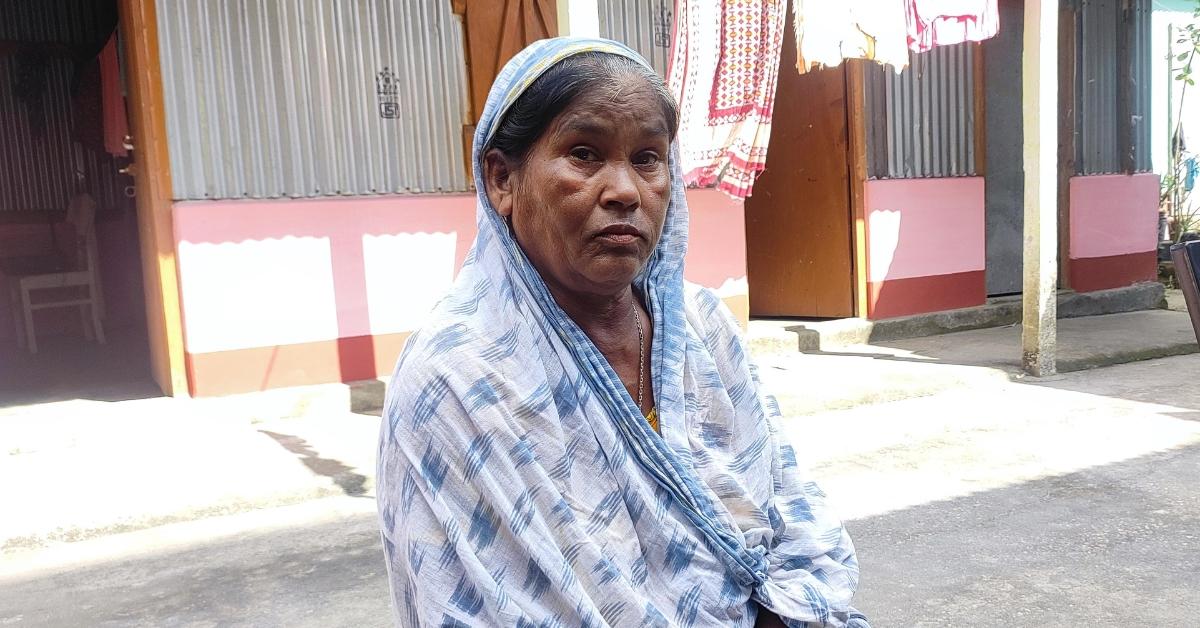
“All I Wanted Was Peace”: How 55-year-old widow Aklima Sarkar won back her citizenship Widowed, landless, and displaced, Aklima Sarkar fought three years to reclaim her citizenship in Assam
03, Dec 2025 | CJP Team
For three years, 55-year-old widow Aklima Sarkar lived in a state of quiet terror. A resident of Shernagar village in Assam’s Dhubri district — nearly 300 kilometres from Guwahati — she had already lost her home, her land, her husband, and every form of security to the forces of nature. Then the state pushed her even further into despair: a suspected foreigner notice from the Border Branch of Agomani Police Station accused her of being a Bangladeshi.
For a woman who had known nothing but tragedy, the notice was a final blow. She could not sleep. She cried alone. She thought she would die with the fear.
But on November 29, 2025, the Foreigners Tribunal No. 9 of Dhubri brought long-awaited relief. After a painstaking evaluation of evidence, the Tribunal declared Aklima an Indian citizen, dismissing the allegations of her being a foreigner. And the first words she uttered when she held the order were simple: “All I ever wanted at this age was peace.”
Every week, CJP’s dedicated team in Assam, comprising community volunteers, district volunteer motivators, and lawyers, provides vital paralegal support, counseling, and legal aid to many affected by the citizenship crisis in over 24 districts in Assam. Through our hands-on approach, 12,00,000 people successfully submitted completed NRC forms (2017-2019). We fight Foreigner Tribunal cases monthly at the district level. Through these concerted efforts, we have achieved an impressive success rate of 20 cases annually, with individuals successfully obtaining their Indian citizenship. This ground level data ensures informed interventions by CJP in our Constitutional Courts. Your support fuels this crucial work. Stand with us for Equal Rights for All #HelpCJPHelpAssam. Donate NOW!
A life marked by loss
Long before the state questioned her citizenship, life had already taken almost everything from Aklima.
Born in Kaldoba Pt I to a “Deshi community” family, she had lived her entire life within a cluster of neighbouring villages. Her father, Sonauddin Sk, was a registered voter in 1971; her grandfather, Khusulla Sk, had voted in 1958. The family had lived in the region for generations — long before borders hardened imaginations.
After her marriage to Rahman Prodhani, she moved to Shernagar, where she continued building her life. She cast her first vote in 1997 from her matrimonial home — the same village where, years later, she would be labelled a suspected foreigner.
Then the tragedies began.
The Gangadhar River swallowed her agricultural land. A devastating storm swept away her hut. She lost her husband in 2009. With no children and no property left, she survived by working as a house help, staying either at her workplace or with her brother.
When the FT notice arrived, it felt like the final cruelty.
The notice that shattered what little she had left
A man in plain clothes arrived at her relative’s house with the suspected foreigner notice. Aklima was at work. When she came home and heard the words “police” and “court”, her body shook uncontrollably. Her first instinct was to hide the notice, but fear led her to seek help. She ran to community member Hasrat Zaman, a long-time CJP well-wisher, and placed the notice in his hands.
When the Citizens for Justice and Peace team first met her, she was terrified, fragile, recently ill, and unable to comprehend how she would defend herself.
Her tears wouldn’t stop. Her fear wouldn’t subside. And her documents — scattered, incomplete, and poorly preserved — were nowhere near what the Tribunal would demand.
But CJP refused to let her fight alone.
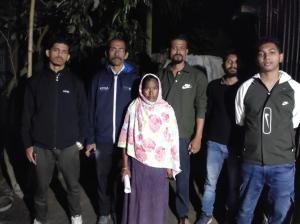
Aklima Sarkar with CJP Team Assam
CJP Steps In: Counselling, rebuilding confidence, restoring dignity
Before touching the documents, the team focused on what mattered most: making Aklima strong enough to fight.
They visited her repeatedly, counselling her, teaching her how to travel to Dhubri, how to speak in court, and how to face officials. Community volunteer Zaman took responsibility for accompanying her. CJP’s advocate Ishkendar Azad patiently explained every step of the legal process.
Only after stabilising her emotionally did the legal work begin.
The documentation struggle
What Aklima had in her possession was nowhere near enough:
- Aadhaar
- Voter ID
- Bank passbook
- Current voter list entry
To build a strong case, CJP had to reconstruct an entire lineage. They met her brother and village elders, applied for old documents, made visits to government offices, collected legacy documents, and arranged certified copies — all within the strict timelines of the Tribunal.
Key ancestral documentation eventually established
- Grandfather Khusulla Sk: Voter in 1958
- Father Sonauddin Sk: Voter in 1971
- Aklima herself: Voter in 1997 at Shernagar
This chain showed three generations of electoral presence — a critical requirement under Assam’s unique citizenship regime.
The final challenge was persuading witnesses. Her elder brother agreed to testify, and CJP volunteers coordinated with local Panchayat and Circle Office officials to support her appearance.
The Legal Battle: What the Tribunal found
Based on the order, the Tribunal made the following key findings:
- An unbroken lineage inside India- The Tribunal accepted the documentary evidence establishing that Aklima’s grandfather and father were Indian voters long before 1971 — placing the family firmly within Indian territory prior to the cut-off date.
- Consistent presence in Assam across decades- Aklima’s migration from her natal village to her matrimonial home was supported by:
- Electoral rolls
- Marriage affiliation
- Community certificates
- Supporting witness testimony
- No evidence of foreign origin- The state could not produce any proof suggesting that she or her ancestors ever migrated from Bangladesh or any foreign territory.
- A legally compliant, coherent narrative- The Tribunal found her documents to be authentic, consistent, and contextually accurate when read together.
As a result, the Tribunal declared that Aklima Sarkar is an Indian citizen and dismissed the reference case.
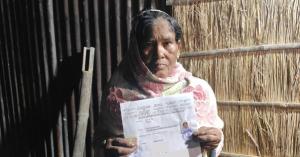
Aklima Sarkar holding up the Foreigners Tribunal order
The moment of relief
On November 29, 2025, CJP State In-Charge Nanda Ghosh, Advocate Ishkendar Azad, and community volunteers Habibul Bepari, Illias Rahman (Rabbi), Zaman, Digamber, and driver Asikul Hussain travelled to meet her and hand over the order copy.
She took the papers in her hands, held them to her chest, and cried.
She could not read the order — but she felt its meaning.
“Without you, I would have died with this tension. All I can give is my duaa.”
She insisted on serving tea. And in the cool evening breeze, with her smile returning after years, the team felt the quiet satisfaction of justice finally delivered.
For women like Aklima, who work as domestic labourers, lack formal education, and have lost ancestral land to erosion, navigating the FT system becomes nearly impossible without support.
Conclusion: Peace, finally — but at a cost no citizen should bear
Aklima Sarkar’s victory is not just a legal outcome — it is a reminder of what countless people in Assam must endure to prove something as basic as belonging to their own country.
Her tears, her trembling fear, her years of sleeplessness — all originated from a notice served “on suspicion”. For a widow who has lost land, home, health, and family, the simple right to live in peace had become a battle. Now, with the Tribunal affirming her citizenship, she finally has the peace she longed for.
The complete order may be read here.
Related:
From Despair to Dignity: How CJP helped Elachan Bibi win back her identity, prove her citizenship
Assam BJP’s AI video a manufactured dystopia, Congress files complaint, myths exposed
CJP scores big win! Citizenship restored to Mazirun Bewa, a widowed daily wage worker from Assam
Assam’s New SOP Hands Citizenship Decisions to Bureaucrats: Executive overreach or legal necessity?
Bulldozing the Poor: Assam’s eviction drives for Adani project leave thousands homeless