CJP flags Zee News broadcast ‘Kalicharan Maharaj vs 4 Maulanas’ for communal framing before NBDSA The complaint to NBDSA over Zee News broadcast accused of hate framing and communal distortion; seeks takedown
28, Jan 2026 | CJP Team
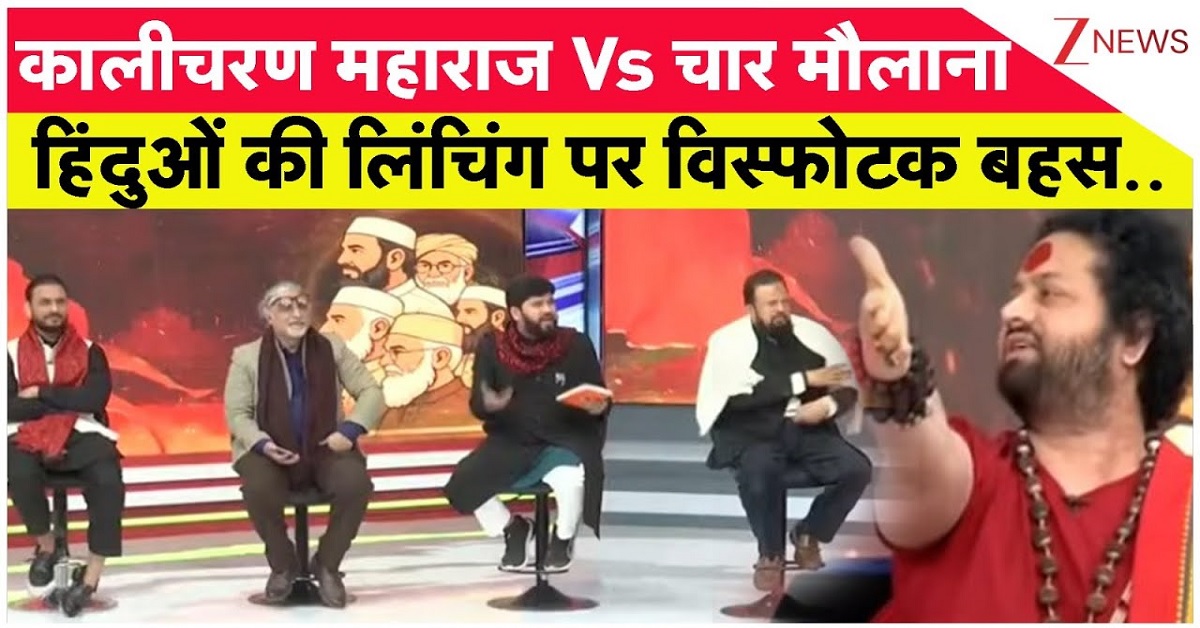
On January 20, the Citizens for Justice and Peace (CJP) approached the News Broadcasting and Digital Standards Authority (NBDSA) against Zee News over a January 1, 2026 prime-time broadcast that the CJP alleges was “a communalised televised spectacle designed to inflame anti-Muslim sentiment” and a “textbook violation” of broadcast ethics. The complaint was filed in relation to Zee News’ debate show titled “कालीचरण महाराज Vs चार मौलाना…हिंदुओं की लिंचिंग पर विस्फोटक बहस I Debate on Hindu Lynching I ZEE”.
According to CJP’s complaint, the show in question surrounded the tragic incidents of violence against Hindus in Bangladesh, which the program used as a pretext to incite communal tension within India. It is important to mention that while the professional identities of the Muslim panellists—including Islamic scholars and researchers—were acknowledged in the introductions, the channel systematically reduced them to a religious monolith by utilising the sensationalist and confrontational title “Kalicharan Maharaj Vs 4 Maulana.”
CJP is dedicated to finding and bringing to light instances of Hate Speech, so that the bigots propagating these venomous ideas can be unmasked and brought to justice. To learn more about our campaign against hate speech, please become a member. To support our initiatives, please donate now!
The show may be viewed here:
The complaint argues that the format, framing, selection of panellists, choice of questions, and on-screen graphics collectively abandoned journalistic neutrality and elevated unverified conspiracy-laden assertions into national discourse without editorial scrutiny. CJP has asserted that the show not only misrepresented facts regarding violence against Hindus in Bangladesh, but also used such incidents as a pretext to frame Indian Muslims as a civilisational threat.
From cross-border violence to domestic polarisation
According to the complaint, the broadcast opened by linking violence against Hindus in Bangladesh with the purported rise of “Islamist aggression” globally. However, instead of exploring geopolitical circumstances or international minority protections, the show allegedly shifted its focus toward a domestic communal binary. The choice to present the debate as “Kalicharan Maharaj vs 4 Maulana” formed the foundation of this shift, CJP states.
Despite introducing the Muslim speakers as an Islamic scholar, political analyst, researcher, and commentator, the anchor and graphics repeatedly referred to them simply as “Maulana,” thus transforming a discussion that could have been political or geopolitical into a religious contest. CJP describes this as “misclassification for ideological staging,” intended to create a perception of siege, in which a solitary Hindu ascetic was portrayed as battling an institutionalised Muslim clerical bloc.
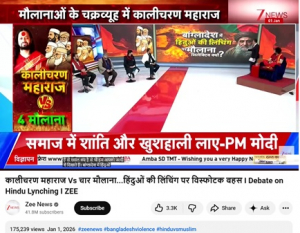
Six-question format framed as leading accusations
Throughout the program, the anchor posed six structured questions with the duration of the program revolving not strictly around them. The title and the overarching theme of the show were entirely misleading, communal, and provocative in nature;
- Why are Maulanas selective regarding the lynching of Hindus in Bangladesh
- Is there a conspiracy to defame India by labelling it ‘Lynchistan’?
- What is the need for a ‘new Babri’ in India?
- Why the deception of Hindu daughters by hiding one’s identity?
- What is the cure for the extremist mindset of ‘Spit Jihad’?
- Is this an attempt to incite Muslims using threats of Jihad?
The debate concluded with a final question from the host that was intentionally biased and communally charged:
- Will the country be governed by the Constitution or by Sharia?
Rather than clarifying the issue, CJP contends that these questions acted as “leading indictments” that presumed collective Muslim culpability. Queries such as “Why are Maulanas selective regarding lynching of Hindus in Bangladesh?” presupposed silence or complicity, while the final question — “Will the country be governed by the Constitution or Sharia?” — framed Indian national identity in existential religious terms.
The complaint argues that such formulations not only lacked neutrality but also “prime viewers toward moral panic,” presenting Muslims as inherently disloyal or hostile to constitutional order.
Unchecked hate speech and historical tropes
CJP identified the segment between timestamps 03:47 and 05:50 as particularly problematic. According to the complaint, Kalicharan Maharaj used this interval to allege that Quranic verses command violence against non-Muslims, that a “Ghazwa-e-Hind” war was imminent, and that Indian Muslims were celebrating terrorism, foreign defeats, and the “endangerment of Hindus.”
The complaint stated that the host refrained from interrupting or contextualising these claims, nor did he correct doctrinal misinterpretations or historical inaccuracies. This lack of intervention, CJP argues, amounted to “editorial acquiescence” and violated NBDSA’s guidelines on anchor conduct, which require moderators to prevent communal provocation and ensure fair debate.
Ticker graphics as messaging devices
Beyond the spoken exchanges, CJP drew the NBDSA’s attention to ticker text such as “थूक जिहाद वाली कट्टर सोच का इलाज क्या?”, which the complaint argues acted as subliminal messaging designed to reinforce conspiracy theories regarding Indian Muslims.
According to CJP, such graphics, appearing independently of verbal debates, functioned as “parallel instruments of communal persuasion,” circumventing potential rebuttal from panellists.
Rebuttals marginalised, counter-narratives interrupted
The four Muslim panellists reportedly condemned violence against Hindus in Bangladesh, referenced Quranic principles of humanity, and questioned the logic of demographic threat narratives. However, the complaint contended that these rebuttals received limited airtime, often collapsed mid-sentence, or were reframed by the anchor to suit the original premise.
This, CJP argues, transformed the broadcast from a debate into a performance of polarisation, where countervailing facts were permitted only insofar as they sustained spectacle.
Constitutional vs. civilisational framing
The complaint pays particular attention to Zee News’ repeated invocation of a “civilisational clash” premise, perpetuated through references to “New Babri,” “Land Jihad,” and demographic fear-mongering. This framing intentionally juxtaposed constitutional citizenship against religious identity, portraying Indian Muslims as aligned with transnational Islamist forces rather than as domestic citizens.
According to the complaint, this framing not only essentialised Indian Muslims into a singular political category but also presumed collective disloyalty, a hallmark feature in scholarly definitions of hate speech.
Journalistic responsibilities and democratic stakes
The complaint stresses that broadcasters hold heightened responsibility during prime-time debates, which significantly influence public discourse and Zee News neglected established standards requiring accuracy, fairness, and avoidance of communal colour, thereby violating both NBDSA guidelines and the basic tenets of responsible media conduct.
The broadcast “an act of manufactured communal crisis,” warning that such content corrodes democratic deliberation by replacing informed public reasoning with fear-driven binaries, the complaint reads
Relief sought
In its prayer for relief, CJP has requested corrective action, including takedown of the broadcast, broadcast of a public apology, and institutional compliance directives aimed at preventing recurrence of such programming. The petition argues that accountability is essential not merely for redress but for restoring ethical norms within India’s broadcast ecosystem.
The copy of complaint dated January 20, 2026 may be accessed from here
A complaint had earlier addressed to Zee News on January 7, 2026, seeking a response and corrective action. As the broadcaster did not engage, CJP subsequently escalated the case to the NBDSA on January 20, 2026.
Related
Hate Watch 2025 | Tracking Hate, Defending Democracy | CJP
NBDSA orders Times Now Navbharat to take down ‘agenda-driven’ report on Assamese singer’s arrest