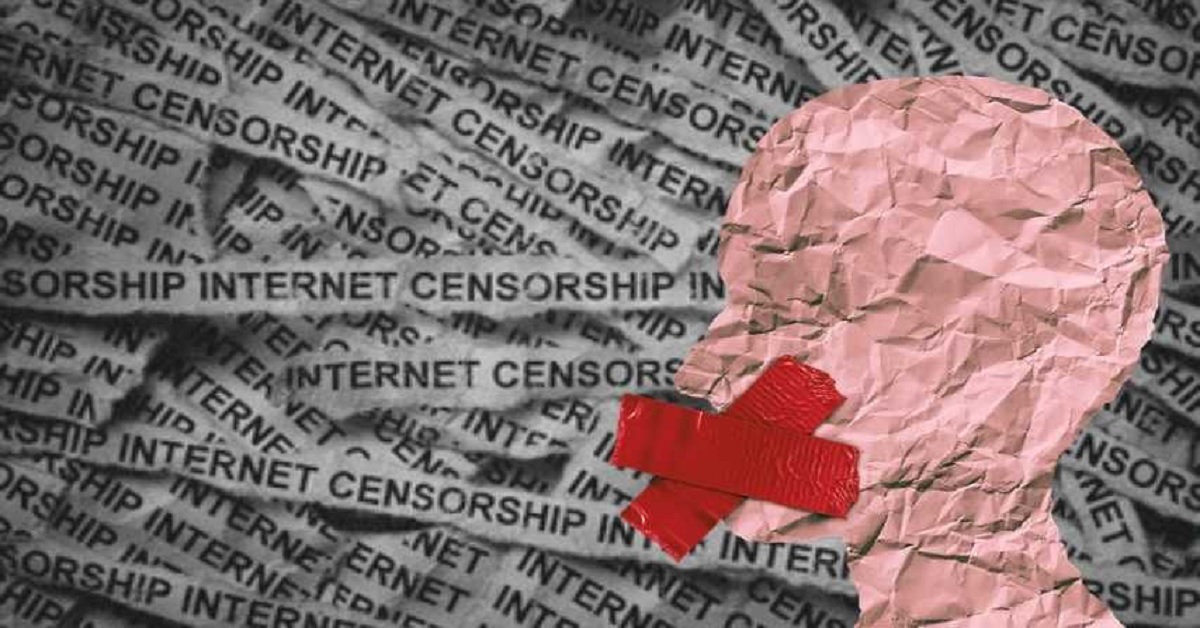
When the State Wants Silence: The growing machinery of digital takedowns and censorship in India The sharp rise in government-backed content restrictions, automated blocking and opaque removal orders threatens to turn online regulation into an instrument of censorship
27, Nov 2026 | CJP Team
The message is becoming increasingly familiar to social media users in India: “Your post is unavailable in India.” For journalists, independent media organisations, political commentators, satirists and ordinary citizens, this notification has come to represent something considerably larger than a routine content moderation decision. Across Instagram, Facebook, YouTube and X, users have reported posts being restricted, videos disappearing and accounts becoming inaccessible, often without a clear explanation of the legal grounds for the action or the authority that initiated it.
The growing number of content restrictions comes at a particularly significant moment. As public demonstrations against the Special Intensive Revision (SIR) of electoral rolls have spread across the country, and questions have been raised about the functioning of constitutional institutions, social media has become an important space for documenting protests, circulating information and challenging government decisions. The restrictions reported during this period have therefore raised concerns about whether the mechanisms ostensibly designed to regulate unlawful online content are also creating an environment in which legitimate political expression can be suppressed.
The scale of the problem is becoming increasingly difficult to ignore. Recent transparency disclosures by Meta and Google, alongside government figures on takedown requests and investigations by independent media organisations, point towards a substantial expansion of content restrictions in India. The controversy is no longer confined to isolated complaints about deleted posts. It concerns the architecture through which online expression is monitored, flagged, restricted and, in some cases, removed without meaningful public scrutiny.
Millions of Posts Restricted: What the numbers reveal
According to an analysis of Meta’s transparency data reported by The Indian Express, Facebook and Instagram restricted access to approximately 54.39 lakh pieces of content and accounts in India between January and June 2026 under local laws. This represented an increase of more than 13,000 per cent compared with the approximately 41,400 restrictions recorded during the preceding six months.
India accounted for more than 20 per cent of the 2.71 crore content restrictions imposed by Meta globally during this period, making it the second-highest country after Indonesia. The contrast is particularly striking because, while content restrictions globally declined by approximately 2.7 per cent compared with the preceding six months, restrictions in India increased more than 131-fold.
The breakdown is equally significant. Restrictions on Facebook posts increased from approximately 23,000 to 28.02 lakh, while restrictions on Instagram content rose from around 10,500 to more than 26 lakh. Meta also restricted 11,182 Facebook profiles and 12,989 Instagram accounts. In practical terms, this meant that more than 30,000 pieces of content and accounts were being restricted in India every day during the first half of 2026, or approximately one every three seconds.
A separate set of disclosures from Google reveals a parallel pattern. As reported by The Times of India, YouTube removed 34,41,973 videos uploaded from India between April and June 2026, the highest number recorded for any country during that quarter. This represented a 28 per cent increase over the preceding quarter and accounted for approximately 31 per cent of the 1.1 crore videos removed worldwide for violations of YouTube’s Community Guidelines. The United States followed with approximately 12.4 lakh removals, while Indonesia recorded around 9.2 lakh. Globally, child safety violations accounted for 68.2 per cent of video removals, while automated systems initially identified 98.6 per cent of the videos subsequently removed.
Between January and June 2026, Google received 4,006 content removal requests from Indian courts and government authorities, an increase of approximately 61 per cent over the preceding six months. These requests covered 65,091 pieces of content across Google’s services, including Search and YouTube. India ranked third globally in the number of such requests, behind Russia and South Korea. Of the 4,006 requests, 2,870 originated from police agencies, accounting for nearly 72 per cent of the total. Courts accounted for another 695 requests. Defamation was the most frequently cited ground, appearing in 2,130 requests, compared with 850 during the corresponding period a year earlier. Requests citing criticism of the government increased from 18 to 74, while those citing national security rose from 181 to 210.
Google reported removing 19,883 items for violations of local laws. It took no action on 19,402 items and stated that it did not have sufficient information to act on another 17,473. Notably, YouTube accounted for nearly 92 per cent of the content Indian authorities sought to remove across Google’s services, with 59,779 items targeted.
The figures, reported by The Indian Express on November 26, 2026, point to a substantial expansion in the use of government-backed content removal requests. They also raise an important question: when defamation becomes the most frequently invoked ground for taking down online material, what safeguards exist to ensure that the provision is not used to suppress criticism, investigative reporting or uncomfortable political commentary?
The Sahyog Portal: A new and expansive route for content removal
At the centre of the growing controversy is the Union Ministry of Home Affairs’ Sahyog portal, a centralised mechanism launched in October 2024 to facilitate communication between government authorities, law enforcement agencies and online intermediaries. The portal enables central ministries, state governments and police authorities to transmit notices to social media platforms, internet service providers and other intermediaries, seeking the removal or disabling of access to online content.
While the government maintains that the mechanism facilitates action against unlawful material, its expanding use has raised concerns among digital rights advocates, journalists and technology companies about the legal basis, procedural safeguards and transparency of these requests. An investigation by The Indian Express, published in August 2026, revealed that approximately 1.95 lakh government-backed blocking orders had been issued to Instagram, Facebook and YouTube between March and July 2026. This amounted to an average of approximately 1,275 orders every day, or one order every 68 seconds.
The scale represented a remarkable departure from the portal’s initial usage. According to an earlier investigation by the newspaper, 2,312 blocking orders had been sent to 19 online platforms between October 2024 and October 2025, averaging approximately six orders a day.
The government subsequently acknowledged the substantial volume of requests. According to figures published by the Press Information Bureau’s Fact Check unit, approximately 2.98 lakh URLs were sent for takedown through the Sahyog portal between March and July 2026. More than 82 per cent, approximately 2.44 lakh URLs, originated from state governments. Another 51,000 were reportedly sent by the Indian Cyber Crime Coordination Centre (I4C) in connection with cybercrime, infrastructure-related offences and stock-investment scams.
The government has defended the portal by arguing that it is necessary to address the enormous volume of unlawful online material, including financial fraud, child sexual abuse material, impersonation and offences involving women and children. It has also maintained that only authorised officers can issue intimations through the portal and that the notices are subject to periodic review. However, the central concern is not whether the State should have the authority to address genuinely unlawful content. It is whether a mechanism capable of generating restrictions at such a scale is sufficiently constrained by constitutional safeguards.
The controversy is particularly significant because Google, Meta and ShareChat have collaborated with the government in using the portal, while X has resisted its use. An additional concern emerged from an RTI response reportedly obtained in November 2026, which revealed that the Gujarat Police had issued 5,358 notices through Sahyog, covering approximately 1,90,633 URLs. The sheer number of URLs covered by these notices raises questions about the extent to which individual items are examined and whether the people affected are informed of the grounds for their removal.
Automated Censorship: When an algorithm decides what citizens can say
The expansion of government-backed takedowns has coincided with changes to the Information Technology (Intermediary Guidelines and Digital Media Ethics Code) Rules, 2021, which have significantly reduced the time available to online platforms to act on certain content removal intimations.
In February 2026, the government amended Rule 3 (1) (d), reducing the compliance period for removing or disabling access to specified unlawful information from 36 hours to just three hours after receipt of the requisite legal intimation. The amendment also introduced a seven-hour deadline for certain grievance-related obligations previously subject to a longer period. The government has defended the changes as necessary to respond swiftly to harmful online material, including deepfakes, impersonation and other forms of unlawful content. However, the reduction in compliance time raises serious questions about the quality of scrutiny that can realistically take place before a restriction is imposed. A three-hour deadline leaves intermediaries with very little time to examine the context of a disputed post, assess the legality of the underlying request, distinguish between criticism and unlawful content, or consider whether the material serves a legitimate public interest.
Perhaps the most troubling development in India’s evolving content regulation framework is the increasing reliance on automated systems to identify and restrict online material. The February 2026 amendments to Rule 4(4) of the IT Rules require significant social media intermediaries to deploy automated tools to identify and restrict information that is exactly identical to content previously removed or disabled following a court order or a written government notice under the prescribed mechanism.
The stated objective is to prevent the re-uploading and circulation of content that has already been found unlawful. However, the manner in which this requirement is being implemented has generated serious concerns about accuracy, proportionality and the possibility of collateral censorship. The controversy has become particularly visible in the dispute between the Indian National Congress and Meta, the parent company of Facebook and Instagram.
Detailed report on the IT rules amendment may be read here.
Congress takes its protest from the streets to the courtroom
According to a report by LiveLaw, the Congress has approached the Delhi High Court against Meta and the Union government, alleging that an automated content-removal mechanism is restricting lawful political expression, particularly posts featuring the name or photograph of Leader of Opposition in the Lok Sabha Rahul Gandhi.
The petition, filed on November 25 by Manu Jain, who heads the Indian Youth Congress’s social media department, challenges the constitutional validity of Rule 4(4) to the extent that it mandates automated blocking of allegedly identical content. The Congress alleges that posts featuring Rahul Gandhi have been restricted without prior notice, disclosure of the underlying government order or an opportunity for the affected users to explain their position. More concerningly, the party claims that the automated system is not merely identifying exact copies of previously prohibited material but is also restricting otherwise unrelated political and personal posts simply because they contain Gandhi’s name or photograph.
The examples cited in the petition include birthday greetings, photographs of party workers with Gandhi, a wedding invitation extended to him, tributes to former Prime Minister Rajiv Gandhi and a post concerning Rahul Gandhi’s interaction with students and faculty at the University of Chicago. One of the examples involved a birthday greeting posted on November 8 by a Youth Congress functionary. The post featured the recipient standing beside Gandhi and was reportedly restricted on the same day. Another post concerning Gandhi’s interaction with students at the University of Chicago was restricted on November 19 and subsequently restored later that day.
According to the petition, users received notifications stating that their content had been restricted through an automated system implemented pursuant to legal requirements. However, neither the specific blocking orders nor the legal requests allegedly underlying these restrictions were disclosed. The petition further alleges that repeated restrictions are being counted against individual accounts as violations of Meta’s Community Standards, potentially placing ordinary users at risk of permanent suspension. The Congress has argued that the system violates Articles 14, 19(1)(a), 19(1)(c) and 21 of the Constitution by enabling automated restrictions without recorded reasons, prior notice or an opportunity of hearing.
It has also challenged advisories issued by the Ministry of Electronics and Information Technology (MeitY) on October 8 and October 10, which called upon social media intermediaries to exercise enhanced diligence in relation to online content. Importantly, the petition does not seek to challenge the use of automated tools to identify and remove material depicting rape or child sexual abuse. Its challenge is directed at the automated restriction of allegedly identical content previously removed under the government’s legal takedown mechanism.
The legal challenge followed a series of protests by Congress workers outside Meta offices in Hyderabad, Bengaluru and Mumbai. As reported by The Indian Express, the Congress accused Meta of selectively restricting accounts and posts associated with opposition leaders while allowing content favourable to the ruling BJP to remain accessible.
A Congress delegation subsequently met Meta India representatives, including Head of Public Policy Aman Jain and senior Instagram public policy executive Natasha Jog. The delegation, led by Congress social media head Supriya Shrinate, reportedly presented a list of accounts and posts that it believed had been unfairly restricted.
According to Congress representatives quoted by the newspaper, Meta maintained that the restrictions were being imposed in compliance with Indian laws and requests from law enforcement agencies. The Congress, however, alleged that the company’s enforcement was inconsistent, pointing to instances of allegedly AI-generated or mocking content targeting opposition leaders that remained accessible even as other political material was removed. The party also cited X as an example of a platform that provides users an opportunity to present their side before certain account suspension decisions are taken. Meta, for its part, maintained that it was politically neutral and bound by local laws. It also raised concerns about the safety of its employees following protests outside its offices.
The disappearing posts of journalists, satirists and independent media
The controversy over content restrictions is not limited to political parties. Independent journalists, digital media organisations, satirists and commentators have increasingly reported restrictions on their work, often receiving little information beyond a generic notification that their content is unavailable in India following a legal request.
One such instance involved satirist and lyricist Varun Grover, who reported that Instagram had removed the musical version of his satirical poem criticising the government’s Viksit Bharat 2047 promise. The notification he shared reportedly stated that the content had been restricted under a legal requirement involving India’s IT Act. Another incident involved LiveLaw, a legal news platform, which reported that Instagram had removed a reel explaining the Election Commission’s affidavit before the Supreme Court. The same video reportedly remained accessible on YouTube.
The difference between the two platforms raises questions about the consistency of content moderation and whether users can obtain meaningful explanations for restrictions imposed on their material.
On October 26, CJP leader Ashutosh Ranka alleged on X that thousands of Instagram accounts had been restricted in India and lakhs of videos removed. Two days later, CJP founder Abhijeet Dipke alleged that thousands of critical posts and accounts were being taken down every day. At a press conference in Nagpur, Dipke played a satirical Modi Chalisa and placed Prime Minister Narendra Modi’s photograph behind him, explaining that the display was intended to prevent the press conference itself from being removed from Instagram. He alleged that more than five million pieces of political content had been removed from Instagram between January and June 2026.
Kerala government’s 15,627 takedowns
The controversy surrounding Sahyog is not restricted to the Union government or the BJP-led administration at the Centre. Recent developments in Kerala demonstrate that the potential for misuse of content-removal mechanisms must be examined across political parties and governments. In a written reply to the Kerala Legislative Assembly, Home Minister Ramesh Chennithala disclosed that 15,627 social media posts and links had been removed during the tenure of the current United Democratic Front government led by Chief Minister V.D. Satheesan.
The disclosure, reported by The News Minute on November 17, 2026, revealed that the government had received 4,201 complaints relating to AI-generated, morphed and manipulated images and videos, with legal action taken in 3,472 cases. The notices were issued to social media platforms through the Union Home Ministry’s Sahyog portal under the Information Technology Act and Rules. The revelation assumed significance because it appeared to contradict earlier statements by Chief Minister Satheesan, who had denied on August 13 that he or his government had instructed Meta to remove posts critical of him or the government. At the time, Satheesan had even offered to write to social media intermediaries seeking the restoration of content critical of him if news organisations complained about its removal. However, the Assembly disclosure established that the state government had, in fact, used the Sahyog mechanism to seek the removal of substantial volumes of online material.
The Home Minister maintained that the restrictions were directed at unlawful material, including manipulated photographs and videos, financial fraud, fake trading platforms, illegal loan applications, betting links, communal hate speech, obscene content, cyberbullying and fraudulent accounts impersonating law enforcement agencies. According to The News Minute, Reporter TV had previously alleged that approximately 26 news cards containing criticism of the Congress-led government and featuring Satheesan’s photograph were removed from its Instagram account. The platform’s response reportedly referred to legal requirements under India’s IT Rules.
The Accountability Gap: Who Actually Orders a Takedown?
One of the most troubling features of India’s current content-removal framework is the difficulty faced by affected users in identifying the authority responsible for restricting their material. A user may receive a notification stating that a post has been blocked pursuant to a legal request or government requirement. However, the notification may not identify the specific department, police authority or government official that initiated the request. This creates an accountability gap in which the government, the platform and the affected user occupy very different positions.
The problem was highlighted in an investigation by The Hindu and other media organisations examining recent restrictions on Instagram and Facebook. When users began reporting that their posts were unavailable in India, sources within MeitY told NDTV on October 28 that the ministry had not instructed Meta to remove specific Instagram posts or restrict accounts. A senior MeitY official reiterated the position to Hindustan Times on October 30, stating: “We are not sending these takedowns. Ask Meta.” However, government agencies and police authorities can transmit removal requests through other channels, particularly Sahyog.
The result is a system in which the affected user may be told that the restriction arose from a legal requirement, while the ministry denies having issued the instruction. Without disclosure of the underlying request, establishing responsibility becomes unnecessarily difficult.
Image : liberation.org.in
Related:
Censorship: Government keen on stripping legal immunity for social media platforms
Anatomy of a Censoring Mob Threatened by Book Reading in Public
The State Wants the Delete Button: India’s new architecture of digital censorship
Telegram before NEET: When governance fails, censorship takes its place
Censorship and the Drumbeats of Hate: Mapping the state of free speech ahead of the 2026 polls