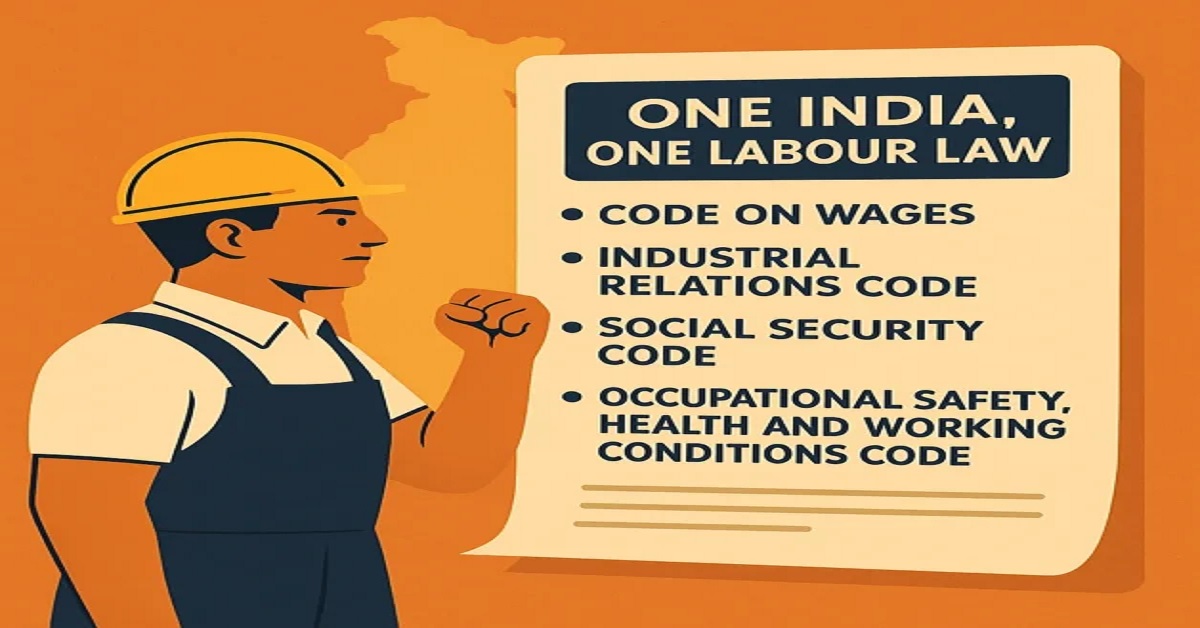
Critical examination of India’s new labour codes From gig workers to factory floors, the Labour Codes reshape workers’ rights—this piece examines their real-world impact
18, Dec 2025 | CJP Team
India’s labour regulatory framework has long been criticised for fragmentation, complexity and weak enforcement. Despite the 1991 economic reforms that emphasised market liberalisation, India has struggled to attract large-scale, labour-intensive manufacturing — in part because regulatory burdens incentivised firms to remain small to avoid compliance obligations. In response to these structural constraints, the Second National Commission on Labour (2002) recommended consolidating India’s 29 central labour laws into four streamlined Codes. Parliament enacted these Codes between 2019–2020, and the Government officially implemented them in November 2025.
The Government presents the Codes as a modernisation that eases compliance, simplifies regulatory processes and boosts investment. From an industry perspective, consolidation reduces administrative burden and litigation risk, enhancing flexibility. However, labour unions and many policy analysts contend that these reforms prioritise employer interests, weaken worker protections, and ignore the realities of India’s heavily informal workforce. This paper critically examines the Code on Wages, Industrial Relations Code, Code on Social Security, and Occupational Safety, Health and Working Conditions Code, analysing their likely impact on workers, employers, unions, and labour rights. All the codes have been embedded at the end of this analysis for easy reference.
Understanding the Four Labour Codes
- The Code on Wages, 2019
The Code on Wages replaces four earlier laws — Minimum Wages Act, 1948, Payment of Wages Act, 1936, Payment of Bonus Act, 1965 and the Equal Remuneration Act, 1976 — into a unified wage framework. At first glance, this rationalisation is welcome: it removes the peculiar fragmentation wherein only certain “scheduled employments” were entitled to minimum wage protection, leaving vast sectors uncovered.
Its most noted provision is the establishment of a National Floor Wage, below which no state can fix minimum wages. In theory, this should reduce inter-state disparities. However, the Code does not mandate that states must revise their minimum wages upward if their current rates slightly exceed the national floor. Many states already have minimum wages far higher than earlier floor-level recommendations; thus, unless the national floor is set ambitiously, something economists have long urged, it will have little meaning.
The Code also introduces a uniform definition of “wages”, attempting to address the inconsistencies across earlier laws. Critically, this definition includes basic pay and dearness allowance but excludes a list of allowances. If exclusions exceed 50% of total remuneration, the excess counts back into wages. While this aims to prevent employers from artificially restructuring wages to avoid statutory contributions, it remains complex in practice and will likely generate future litigation.
Moreover, enforcement has been significantly weakened. Earlier, workers could approach labour courts directly for wage-related grievances. The new system shifts much of the enforcement to inspectors-cum-facilitators and administrative mechanisms, reducing avenues for judicial redress. In a country where workers face stigma, fear, and lack of access to representation, administrative barriers often function as substantive barriers.
- Industrial Relations Code, 2020
The Industrial Relations (IR) Code arguably represents the most transformative and contentious reform. It combines the Trade Unions Act 1926, Industrial Disputes Act 1947, and Standing Orders Act 1946, governing everything from unionisation and dispute resolution to layoffs and closures.
The most controversial shift is the increase in the threshold for layoffs and closures from 100 to 300 workers. Units employing fewer than 300 workers no longer need prior government permission to terminate or retrench employees. This is not a minor change; it effectively removes a layer of job security for workers in medium-sized establishments, a sector which accounts for a large share of India’s organised workforce.
Proponents argue that rigid labour laws have suppressed the growth of labour-intensive industries, forcing firms to remain small to avoid crossing the regulatory threshold. They insist that increased flexibility will encourage larger hiring. But India’s own experience, and that of countries like Bangladesh and Vietnam, suggests that labour protections alone do not determine employment growth; infrastructure, productivity, skill development, and stable markets play a far more decisive role.
The IR Code also tightens procedures around strikes. The new rules require workers to provide extended notice in all industrial establishments, and prohibit strikes during conciliation proceedings and arbitration. Taken together, this significantly curtails the traditional bargaining power of unions. With union density already low in the private sector, critics argue that the Code further shifts the power imbalance in favour of employers.
The introduction of fixed-term employment — contracts with a defined duration but parity in benefits — adds another layer of flexibility. While it technically ensures equal benefits, the ability to not renew a contract provides employers a way to bypass protections against arbitrary dismissals. Without strong union presence or dispute-resolution mechanisms, many workers may experience heightened precarity.
- Code on Social Security, 2020
The Social Security Code replaces nine statutes, such as the Employees’ State Insurance Act, Provident Funds Act, Maternity Benefit Act and the Unorganised Workers’ Social Security Act, into one framework intended to extend welfare benefits across India’s vast workforce — including organised, unorganised, gig and platform workers.
The Code on Social Security puts in place suitable welfare arrangements for unorganised workers, like health and maternity benefits, education, etc. [Section 109(1)] as well as provident fund, gratuity, housing, old-age homes, funeral assistance, etc [Section 109 (2)]. However, it makes the registration of such unorganised workers, including gig workers, compulsory. Such registration is also subject to submission of the Aadhaar details of the workers under Section 113 (2)(1)-
shall make an application for registration in such form along with such documents including Aadhaar number as may be prescribed by the Central Government and such worker shall be assigned a distinguishable number to his application
Yet, recognition alone does not guarantee actual coverage. Registration under the Code requires Aadhaar-based identification, which has been criticised for excluding those without stable documentation, particularly migrant workers and those on the margins of the digital ecosystem. Several constitutional arguments have been raised against making Aadhaar a mandatory precondition for accessing statutory benefits, but the Code nevertheless embeds this requirement.
Moreover, the Code leaves most of the substantive welfare provisions to be framed through future schemes. This skeletal drafting has drawn criticism for shifting the real decision-making power from Parliament to the executive. Funding responsibilities between states and the Centre are vaguely articulated, leaving scope for jurisdictional friction and uneven implementation. Another issue arises for the gig workers. While the gig workers are a part of a larger subset of unorganised workers, the SSC 2020 lays down separate provisions for the gig workers, making the provisions applying to such workers confusing. Gig workers, in particular, are recognised as a category but remain non-employees in the eyes of the law.
- Occupational Safety, Health and Working Conditions Code, 2020
The OSH Code merges 13 different laws on factories, mines, construction, contract labour, inter-state migrant workers and more, aiming for uniform workplace safety standards. It increases formalisation by allowing a single registration for establishments working across sectors, and in principle extends certain safety and welfare protections to gig/platform workers as well. However, as with the Social Security Code, most operational details are delegated to subordinate rule-making.
One notable change is the relaxation of restrictions on women working at night. While framed as a progressive step toward gender equality, the Code requires that states ensure adequate safety conditions. Critics point out that without strong monitoring mechanisms, this provision could expose women to vulnerabilities in poorly regulated industries such as hospitality, manufacturing, and gig-based delivery. Moreover, the Occupational Safety and Health Code, 2020, while bringing together various labour laws, fails to incorporate specific measures to safeguard women from violence and harassment comprehensively.
The OSH Code also does not adequately address India’s longstanding compliance problems. The earlier Factories Act mandated facilities like crèches and sanitation, but enforcement remained abysmally weak. Merely codifying these rights in a consolidated law does not guarantee their realisation without institutional strengthening.
Do the New Labour Codes Strengthen Labour Rights?
The central claim of the Government is that legal consolidation promotes clarity, reduces duplication and enhances compliance. But the deeper question is whether this simplification translates into strengthened labour rights or whether it functions as an understated pathway to employer-centred deregulation. Across the Codes, several concerns persist:
Weakening of Unions and Collective Bargaining: The expanded notice requirements for strikes, and the constraints placed on union recognition and dispute resolution, have raised alarms about the shrinking space for collective bargaining. In a labour market already skewed in favour of employers, these restrictions deepen the imbalance.
Ease of Retrenchment: Raising the threshold for retrenchment permission to 300 workers enables employers to terminate workers more easily. Economic studies show that greater job insecurity often pushes workers into informal or precarious employment, undermining long-term industrial stability.
Ambiguous Social Security for Gig Workers: Recognition without rights creates a misleading sense of inclusion. Gig workers remain outside traditional employer-employee frameworks, and the Code does not mandate contributions that would secure pensions, provident funds or health insurance for them.
Dilution of Safety Standards: By shifting critical provisions to future rules, the OSH Code risks weakening existing protections — especially in sectors with historically high accident rates such as construction and mining.
Skeletal Legislative Frameworks: All four Codes defer substantial amounts of lawmaking to delegated legislation. This centralises power in the executive and sidelines parliamentary oversight. Critics argue that this makes workers’ rights contingent on administrative discretion rather than statutory guarantees.
Constitutional Concerns: Questions arise under: Article 14 (differential treatment of workers based on establishment size, potentially arbitrary), Article 16 (fairness in employment procedures), Article 19(1) (c) (restrictions on forming associations and unions) and Article 21 (dignity and security of livelihood). While not necessarily unconstitutional, the Codes open space for litigation and judicial scrutiny.
Overlapping and Confusing Jurisdictions
The Delhi High Court on December 11, 2025, noted that The Industrial Relations Code, 2020, was brought in without repealing the previous 3 laws- Trade Unions Act, 1926, Industrial Disputes Act, 1947 and the Industrial Employment (Standing Order) Act, 1946. As reported in Bar and Bench.
There has also been a great deal of opposition from the labour unions with regard to the judicial recourse available to the working class. All cases pending in the Labour Courts and Industrial tribunals under the Industrial Disputes Act,1947 have now been transferred to special tribunals under the new code. These tribunals have, however, not yet been put in place. This raises much doubts on the effectiveness of these tribunals.
In terms of the jurisdiction, there is an overlap between the Centre and the State Governments. While the boundaries are clearly demarcated between the central and the state governments under Section 109(1) and Section 109(2) of the OSH Code, what it does not specify is the implementation authority. Another point of contention is that of the fund allocation between the states. Till the time these issues are clarified and sorted out, no progress of any sort could be made.
Challenges in Implementation
Even the best-designed labour laws fail without effective implementation — and here, the Codes face formidable challenges. One bigger question that comes is up: how well the government has resources and infrastructure for the electronic registration of unorganised workers, gig workers, and platform employees.? A report by Mehrotra and Sarkar in EPW also point out that the current OSH Code does not take into account the high proportion of unregistered establishments (67.7 percent) in the unorganised sector, instead stating that ‘every establishment to which the code applies’ must be registered.
A major concern is the transition from labour inspectors to “Inspector-cum-Facilitators”, which shifts the enforcement philosophy from deterrence to self-certification and advisory compliance. Critics argue that replacing surprise inspections with web-based randomised checks significantly dilutes state oversight, especially in sectors notorious for exploitation such as construction, textiles, and mining. This new framework assumes that employers will voluntarily comply with safety and welfare norms; an assumption that may not hold in an economy where informalisation is widespread and labour violations are systemic.
Migrant workers, who make up a large share of India’s workforce, face particular vulnerabilities under the new regime. While the Occupational Safety, Health and Working Conditions Code promises better registration and portability of benefits, the on-ground mechanisms required to operationalise these guarantees remain weak. The experience of the pandemic, when millions of migrant workers were left without income, shelter, or social protection, demonstrates the fragility of India’s labour governance system and raises serious questions about whether the Codes can be meaningfully enforced without substantial administrative strengthening.
Ultimately, the effectiveness of the Codes will depend not only on legislative intent but on the capacity of state labour departments, the willingness of employers to comply, and the ability of workers, especially those in informal and precarious sectors, to access grievance redressal mechanisms. Without significant investment in personnel, digital infrastructure, and awareness-building, the promise of simplification may translate into weaker protections and heightened precarity for millions of Indian workers.
Conclusion
The consolidation of labour laws into four comprehensive Codes was an enormous legislative undertaking, long recommended by commissions and economic advisors. Again, like the much-opposed erstwhile Farm laws (that were subsequently withdrawn because of intense agitation by India’s famer organisations (2020-2021), the Labour Codes have been brought in near unilaterally without effective debate, deliberations and discussions either with sake holder Worker’s Unions or Parliament. On paper, simplification seems beneficial. But simplification that simultaneously erodes substantive rights, weakens collective bargaining, and defers essential protections to executive rule-making demands scrutiny.
India’s economy does need labour reform. It needs modernisation, expanded social security, and flexible frameworks that encourage job creation. But reform must not come at the cost of workers’ security, dignity and constitutional rights.
Central to any step forward must remain the rights, welfare and accountability due to India’s marginalised workforce. While the Labour Codes attempt to position themselves as a new social contract for India’s workforce, several provisions remain vague. Most concerning is the push-back on a rights-based approach with constitutional provisions of judicial review to restricting redressal to tribunals etc. Finally, whether they become meaningful instruments of empowerment, or mechanisms that accelerate employer-centred deregulation, will depend on how the rules are drafted, how states implement them, and whether the opinions, concerns and voices of workers and unions are meaningfully included in shaping the next phase of India’s labour landscape.
(The legal research team of CJP consists of lawyers and interns; this resource has been worked on by Shyamli Pengoriya)
Code on Wages may be read here:
Industrial Relations Code may be read here:
Code on Social Security may be read here:
Occupational Safety, Health and Working Conditions Code may be read here:
Image Courtesy: legalservicesindia.com
Related
Lockdown has reduced lives of bidi labourers to ashes!
Bandna Parab: A festival that celebrates light and life