


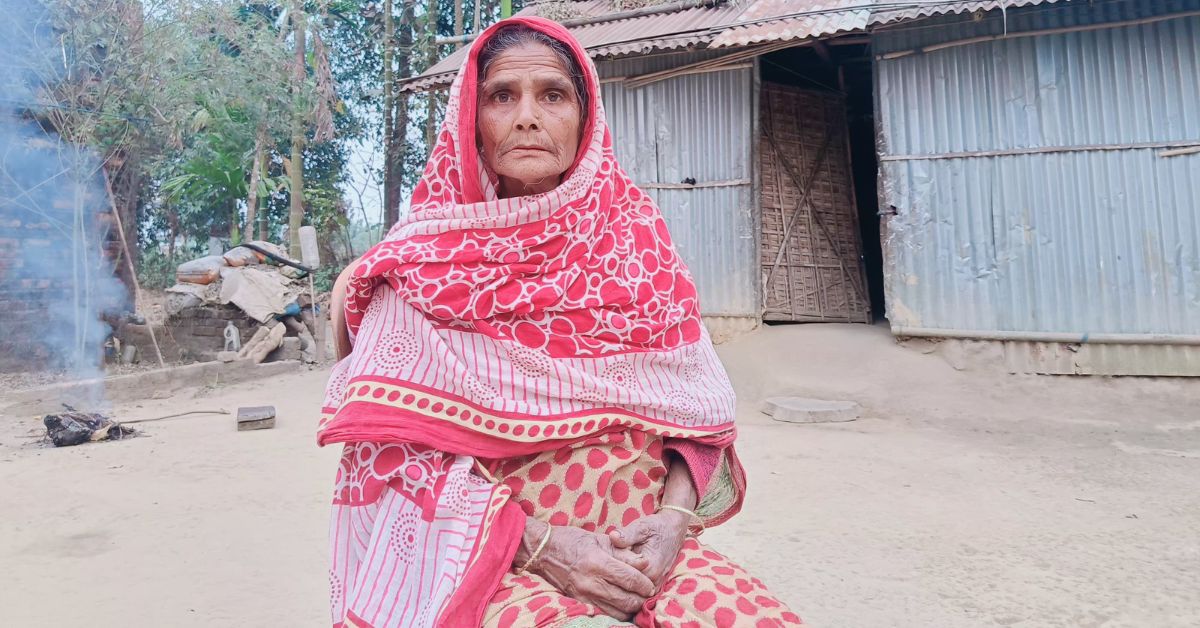
Citizens for Justice and Peace (CJP) has secured a favourable Foreigners’ Tribunal order for Anowara Khatun, a resident of Sidhabari Part-II (Nigam Shantipur), Goalpara district, Assam, who had been marked as a “Doubtful Citizen” by the state authorities.
By an opinion dated November 27, 2025, Foreigners’ Tribunal No. 5, Goalpara, presided over by Member N.K. Nath, declared that Anowara Khatun is an Indian citizen, answering the reference made by the Superintendent of Police (Border), Goalpara, in the negative.
The order brings to a close the said proceedings that originated over two decades ago and highlights persistent structural issues in Assam’s citizenship determination framework, particularly its impact on poor and marginalized women.
Every week, CJP’s dedicated team in Assam, comprising community volunteers, district volunteer motivators, and lawyers, provides vital paralegal support, counseling, and legal aid to many affected by the citizenship crisis in over 24 districts in Assam. Through our hands-on approach, 12,00,000 people successfully submitted completed NRC forms (2017-2019). We fight Foreigner Tribunal cases monthly at the district level. Through these concerted efforts, we have achieved an impressive success rate of 20 cases annually, with individuals successfully obtaining their Indian citizenship. This ground level data ensures informed interventions by CJP in our Constitutional Courts. Your support fuels this crucial work. Stand with us for Equal Rights for All #HelpCJPHelpAssam. Donate NOW!
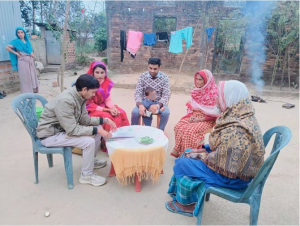
Team CJP Assam sits to discuss the case with Anowara Khatun and family outside their home in Assam

From IMDT to Foreigners’ Tribunal: A case born of institutional suspicion
Anowara’s case originated as far back as 2004, when the Superintendent of Police (Border), Goalpara referred her name under the now-defunct Illegal Migrants (Determination by Tribunals) Act, 1983, alleging that she had illegally entered India between 1966 and 1971. The referral admitted that the “doubt” arose because she could not immediately produce documents during verification — a familiar and deeply flawed basis used against the poor and illiterate.
Following the Supreme Court’s judgment in Sarbananda Sonowal v. Union of India (2005), which struck down the IMDT Act as unconstitutional, Anowara’s case was mechanically transferred to Foreigners’ Tribunal No. 5, Goalpara under the Foreigners Act, 1946, shifting the entire burden of proof onto her under Section 9.
Who is Anowara Khatun?
Anowara Khatun was born and raised in Kharda Manikpur (also recorded as Kharija Manikpur), Goalpara, Assam. She is the daughter of Late Alom Shah, a lifelong resident of Assam, and Korimon Nessa, and the granddaughter of Late Rose Mamud Shah. Documentary evidence showed that her father, Alom Shah, purchased land in Assam in 1947, 1952, and 1959. His name, along with that of Anowara’s mother, appears in the electoral rolls of 1966 and 1970, demonstrating their presence in Assam prior to the relevant cut-off dates.
Anowara studied up to Lower Primary level at Majgaon LP School, married Saiful Hussain of Mamudpur Part-I, and later settled in Sidhabari Part-II, where she has lived for decades. She first voted in 1985, and her name consistently appears in electoral rolls for 1985, 1997, 2005, 2011, and 2015.
Despite this, she was eventually marked a “D-Voter”, stripped of voting rights, and subjected to relentless suspicion — a fate shared by thousands of Bengali-speaking Muslims in Assam.
Her personal circumstances make the cruelty of this process even more stark. Anowara suffers from mental imbalance and chronic health issues, lives in extreme poverty, has no proper bedding, and struggles daily for food and medical care. She and her husband survive on daily labour, entirely unequipped to navigate a legal system designed to break the poor.
CJP Steps In: Building a case where the State saw only suspicion
Recognising the grave injustice involved, Assam Team CJP took up Anowara’s case, committing to pursue it despite the enormous evidenti and procedural hurdles.
On behalf of Anowara, Advocate Ashim Mubarak, assisted by Advocate Shofior Rahman, and supported by CJP’s para-legal and community teams, presented a meticulous defence before the Tribunal.
Four defence witnesses were examined:
- DW-1: Anowara Khatun herself
- DW-2: Her brother, Kurban Ali
- DW-3: Her sister, Ambia Bibi
- DW-4: The Land Record Assistant, Matia Revenue Circle
CJP placed before the Tribunal a comprehensive documentary trail, including:
- Three registered land sale deeds executed in 1947, 1952, and 1959 in her father’s name
- Electoral rolls of 1966 and 1970, recording her parents as Indian voters
- Subsequent voter lists (1979, 1985, 1997, 2005, 2011, 2015) showing uninterrupted electoral presence
- Jamabandi and citha records proving inheritance of ancestral land in Assam
The Tribunal explicitly accepted that the land deeds were over 30 years old and required no further proof, and relied heavily on the voter lists of 1966 and 1970 to establish her father’s citizenship.
Even when Anowara’s deteriorating mental health made her continued presence difficult, CJP persisted with evidence and arguments, ensuring the case did not collapse under procedural cruelty.
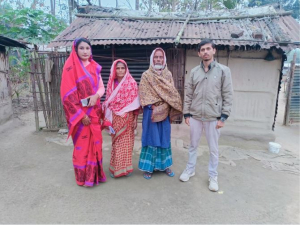
Anowara Khatun with her husband and CJP Team Assam outside her home in Assam

The Tribunal’s Finding: Citizenship proven, suspicion rejected
After a detailed appreciation of evidence, the Tribunal held that:
- Alom Shah, Anowara’s father, was conclusively established as an Indian citizen, present in Assam since at least 1947
- Anowara, being his daughter, cannot be treated as a foreigner
- The state failed to rebut the overwhelming documentary record
The reference was therefore answered in the negative, and Anowara Khatun was declared not a foreigner, with directions issued to inform the Superintendent of Police (Border), Goalpara.
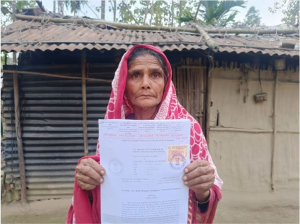
Anowara Khatun holding up the FT order outside her home in Assam

A system designed to break the poor
Anowara Khatun’s case is not an aberration — it is a window into a larger architecture of state oppression. Instruments such as D-Voter tagging, Foreigners’ Tribunals, NRC, detention camps, “push-backs,” the Passport Act, SR and SIR exercises operate together to produce statelessness among workers, farmers, minorities, and Bengali-speaking communities.
Assam has long served as a pilot project for citizenship stripping, but the same logic is now visible across India. Behind this bureaucratic machinery lie document-wars, midnight detentions, suicides, custodial deaths, and families torn apart — all in the name of identifying “Bangladeshis.”
India’s constitutional promise of secularism, dignity, and equality collapses when impoverished citizens are tortured for papers they were never equipped to preserve.
CJP’s Role: Law as resistance
At a time when the Chief Minister of Assam openly targets Muslims, spreads communal suspicion, and legitimises exclusion under the rhetoric of “illegal migration,” CJP continues to fight case by case, restoring citizenship through evidence, law, and persistence.
In the first week of February, members of Team CJP — State In-Charge Nanda Ghosh, DVM Goalpara Zeshmin Sultana, Community Volunteer Hasunir Rahman, and Office Driver Ashikul Hussain — stood by Anowara and her family, reaffirming that justice is not charity, but resistance.
Anowara Khatun’s victory is not just hers. It is a reminder that citizenship in India is increasingly something the poor must fight to prove, and that without sustained legal intervention, countless others will disappear into detention camps, deportation attempts, or silent graves.
This case stands as another testament to what determined legal solidarity can achieve — even in the face of a system designed to erase.
The complete order may be read here.
Related:
CJP flags Zee News broadcast ‘Kalicharan Maharaj vs 4 Maulanas’ for communal framing before NBDSA
The case of “pushback” of Doyjan Bibi and the quiet normalisation of undocumented deportations
From Hate Speech to State Action: How communal vigilantism at Malabar Hill continues unchecked