


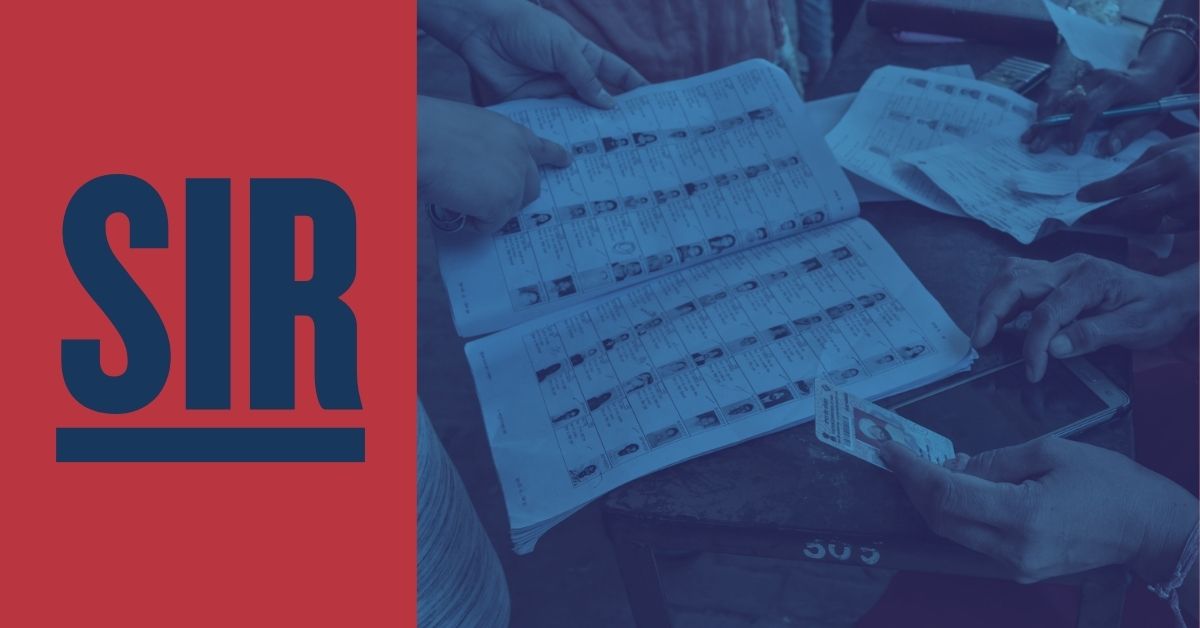
A wide-ranging national consultation on the Special Intensive Revision (SIR) of electoral rolls has brought together senior retired members of the higher judiciary, senior advocates from Mumbai, Delhi and Chennai, former senior bureaucrats, academics, activists and independent journalists, alongside representatives of civil-society organisations from across India. The consultation, held on October 3, 2026, brought together more than 80 participants representing nearly 200 organisations, with several others who were unable to attend contributing informed inputs in advance.
Organised by People’s First, Citizens for Justice & Peace (CJP) and Vote for Democracy (VFD), the consultation examined the growing concerns surrounding electoral-roll revision, the exclusion of eligible voters, transparency and accountability within the Election Commission of India, and the legal and democratic consequences of conducting elections on disputed or procedurally defective electoral rolls.
Among the prominent voices at the consultation were MG Devasahayam, soldier, economist, administrator and public servant and an expert on India’s electoral system; Dr Pyarelal Garg, former Dean and Professor of Surgery and an expert with VFD; Professor Harish Karnick, formerly of IIT Kanpur; senior RTI activist Venkatesh Nayak; former Union Home Secretary Gopal Krishna Pillai; former Union Finance Secretary EAS Sarma; former bureaucrat Amitabha Pande of the Constitutional Conduct Group; actor Prakash Raj; human rights activist Usha Ramanathan; Thomas Franco, former General Secretary of the All India Bank Officers Confederation; Tara Rao and Noor Sridhar of Wake Up Karnataka; and academic Ashoke Chatterjee.
The consultation reflected the breadth of concern over the SIR process, with participation from Assam, Manipur, West Bengal, Andhra Pradesh, Telangana, Tamil Nadu, Kerala, Gujarat, Karnataka, Maharashtra, Rajasthan, Delhi, Uttar Pradesh and Jharkhand, among other States. Independent journalists Prashant Tandon of DB Live and Indra Kumar Theradi from Tamil Nadu also participated.
The strong representation from Assam was particularly significant. In a State where citizens have for decades faced the enormous burden of establishing their citizenship through documentary records, Dr Ghyansham Nath, senior academic; Nanda Ghosh of CJP; advocates Mrinmoy Dutta, Abhijeet Chowdhury, Abdur Rahim and Jamal Uddin; Harkumar Goswami; Dr Rituraj Kalita of the Forum for Social Harmony; and Professor Taijuddin Ahmed brought the experience of Assam’s citizenship and electoral processes into the national discussion. The consultation was conducted by Teesta Setalvad, Secretary of CJP.
The diversity of those participating was itself a reflection of the seriousness with which the question of SIR is being viewed. Electoral-roll revision is not merely an administrative exercise. It determines who is recognised as an elector and therefore who is able to exercise one of the most fundamental forms of democratic participation: the right to vote.
The consultation consequently resolved to bring together public mobilisation, systematic documentation, social audits, legal intervention and institutional accountability around a single overarching demand: SIR must be scrapped and the electoral rights of every eligible citizen must be restored and protected.
Demands for the Public Campaigns/ Protests
- CEC GYANESH KUMAR MUST RESIGN: Resignation/ removal Chief Election Commissioner (CEC) (Impeachment is the legal provision for this process if there is no resignation)
- SIR MUST BE SCRAPPED: Completely reverse SIR. All future elections to be based on 2024 rolls + any revisions made as per law and past practice for addition/deletion for the past 2 years.
- ELECTION COMMISSION OF INDIA MUST BE DISBANDED
- 2023 ACT THAT GRANTS IMMUNITY TO ECI ETC FROM PROSECUTION & NON-TRANSPARENT APPOINTMENT OF COMMISSIONERS BE REPEALED: Repeal 2023 law giving commissioners immunity for decisions taken.
- RE-ENACT A LAW FOR THE APPOINTMENT OF ALL ELECTION COMMISSIONERS: This new law should ensure that the Appointment Committee and procedure is broad-based, diverse and ensures some accountability: Appointment by/through a broad based committee of 8-10 people containing two government nominees, two opposition nominees, two past election commissioners (not holding any position given by govt.), two representatives of the higher judiciary (retired judges of high/supreme court not holding any position). The Final Selection should be by two-third majority.
- ANNUL AND RE-DO ELECTIONS CONDUCTED AFTER THE SIR 2025 PROCESS: Elections to be conducted based on Electoral rolls verified and transparent after annual Summary Revision of 2025 and 2026 as the case may be.
- TRANSPRENCY & ACCOUNTABILITY IN ECI FUNCTIONING: Complete transparency and public access to all data in machine readable form as soon as it is available to the EC both during elections and during normal times. In particular all electoral rolls, all forms filled by presiding officers during elections, counting related data.
- MAKE SOURCE CODES(S) PUBLIC: Source code of EVM software, ECInet/EROnet software and any other s/w used for any sanity checks of the electoral roll (e.g. logical discrepancy) should be in the public domain.
Electoral transparency is a constitutional necessity
The Assembly has called for complete transparency in the functioning of the ECI, including public access to electoral data in machine-readable form, electoral rolls, relevant forms filled by election officials and counting-related information. It has also called for the source codes of EVM software, ECINet, ERONet and other software used for electoral-roll verification and discrepancy detection to be placed in the public domain. These demands arise from a fundamental democratic principle. Citizens cannot effectively challenge an electoral decision if the processes producing that decision remain inaccessible or impossible to independently scrutinise. Digitalisation cannot become a substitute for accountability.
If an elector’s name is deleted, the citizen must be able to know why. If a deletion application has been filed, the grounds and source of that application must be capable of scrutiny. If a claim for inclusion is rejected, the elector must have access to the reasons. If an appeal is pending, its status must be ascertainable. If software contributes to identifying a discrepancy or exclusion, there must be an auditable record of how that decision was generated and reviewed. A constitutional election process cannot be allowed to operate as a black box.
Legal intervention must be narrow, rigorous and evidence-based
The Assembly has resolved to assist in exploring appropriate legal remedies concerning the SIR and electoral processes conducted on the basis of disputed or procedurally defective rolls. The legal strategy must begin with evidence. It must document patterns of exclusion, bulk deletion applications, Forms 6 and 7, software-related exclusions, unresolved appeals, failures of restoration and instances where citizens were denied meaningful opportunities for verification or hearing.
This approach is especially important after the Supreme Court’s May 2026 judgment concerning Bihar. The appropriate constitutional question now is not simply whether the ECI possesses the power to undertake an intensive revision, but whether particular exercises of that power comply with the statutory framework and constitutional safeguards.
Where elections have already been conducted on rolls shown to have been seriously compromised, remedies must be examined through the statutory framework governing election challenges and on the basis of constituency-specific evidence. The Assembly has specifically identified the large number of pending appeals and limited restoration of voters in West Bengal as matters requiring close examination before any conclusions are drawn about the validity of elections conducted on the revised rolls.
Give every excluded voter a name and a face
The Assembly has therefore called for a nationwide Public Social Audit of electoral rolls across SIR-affected States. Civil-society organisations, community groups, youth organisations and citizens are being encouraged to undertake participatory verification at the booth, ward and Gram Sabha levels, with the involvement of the concerned Booth Level Officer and Electoral Registration Officer wherever possible.
Such exercises have already been undertaken in parts of Delhi and across approximately 100 booths in Karnataka. The Assembly seeks to expand these efforts into a systematic national campaign documenting exclusions, pending claims and objections, Forms 6 and 7, deletion notices, bulk applications and procedural violations.
This public process will include comparing the SIR-driven deletions and additions with a comparison of earlier electoral records, including the 2002-03 rolls where relevant, with the 2025-26 SIR rolls is intended to establish what happened to individual voters rather than allowing their exclusion to disappear into administrative statistics.
The campaign is intended to give a face and name to the 13.60 crore Indians so tragically and shamefully excluded. That too by a constitutional authority like the Election Commission of India. The conduct of this Campaign for a Public Social Audit is crucial to drum up and sustain the demand for a Scrapping of the 2025-2026 SIR.
Every proposed deletion and addition must be publicly disclosed, with the voter given a meaningful opportunity to contest the deletion and have their name restored where wrongly excluded. The process must ensure transparency regarding who sought a deletion, on what grounds, whose name is proposed to be deleted and what verification was undertaken. No electoral-roll change should be affected without public notice, verification and an effective opportunity to object.
Independent inquiry must strengthen public accountability
The Assembly has welcomed the Independent Commission of Former Supreme Court and High Court Judges constituted by the Lawyers Association for Constitution (LAFC) to examine the constitutional and statutory validity, methodology and impact of the SIR. The five-member Commission, chaired by former Supreme Court judge Justice Madan B. Lokur, includes former Supreme Court judge Justice A.K. Patnaik and former judges of the Jammu & Kashmir, Delhi and Patna High Courts. It proposes to conduct public hearings, collect testimony from affected citizens and analyse electoral-roll data, with a report expected by December 2026.
The Assembly will assist this process by placing before the Commission relevant data, documentation and evidence emerging from public campaigns, independent investigations and social audits. Such an inquiry must complement, not replace, judicial and statutory remedies. Its importance lies in bringing together evidence that is otherwise dispersed among individual voters, election officials, civil-society groups and independent investigations.
Electoral democracy cannot survive exclusion without accountability
The controversy surrounding SIR has brought together questions that cannot be treated separately: the integrity of electoral rolls, the right to vote, institutional independence, and transparency, collective decision-making and judicial accountability. The integrity of an election begins long before polling day. It begins with the electoral roll.
If an eligible citizen is removed without adequate notice, verification or an effective remedy, the democratic injury occurs before that citizen ever reaches the polling station. The October 3 Assembly has therefore resolved to combine public mobilisation, social audits, evidence-building, legal intervention and institutional accountability around one central demand.
Every eligible citizen must have the right to remain on the electoral roll, to know why any deletion is proposed, to challenge it effectively and to have a wrongful exclusion corrected.
Scrap SIR and restore electoral rolls
The Assembly has called for the SIR process to be completely reversed and for future elections to be conducted on the basis of the 2024 electoral rolls, subject to additions and deletions carried out through the ordinary statutory processes and established safeguards. The demand comes against the backdrop of the Supreme Court’s May 2026 judgment upholding the constitutional validity of the Bihar SIR. That judgment, however, cannot be read as placing every subsequent decision or implementation of SIR beyond judicial scrutiny. The present controversy concerns not merely the existence of a power to revise electoral rolls, but the manner in which that power is exercised, the safeguards accompanying it and the legality of particular decisions taken during the process.
The distinction is crucial. A constitutional power must still be exercised in accordance with the Constitution, the Representation of the People Acts, the Registration of Electors Rules, applicable directions and the principles of procedural fairness. The Assembly therefore proposes an evidence-based legal strategy focused on specific violations, documented exclusions, defective procedures and departures from statutory safeguards rather than relying on broad assertions about the SIR in the abstract.
The Election Commission cannot function without accountability
The Assembly has demanded the resignation of CEC Gyanesh Kumar and has also called for a fundamental restructuring of the institutional framework governing the Election Commission. These demands have acquired renewed significance following the Supreme Court’s October 5 proceedings concerning allegations that important decisions connected with the SIR were taken unilaterally by the CEC despite objections from the other two Election Commissioners.
Reports based on an investigation by The Indian Express have stated that Election Commissioners Sukhbir Singh Sandhu and Vivek Joshi recorded objections on at least 14 occasions over ten months concerning decisions and orders connected with the SIR, with some objections alleging that decisions were taken without their knowledge or contrary to their recommendations. The Supreme Court has now sought responses and records from the concerned authorities. The Court declined, at this stage, to suspend the CEC, but made clear that the legality of the alleged unilateral decisions remains open for examination. It also indicated that decisions of the Commission must comply with the legally prescribed mechanism of collective decision-making.
The controversy over Form 6 makes the issue particularly serious. During the October 5 hearing, Chief Justice of India Surya Kant clarified that the Supreme Court had not approved modifications allegedly made to Form 6 and indicated that the Court would examine who authorised those changes.
Form 6 is a form distinctly and procedurally meant for enrolment of first-time new voters. The ECI, by using this process meant for a limited and specific purpose, for the re-enrolment of wrongfully deducted previous voters is itself committing a flawed illegality and asking citizens to do the same. Making matters worse, the amended Form 6 includes a declaration on oath by an older voter to the effect that ‘she or he has not voted before’, making matters worse.
The question before the country is consequently larger than whether one particular administrative decision was correct. It is whether a constitutional body exercising enormous power over the democratic franchise is functioning collectively, transparently and within the limits imposed by law.
The complete resolution may be read below:
Related:
Census 2027: When a population count starts asking for more than just numbers
From Statelessness to Citizenship: CJP helps Adori Bibi reclaim her Indian identity
Who had access to 3,404 SIR forms? CJP, VFD and BCS seeks statewide audit after Kharghar breach
Another CJP Victory: Barpeta Tribunal declares Alam Khan ‘not a foreigner’