


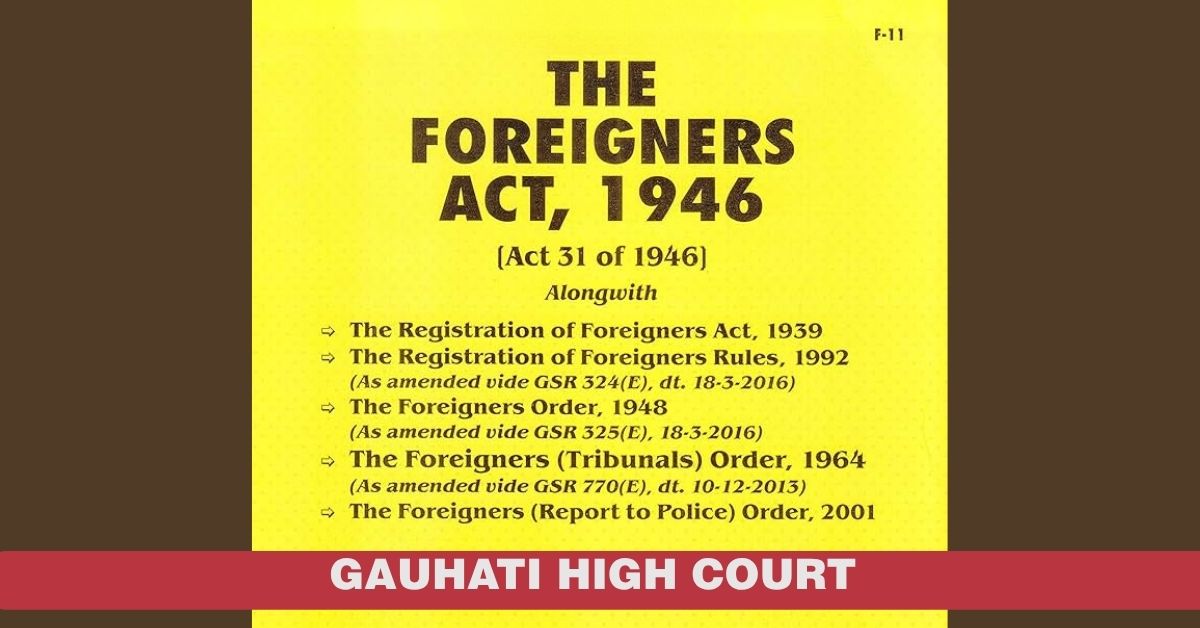
On May 21, 2026, in a significant ruling on citizenship adjudication under the Foreigners Act, 1946, the Gauhati High Court has reiterated that the burden to establish Indian citizenship in proceedings before a Foreigners Tribunal rests entirely and exclusively upon the proceedee, and such burden cannot be discharged through vague pleadings, inconsistent electoral records, unproved certificates, or oral assertions unsupported by contemporaneous documentary evidence.
The judgment came in a writ petition filed by Dabir Rahman challenging a 2018 opinion of a Foreigners Tribunal which had declared him to be a foreigner who entered India after 25 March 1971 — the statutory cut-off date under the Assam Accord framework.
A Division Bench comprising Justice Sanjay Kumar Medhi and Justice Pranjal Das dismissed the challenge and upheld the Tribunal’s findings, holding that the petitioner had failed to discharge the mandatory evidentiary burden imposed by Section 9 of the Foreigners Act.
Yet, beyond the immediate outcome of the case, the ruling once again exposes the deeply contentious architecture of citizenship determination operating in Assam — a framework built upon a colonial-era reverse burden law, extraordinary evidentiary expectations, and a process in which impoverished and document-deficient individuals are often compelled to prove lineage, residence, and belonging across generations through fragile and inconsistent archival traces.
Court reiterates that burden of proof “never shifts”
At the heart of the ruling lies the Court’s reaffirmation of the exceptional evidentiary framework governing Foreigners Tribunal proceedings in Assam. The Bench observed that Section 9 of the Foreigners Act creates a complete departure from ordinary evidentiary principles and squarely places the burden upon the person proceeded against to prove that he or she is not a foreigner. Stressing the overriding nature of the provision, the Court held:
The Bench observed:
“With regard to the aspect of burden of proof as laid down in Section 9 of the Act of 1946, the law is well settled that the burden of proof that a proceedee is an Indian citizen is always on the said proceedee and never shifts. In the said Section, there is non-obstante clause that the provisions of the Indian Evidence Act would not be applicable.” (Para 18)
The Court rejected the petitioner’s contention that, in the absence of rebuttal evidence from the State, the Tribunal ought to have accepted his claim of citizenship. The Bench made it clear that citizenship cannot be presumed merely because the State fails to adduce contrary evidence. In proceedings under the Foreigners Act, the initial and continuing burden remains solely upon the proceedee throughout.
The ruling therefore reinforces a long-standing judicial position that citizenship claims before Foreigners Tribunals are not adjudicated through adversarial balancing of evidence in the conventional sense, but through a statutory reverse burden mechanism requiring the proceedee to affirmatively establish citizenship through reliable documentary linkage.
One cannot forget that the Foreigners Act, 1946 is not merely a pre-Constitution statute — it is a pre-Independence colonial enactment originally designed to regulate the entry, presence, and departure of foreigners during British rule. Significantly, the statute itself contains no detailed machinery for identification or detection of foreigners. That role eventually emerged through the Foreigners (Tribunals) Order, 1964, which vested wide discretionary powers in quasi-judicial tribunals tasked with determining citizenship status.
What makes Section 9 particularly extraordinary is that it creates a reverse burden framework unlike ordinary criminal or civil adjudication. In conventional jurisprudence, the State must first establish foundational facts before the burden shifts onto an accused person. Reverse burden clauses in statutes such as narcotics, customs, or dowry laws operate only after certain threshold facts are established by the prosecution.
Citizenship proceedings in Assam, however, frequently begin merely on the basis of suspicion, “D-voter” marking, vague border police references (notices issued without any prior investigations), or unverifiable allegations of illegal migration — after which the entire burden shifts onto the proceedee to prove citizenship.
The present judgment strongly reiterates this framework but does not substantially engage with the constitutional tensions underlying such an approach.
Detailed piece on this legal and existential dilemma may be read here.
A constitutional court’s treatment of documentary discrepancies
One of the most striking aspects of the ruling lies in the Court’s treatment of discrepancies in names, ages, electoral entries, and village descriptions.
Before the Tribunal, the petitioner had relied upon electoral rolls of 1966, 1971, 1997 and 2018, a voter identity card, NRC acknowledgement receipt, legacy data code, and a Gaonburah certificate to establish linkage with his projected father and claim Indian citizenship.
However, the High Court found “lots of inconsistencies” in the documents. The Court noted that the names of the projected parents differed across the 1966 and 1971 voter lists. It also pointed to changes in village names and inconsistencies relating to the petitioner’s projected brother, who appeared as a 27-year-old in the 1971 voter list despite his absence in the earlier 1966 roll.
The Bench noted:
“So far as the Voters Lists of 1966 and 1971 are concerned, apart from the fact that the same would not serve as link documents, it is found that there are lots of inconsistencies. In the Voter List of 1966, the names of the parents were Jasi Seikh (father) and Moujan Nessa (mother) and the village was Bhelenganari Part No.54. On the other hand, in the Voter List of 1971, the names are Jasimuddin (father) and Matujan (mother), there is also a change in the village to No.3 Nangli Char. Further, though the same contains the name of a projected brother, Tabibar Rahman, it is seen that the said projected brother was 27 years of age in 1971 and therefore, it was necessary for his name to be featured in the earlier Voters List especially, in the List of 1966 along with his parents. Though the Voters Lists of 1989 and 1993 have been referred, those have not been exhibited.” (Para 23)
One of the most damaging aspects of the petitioner’s case, according to the Court, was the unexplained absence of documentary continuity over several decades. The Bench noted that by 1997, the petitioner was already shown as being 45 years old. Yet, there were no exhibited voter lists or contemporaneous records from the earlier years reflecting his presence.
The Court remarked:
“What is intriguing is the fact that though in 1997, the Page No.# 13/14 petitioner was aged 45 years why Voters List of earlier years did not contain his name and have not been proved. As regards the Voters List of 2018, the same is not a certified copy. It is also noted that there is inordinate and unexplained delay in the Voters List produced and exhibited. As noted above, the first Voters List wherein the name of the petitioner finds place is of the year 1997 and the previous Voters List which has been relied upon is of the year 1971 and the huge gap of more than 25 years remains unexplained. Even thereafter, the Voters List produced, though uncertified is of the year, 2018 which is after a gap of about two decades.” (Para 24)
This aspect of the ruling is particularly important because it reflects the judiciary’s increasing insistence upon documentary continuity in citizenship adjudication. Merely producing isolated voter lists from scattered years, without establishing a consistent and traceable documentary chain, may not suffice to prove citizenship claims. The Court’s reasoning indicates that unexplained gaps in documentary history can themselves generate adverse inferences regarding the authenticity and reliability of the citizenship claim.
These inconsistencies were ultimately treated as fatal to the petitioner’s claim.
Yet, the judgment raises larger concerns regarding how constitutional courts evaluate documentary irregularities in Assam’s citizenship litigation. Spelling variations, phonetic inconsistencies, transliteration errors, age discrepancies, and changes in village nomenclature are endemic to rural documentation practices in Assam, especially among poor and marginalised communities whose records often span decades of floods, displacement, illiteracy, migration within districts, administrative restructuring, and inconsistent clerical practices across Assamese, Bengali, and English records.
Women, landless labourers, internally displaced families, and Bengali-speaking Muslims are particularly vulnerable to such documentary instability. The judgment, however, appears to approach these discrepancies through a framework of suspicion rather than social context.
Notably, the Supreme Court itself in Sirajul Hoque v. State of Assam had intervened against precisely such rigid treatment of documentary inconsistencies, setting aside a Foreigners Tribunal order where spelling discrepancies in ancestral names had been treated as determinative of foreignness. The present ruling, however, appears to adopt a far stricter evidentiary posture.
Citizenship through documents — or documentary survival?
The High Court also reiterated that oral testimony, in the absence of reliable documentary corroboration, carries limited evidentiary value in Foreigners Tribunal proceedings. Rejecting the petitioner’s attempt to rely upon oral assertions and unproved certificates, the Court held:
“In the case of Bijoy Das Vs. UOI reported in2018 (3) GLT 118, this Court Page No.# 14/14 has laid down that in proceedings of this nature, oral evidence alone would not be enough and such evidence is required to be supported and corroborated by documentary evidence and contemporaneous records. However, in this case, the same has not been able to be done by the petitioner. We are of the view that the petitioner as proceedee had failed to discharge his burden to prove his citizenship.” (Para 26)
The Gaonburah certificate relied upon by the petitioner was also rejected on the ground that it had not been proved in accordance with law.
At one level, the reasoning reflects settled evidentiary principles repeatedly applied in Foreigners Tribunal jurisprudence. At another, however, the judgment once again foregrounds a deeper structural paradox within Assam’s citizenship regime: citizenship has increasingly become dependent upon documentary preservation across generations in a country where millions historically lacked formal birth registration, land ownership, literacy, institutional access, or bureaucratic continuity.
The Citizenship Act, 1955 itself does not prescribe any singular document as conclusive proof of citizenship for natural-born citizens. Yet, in practice, Foreigners Tribunal proceedings have evolved into extraordinarily document-centric adjudications where the inability to produce perfectly consistent records from decades ago may itself generate suspicion of foreignness.
The burden imposed upon proceedees is often particularly severe because the documents demanded by the system are precisely those least likely to have survived among impoverished populations vulnerable to floods, erosion, displacement, or chronic administrative exclusion.
In Assam, where river erosion has destroyed entire villages and displaced lakhs over generations, the expectation of seamless documentary continuity across fifty or sixty years often sits uneasily with lived social realities.
Tribunal opinion upheld
After examining the entire evidentiary record, the Division Bench concluded that the petitioner had failed to discharge the statutory burden imposed under Section 9 of the Foreigners Act.
The Court ultimately held that the petitioner as proceedee had failed to discharge his burden to prove his citizenship. Accordingly, the writ petition was dismissed and the Foreigners Tribunal’s 2018 opinion declaring the petitioner to be a foreigner who entered India after 25 March 1971 was affirmed.
Suspicion, alienage, and the missing foundational question
The ruling also revives a larger jurisprudential question that has long haunted citizenship litigation in Assam: when does suspicion become sufficient to trigger adjudication under the Foreigners Act?
While Section 9 shifts the burden to the proceedee, critics of the citizenship determination framework have repeatedly argued that the State must nevertheless establish at least some foundational material pointing toward alienage before invoking such an extreme reverse burden mechanism.
This distinction becomes crucial because failure to conclusively prove citizenship does not automatically establish foreign nationality.
Yet, in many citizenship proceedings in Assam, the inability to produce satisfactory documents gradually transforms into a judicial declaration that the person is a Bangladeshi who entered India illegally after 1971 — often without independent evidence establishing foreign origin, foreign domicile, or cross-border migration.
The present judgment does not substantially engage with this conceptual distinction. Instead, the Court proceeds from the premise that failure to satisfactorily establish Indian citizenship is sufficient to sustain the Tribunal’s conclusion.
This approach reflects a broader tendency visible across many Foreigners Tribunal proceedings, where suspicion of foreignness frequently operates as the starting point rather than the conclusion of adjudication.
The shadow of Sarbananda Sonowal
The judgment also sits within the continuing shadow of the Supreme Court’s decisions in Sarbananda Sonowal v. Union of India and its subsequent sequel, both of which fundamentally reshaped Assam’s citizenship regime. Those decisions are frequently invoked by the State to justify stringent detection and deportation mechanisms. However, the jurisprudence emerging from Sarbananda Sonowal is considerably more layered than official narratives often suggest.
While the judgments strongly endorsed mechanisms for identifying “illegal migrants,” they also discussed the need for application of mind, prima facie satisfaction, and foundational material before initiating proceedings.
Similarly, the Gauhati High Court’s own decision in Moslem Mondal recognised that references cannot mechanically proceed without some degree of satisfaction regarding the allegation of foreignness.
These nuances are often overshadowed in contemporary citizenship adjudication, where Section 9 is invoked as though it entirely absolves the State from producing any foundational basis whatsoever.
The present judgment aligns firmly with the stricter strand of this jurisprudence.
Contrasting Realities: When courts accept documentary continuity
The present ruling also sharply contrasts with several other tribunal decisions where courts and Foreigners Tribunals have accepted broader patterns of documentary continuity despite minor inconsistencies.
One such case recently supported by Citizens for Justice and Peace involved Anowara Khatun of Goalpara district, who had similarly been marked a “D-Voter” and subjected to prolonged citizenship proceedings. Detailed report on her case may be read here.
In that matter, the Tribunal accepted decades-old land deeds from 1947, 1952, and 1959, electoral rolls from 1966 and 1970, inheritance records, and oral testimony establishing linkage with her father, Alom Shah, who had long resided in Assam.
Despite poverty, illiteracy, mental health struggles, and years of bureaucratic suspicion, the Tribunal ultimately concluded that Anowara Khatun was an Indian citizen and rejected the State’s allegations.
The contrast between such cases reveals the deeply uneven nature of citizenship adjudication in Assam, where the fate of individuals often turns on how particular tribunals and courts interpret documentary inconsistencies, oral evidence, and historical gaps.
For thousands of marginalised residents, citizenship has become less a stable constitutional status and more an ongoing exercise in documentary survival.
Beyond Law: The human consequences of citizenship adjudication
The present judgment ultimately reinforces the severe evidentiary standards governing Foreigners Tribunal proceedings in Assam. The Court concluded that the petitioner had failed to discharge the burden imposed under Section 9 and accordingly upheld the declaration of foreignness.But beyond the legal reasoning lies a larger and deeply troubling constitutional question.
In Assam, citizenship adjudication no longer concerns merely nationality in the abstract. It determines access to liberty, political participation, livelihood, detention, and belonging itself. Over the years, the architecture surrounding citizenship determination — D-voter tagging, Foreigners Tribunals, NRC exclusions, detention centres, alleged “push-backs,” and prolonged litigation — has created a system in which poor and marginalised communities are repeatedly compelled to prove their existence before the State.
Detailed piece may be read here.
The present ruling therefore does more than decide one individual’s citizenship claim. It reflects the continuing evolution of a legal regime where documentary imperfections increasingly become grounds for exclusion, and where the burden of proving belonging falls most heavily upon those least equipped to navigate the evidentiary demands of the system.
The complete judgment may be read below:
Related:
CJP Assam: A journey without parallel, evolving & expanding rights jurisprudence
“Premier agency?” SC slams Assam Police for “appalling” two-year UAPA detention without chargesheet
Assam’s New SOP Hands Citizenship Decisions to Bureaucrats: Executive overreach or legal necessity?