



On June 12 last month, a Mizoram district court sentenced two Border Security Force (‘BSF’) personnel to twenty years of rigorous imprisonment for the 2017 gang rape and acid attack of a Chakma tribal women in the village of Silsuri. The conviction matters because it is perhaps one of the very few instances in which an ordinary civilian court has tried and convicted members of the security forces for crimes of this nature.
Read the judgment primer by CJP here.
“Power tends to corrupt, and absolute power corrupts absolutely,” wrote the historian Lord Acton. Critics argue that legal protections governing the prosecution of offences by uniformed personnel have fostered a culture of impunity by making accountability more difficult. Over the years, members of India’s armed, paramilitary and police forces have been implicated in a range of serious offences against civilians, including rape, extrajudicial killings, staged encounters, culpable homicide, enforced disappearances, illegal detention, and custodial torture.
The 1991 in the villages of Kunan and Poshpora in Kashmir, the army personnel allegedly raped over 23 women in Kashmir (Human Rights Watch assessed the number of survivors at up to 100). It is gut wrenching but it is by no means the only one. In 2004, a 32-year old activist Thangjam Manorama was allegedly raped and murdered by the Indian paramilitary unit 17th Assam Rifles in Manipur. Following this, around twelve elderly women staged a naked protest outside the Assam Rifles headquarters. Their banner read: ‘Indian Army Rape Us.’
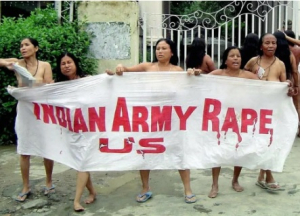

In 2009, two women from Shopian in Kashmir were allegedly abducted, repeatedly gang-raped by soldiers, and murdered. Their bodies were recovered from a river.
In 2010, a 16-year-old Zahid Farooq Sheikh was shot and killed by BSF personnel as he was walking home from playing cricket with friends in Srinagar.
In 2015 and 2016, a National Commission for Scheduled Tribes (NCST) fact-finding report documented three instances of mass sexual violence including gang-rapes, physical assault, and looting by police and paramilitary personnel deployed on anti-Maoist operations in Chhattisgarh. The victims were Adivasi women, subsistence farmers. The report concluded that there had been a breakdown of discipline among the forces concerned.
In 2021, soldiers from the 21 Para Special Forces army unit shot and killed six coal miners in Nagaland’s Mon district, for mistaking the miners for militants.
These are only a few cases that reached the media. The structure of the law and the barriers to FIR registration in conflict areas means that for every case that surfaces, an unknown number do not.
In 2018, over 350 army personnel filed a petition in the Supreme Court to protect the AFSPA from being diluted. Its defenders argue that soldiers operating in counter-insurgency environments face split-second, life-or-death decisions. They are trained not to open fire unless they are fired upon, attacked, or have reasonable grounds to believe an attack is imminent. AFSPA was enacted in 1958 to enable the deployment of the armed forces in areas where the civil administration had failed to maintain law and order. The legal protection under AFSPA is therefore justified, they contend, because actions taken during combat cannot be judged with the benefit of hindsight.
The criticism, however, is not that soldiers acting in good faith during genuine combat operations should be prosecuted. It is that the shield of prior sanction has repeatedly been invoked to protect those accused of abusing that power.
For instance, in Manorama’s case mentioned before, the post-mortem revealed injuries consistent with torture, including bullet wounds on her vagina. Most significantly, the Central Forensic Science Laboratory detected human semen on her clothing, suggesting that she had been sexually assaulted before her death. Yet the Assam Rifles invoked Section 6 of AFSPA to argue that no legal proceedings could continue without prior sanction from the Central Government. Manorama’s family questioned how acts such as rape, torture and the killing of an unarmed woman could ever be considered actions taken ‘in aid of civil power’ or in the exercise of official duty.
The full Human Rights Watch report can be accessed here.
Put very simply, there is no operational rationale for extending immunity to those who have abused the power, and specifically in the offence of rape. Unlike the use of force during an armed encounter, rape can never be characterised as a split-second military judgment or an act committed in good faith in the discharge of official duties. It is an intentional criminal act. The law offers no convincing explanation for why allegations of rape should be subject to the same procedural immunity as decisions taken during armed engagement.
According to Margot Walstrom, Special Representative of the UN Secretary-General on Sexual Violence in Conflict, “[Sexual violence] is a way of demonstrating power and control. It inflicts fear on the whole community. And it is unfortunately a very effective, cheap and silent weapon with a long lasting effect on every society.”
A 2019 paper titled ‘Violence against women by the army personnel’ reads, “Many in Mizoram do not even talk about those days when such trauma was so prominent as to bring gushes of trauma to them. Those instances have been simply called “troubles” and no discussion takes place, such is the trauma that has been inflicted on people.”
In India’s conflict zones, sexual violence has long been dismissed as ‘collateral damage.’ As an unfortunate but inevitable cost of maintaining order in disturbed areas. However, it arguably is a documented, recurring pattern of abuse that is shielded by law and enabled by institutional silence.
The severity and persistence of the reports surrounding rapes by uniformed personnel compelled the Justice Verma Committee constituted in the wake of the 2012 Nirbhaya gang-rape to specifically examine the position of women in conflict areas and recommend a review of the AFSPA. The committee explicitly said that women in conflict areas are entitled to all the security and dignity that is afforded to citizens in any other part of our country.
That was over fifteen years ago.
In the intervening period, India has overhauled its criminal law framework wholesale, replacing the Indian Penal Code, the Code of Criminal Procedure, and the Evidence Act with new statutes expressly on the ground that the old laws were colonial relics. But the provisions of AFSPA, the Border Security Forces (‘BSF’) Act, the Army Act 1950, and the Disturbed Areas Act 1992 that shield uniformed personnel from prosecution for crimes committed against civilians remain untouched.
The Legal Architecture
Several statutory provisions form the backbone of security force immunity in India.
Section 197 of the Code of Criminal Procedure, 1973 (now Section 218 of the Bhartiya Nyaya Suraksha Sanhita ) requires government sanction before a court can prosecute judges and public servants, including armed forces and police officials, for offenses committed while discharging official duties unless the Central Government first grants sanction for prosecution. The Ministry of Home Affairs is vested with the authority to grant sanction for prosecution of public servants.
Section 47 of the BSF Act provides that BSF personnel accused of serious civil offences including murder, culpable homicide not amounting to murder, or rape against civilians cannot ordinarily be tried by an internal Security Force Court, unless the offence was committed on active duty, outside India, or at a location specifically notified by the Central Government. Read alongside the sanction requirement, this provision can operate as a gap between two forums where civilian courts are barred without sanction and military courts barred by the section itself.
Similarly, Section 70 of the Army Act, 1950 specifies when military personnel cannot be tried by a court-martial for certain serious crimes against civilians.
According to section 6 of the AFSPA no prosecution, suit, or legal proceeding may be brought against any person acting under AFSPA without the prior sanction of the Central Government. This provision has operated in parts of the Northeast since 1958 and in Jammu and Kashmir since 1990.
How have the Courts acted?
In Sebastian Hongray v. Union of India (1984), the petitioner, a student from the Naga community contended that two men were unlawfully detained by the 21st Sikh Regiment during a combing operation in Huining village of Manipur. The Army could not produce or account for two men taken into custody and asserted that the men had left the army camp alive and that an extensive search, including a CBI enquiry, had failed to locate them in Manipur. The Court applied habeas corpus directly against the Union of India and later imposed exemplary costs. The Court said:
“As we are inclined to direct registration of an offence and an investigation, we express no opinion as to what fate has befallen to Shri C. Daniel and Shri C. Paul, the missing two persons in respect of whom the writ of habeas corpus was issued save and except saying that they have not met their tragic end in an encounter as is usually claimed and the only possible inference that can be drawn from circumstance already discussed is that both of them must have met an unnatural death. Prima facie, it would be an offence of murder.
….
It is not necessary to start casting a doubt on anyone or any particular person. But prima facie there is material on record to reach an affirmative conclusion that both Shri C. Daniel and Shri C. Paul are not alive and have met an unnatural death. And the Union of India cannot disown the responsibility in this behalf.”
A decade later, in Nilabati Behera v. State of Orissa (1993), the Supreme Court confronted the death of a man after arrest by the police. With characteristic directness, the Court held that the doctrine of sovereign immunity used to shield the State from civil liability has no place in proceedings for the enforcement of fundamental rights and that:
“There is a great responsibility on the police or prison authorities to ensure that the citizen in its custody is not deprived of his right to life. His liberty is in the very nature of things circumscribed by the very fact of his confinement and therefore his interest in the limited liberty left to him is rather precious. The duty of care on the part of the State is strict and admits of no exceptions.”
“A reading of the morning newspapers almost everyday carrying reports of dehumanising torture, assault, rape and death in custody of police or other governmental agencies is indeed depressing,” was the Court’s observation in D.K. Basu v. State of West Bengal (1996) in which it issued a comprehensive set of binding guidelines governing arrest, documentation, medical examination, and notification of family members, and held that violation of these guidelines would render police officers personally liable for contempt of court. The Court reiterated that defence of sovereign immunity is not available to the State for the tortious act of the public servants and for the established violation of the rights guaranteed by Article 21 of the Constitution of India.
In Naga People’s Movement of Human Rights v. Union of India (1997), the Supreme Court constitutionally upheld the validity of AFSPA. It also curated a list of ‘Do’s and Don’ts,’ in which the use of excessive force or retaliatory force by the Manipur Police or the armed forces of the Union was not permissible.
However, the provision that ASPA’s protection was not absolute and that it did not grant a ‘licence to kill indiscriminately’ remained a judicial aspiration rather than an enforceable limit.
Significantly in 2012, a division bench of Justices BS Chauhan and Swatenter Kumar while hearing the Pathribal case at the Supreme Court orally remarked that AFSPA gave very limited protection confined to action in discharge of duty and that rape and murder committed by its personnel should be considered a normal crime. The Court said that there is no question of sanction from the government before prosecution of offenders in such cases. Reported The Indian Express.
“You go to a place in exercise of AFSPA, you commit rape, you commit murder, then where is the question of sanction? It is a normal crime which needs to be prosecuted, and that is our stand,” the bench said. However, ultimately the Court held that where AFSPA’s protection applies, prior sanction from the Central Government is required before the criminal court can take cognizance of the offence but if the competent Army authority opts for trial by court-martial, no such sanction is needed.
In 2013, the Supreme Court affirmed that the power of the armed forces to seek trial before a General Security Force Court is not unlimited. In the case concerning the killing of a teenager by BSF personnel, a Bench of Justices Chandramauli Prasad and Ibrahim Kalifulla set aside a Jammu and Kashmir High Court order that had transferred the trial to a General Security Force Court under the BSF Act, 1968. The Court described the allegations against the accused as “very distressing” and held that merely because the personnel were on active duty in a disturbed area did not automatically entitle the BSF to claim jurisdiction. The Court also held that the commanding officer’s discretion to seek trial before a security force court was not absolute and had been exercised without considering the statutory restrictions requiring such a course to be necessary in the interest of discipline.
In Extra-Judicial Execution Victim Families Association (EEVFAM) v. Union of India (2016), the Court examined 1,528 alleged encounter killings by police and armed forces in Manipur between 1979 and 2012. A court-appointed Justice Hegde Commission investigated six cases and concluded that none were genuine encounters and that the security forces had exceeded their powers.
While hearing the case, a bench of Justices Madan B Lokur and U U Lalit rapped the Army for silence over the allegations and questioned the state government for not proceeding with these cases against them. “Don’t you want to inquire even if somebody makes such allegations against your people (Army personnel)? Are you saying whatever was done was legitimate,” the bench asked. “The reports clearly suggest that the girl was subjected to rape. You are creating a stonewall and you do not want to break that stonewall. You have not tried anything. You have not asked the Army to handover the custody of the alleged culprits,” the Court added.
In its 2017 judgment, the Supreme Court held that even in a disturbed area under AFSPA excessive or retaliatory force is prohibited and ordered every death caused by the armed forces or police to be thoroughly enquired into.
“It does not matter whether the victim was a common person or a militant or a terrorist, nor does it matter whether the aggressor was a common person or the State. The law is the same for both and is equally applicable to both,” the order read.
The EEVFAM litigation remains alive as a continuing mandamus.
Still, it is relatively uncommon for allegations of rape against armed forces personnel to culminate in prosecution before ordinary civilian criminal courts. Instead, cases have often been dealt with through the military courts, if dealt at all. When convictions have resulted from court-martial proceedings, civilian High Courts have generally examined them in the exercise of judicial review rather than hearing the criminal case at first instance.
In Captain Vinod Kumar vs State of J&K (2012), the Jammu and Kashmir High Court heard the case of two members of the 8th Battalion JAKLI who allegedly broke into a residential house in Poonch and repeatedly raped two women, aged 18 and 24, in front of the victims’ young children. The Army’s Commanding Officer initially opted in 1999 for the accused to be tried by a civil criminal court rather than a Court-martial. However, the petitioners challenged this. The Court ruled that the trial should not be abandoned and rejected the idea that army personnel should go ‘Scott free’ due to procedural errors. It famously noted that “Crime does not die in this manner” and emphasized that the seriousness of a rape charge outweighs technical procedural wrangles.
In 2014, a division bench of the Jammu and Kashmir High Court upheld the sentence by the Summary General Court Martial which found four army personnel guilty of rape and sentenced them to ten years of rigorous imprisonment and dismissal from service. The Court ruled that Court Martial proceedings can only be invalidated if there is a breach of fundamental procedural rules that renders the trial illegal. The Court emphasized that there cannot be “any compromise with the standards and maintenance of discipline in the army. They are not only the sentinels of the frontiers of the country but are also sacred guards of the rights of the people. Any invasion of the rights of the people by this kind of force cannot be tolerated.”
Where the Courts have deferred.
Despite this increasingly robust jurisprudential framework limiting blanket immunity under AFSPA, accountability has remained elusive. More than three decades after the alleged mass rapes in Kunan and Poshpora, judicial and investigative orders have been repeatedly challenged, stayed, or left unresolved. In 2015, the Jammu and Kashmir High Court stayed the Magistrate’s order directing further investigation after objections by the Army. Separately, the State challenged the recommendation of the Jammu and Kashmir State Human Rights Commission awarding compensation to the survivors before the Supreme Court. In its report, the Commission observed that the Director General of Police had attempted to “push the collective crime committed by the army personnel under the carpet” and that the medical evidence pointed towards gang rape. Following the abrogation of Article 370, the State Human Rights Commission itself ceased to exist, while the compensation proceedings remain pending before the Supreme Court and the criminal proceedings continue to languish without final adjudication. Reporter The Outlook.
The litigation in Extra Judicial Execution Victim Families Association (EEVFAM) continues as a court-monitored process nearly a decade after the Supreme Court’s landmark rulings. Thangjam Manorama Devi’s case, despite forensic evidence suggestive of sexual assault and repeated judicial scrutiny, has similarly failed to result in criminal prosecution. In these cases justice has been deferred through prolonged litigation, jurisdictional objections, repeated appeals, and institutional inaction. The consequence is much the same that is the promise of accountability remains suspended indefinitely.
According to Rishika Arora and Iyina Grover, there is a requirement for a new protocol for protecting the women in an armed conflict. Women’s participation in the drafting of future laws and their appointment as judicial officers in army tribunals are essential steps. The concept of the court martial must be women-oriented.
The Justice Verma Committee recommendations are as follows:
- Sexual violence against women by members of the armed forces or uniformed personnel must be brought under the purview of ordinary criminal law;
- Special care must also be taken to ensure the safety of women who are complainants and witnesses in cases of sexual assault by armed personnel;
- There should be special commissioners – who are either judicially or legislatively appointed – for women’s safety and security in all areas of conflict in the country. These commissioners must be chosen from those who have experience with women’s issues, preferably in conflict areas. In addition, such commissioners must be vested with adequate powers to monitor and initiate action for redress and criminal prosecution in all cases of sexual violence against women by armed personnel;
- Care must be taken to ensure the safety and security of women detainees in police stations, and women at army or paramilitary check points, and this should be a subject under the regular monitoring of the special commissioners mentioned earlier;
- The general law relating to detention of women during specified hours of the day must be strictly followed;
- Training and monitoring of armed personnel must be reoriented to include and emphasize strict observance by the armed personnel of all orders issued in this behalf;
- There is an imminent need to review the continuance of AFSPA and AFSPA-like legal protocols in internal conflict areas as soon as possible. This is necessary for determining the propriety of resorting to this legislation in the area(s) concerned; and
- Jurisdictional issues must be resolved immediately and simple procedural protocols put in place to avoid situations where police refuse or refrain from registering cases against paramilitary personnel.
Those recommendations remain unimplemented.
The Supreme Court has already suggested that AFSPA’s protection is limited to acts conducted in the line of duty, and that offences such as rape and murder are ordinary crimes that do not require special courts. The incorporation of these suggestions remains awaited because the nation will not fully deliver on its constitutional promise until its laws place all citizens, including those in its border areas and conflict zones, on an equal footing before justice.
“The primary task of the armed forces of the Union is to defend the country in the event of war or when it is face with external aggression. Their training and orientation defeat the hostile forces. A situation of internal disturbance involving the local population requires a different approach. Involvement of armed forces is handling such a situation brings them in confrontation with their countrymen. Prolonged or too frequent deployment of armed forces for handling such situations is likely to generate a feeling of alienation among the people against the armed forces who by their sacrifices in the defence of their country have earned a place in the hearts of the people,” said the Court in Naga People’s Movement of Human Rights in 1997.
Nearly three decades later, that warning remains as relevant as ever. The Mizoram conviction in the 2017 case is still, in this landscape, a welcome anomaly even though it took the Court nine years to reach a decision because it shows what the system is capable of. The guarantee that every woman in a conflict area who files a complaint will have her case heard by a court that is independent of the institution she is accusing is perhaps the minimum that the Constitution already promises and what the Mizoram court, in its judgment of June 2026, briefly delivered.
(The legal research team of CJP consists of lawyers and interns; this judgement primer has been worked on by Tanishka Shah)
Related
Revisiting the Justice Verma Committee report of 2013: #JusticeForRapeVictims
The story I never got to tell – of rape and torture by the Indian army
NHRC issues notice to MoD for compensating victim of Army’s “indiscriminate” firing
Will Army Court Martial Captain who allegedly took money to stage Shopian ‘encounter’?