


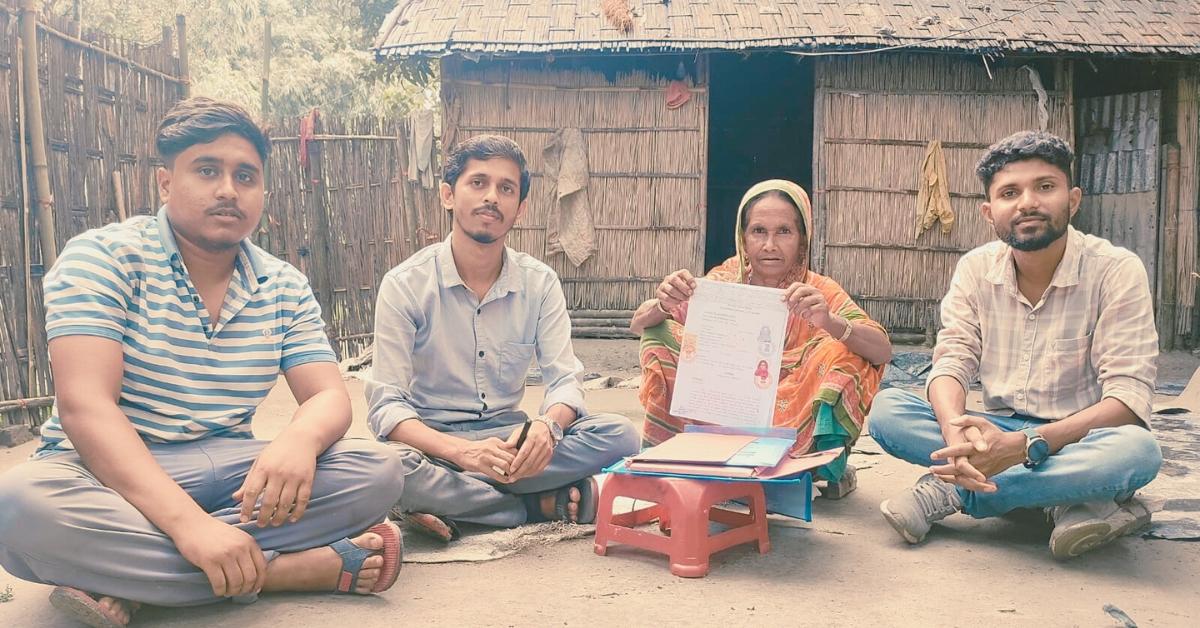
Citizens for Justice and Peace (CJP) has secured another victory in Assam, where countless marginalised people face arbitrary and humiliating challenges to their citizenship. This time, the triumph belongs to Mazirun Bewa, a widowed daily wage worker from Jhapusabari Part III village in Dhubri district, who was wrongfully branded a “foreigner.”
After years of fear, suffering, and uncertainty, Mazirun Bewa @ Maziran Bewa has finally been declared an Indian citizen by birth by the Dhubri Foreigners’ Tribunal No. 10, in a reasoned order dated May 21, 2025.
A widow’s struggle
Mazirun’s life speaks to the cruelty of administrative suspicion when it collides with poverty. Born on December 16, 1963 in Balabhut village, Tufanganj, Coochbehar (West Bengal), she was taken to Assam when she was about 2–3 years old and brought up in Jhapusabari. She married Samsul Fakir (of Jhapusabari Part-III) and raised a daughter, Rokeya Khatun. After losing her father and then her husband, she survived on daily wages — often earning only ₹150 per day — and lived alone in a small hut with her grandson on borrowed land while her daughter worked at a brick factory.
Every week, CJP’s dedicated team in Assam, comprising community volunteers, district volunteer motivators, and lawyers, provides vital paralegal support, counseling, and legal aid to many affected by the citizenship crisis in over 24 districts in Assam. Through our hands-on approach, 12,00,000 people successfully submitted completed NRC forms (2017-2019). We fight Foreigner Tribunal cases monthly at the district level. Through these concerted efforts, we have achieved an impressive success rate of 20 cases annually, with individuals successfully obtaining their Indian citizenship. This ground level data ensures informed interventions by CJP in our Constitutional Courts. Your support fuels this crucial work. Stand with us for Equal Rights for All #HelpCJPHelpAssam. Donate NOW!
One day in the field two men in civil clothes handed her a white paper: a foreigner notice. Confused and terrified, she did not know what to do, whom to ask, or how to pay for legal help. She was later found crying in the Ronpagli market, clutching the notice and pleading for small amounts to fund a case. It was there that CJP community volunteer Jinnar Hussain (Bapon) found her and read the paper. He calmed her and promised CJP would take up her case.
CJP’s field response — human, legal and logistic support
Mazirun had never heard of CJP. When our team visited her at her hut they explained the process, built trust, and took on the case without charging her. The practical barriers were real: each hearing in Dhubri cost a minimum of ₹300 for travel — twice her daily wage.
Team CJP Assam with Mazirun Bewa outside her home

CJP’s volunteers stepped in:
- Jinnar Hussain (Bapon) located and calmed her in the market.
- Zahid Hussain (Rohan) handled online applications and paperwork.
- DVM Habibul Bepari and team arranged and paid for travel.
- State in-charge Nanda Ghosh coordinated with local officials and persuaded the Gaon Pradhan of Balabhut (West Bengal) to issue a certificate and testify — a crucial linkage document.
- Advocate Iskandar (Ishkendar) Azad led the legal team in court.
Mazirun remembers CJP’s support in her own trembling words and in the assurance, she gave to her daughter over the phone she was sure that CJP will not let anything happen to her.
“ai j bhai banaya dilam, bhai nai tomar, kotha kow. Bujailo na, kando na. kandish naa! Ami Dhubri jamu manush ekjon niya jamu, ora ase na sathe! oi j beta ase naa sathe!Ora dekhpo na amak!! Kischu hobo na (I found you a brother; you don’t have a brother — talk to him. Don’t cry. I will go to Dhubri with one person; they (CJP) are with me. My son is there too. Nothing will happen to me!)”
Documentary legacy and the Tribunal record
Mazirun’s family history is recorded across official documents:
- Her family’s name appears in electoral rolls going back decades: father in 1960 (Mouza: Balabhut), father again in 1977 at Jhapusabari, and Mazirun herself in 1997, 2005 and 2024 at Jhapusabari.
- A registered sale deed (Deed No. 3570 dated March 30, 1962) shows her father and uncles purchased land in Dhubri (covering 6 bigha, Touzi No. 419) — documentary proof of residence in Assam well before 1 January 1966 (the critical cut-off under the Assam Accord).
- She produced identity documents (Voter EPIC, PAN, Aadhaar) and gave sworn testimony (examined as DW-1). Her younger brother (DW-2) corroborated her evidence. The Election Officer of Dhubri authenticated certified copies of the electoral rolls in response to a tribunal summon (report dated January 7, 2025), and the Sub-Registrar’s office authenticated the 1962 deed. These evidences were accepted by the Tribunal as genuine and trustworthy.
Prior official enquiries — contradictory procedural history
Before the Tribunal reference, official enquiries had already found that Mazirun did not appear to be an illegal migrant. An inquiry under the Illegal Migrants (Determination by Tribunals) Act, 1983 concluded she was not an illegal migrant, and a later inquiry in 2008 also returned a similar finding. The Superintendent of Police (Border), Dhubri, had recommended that the case be forwarded to the Tribunal with the intimation that the suspect does not appear to be a foreigner — hence the case may perhaps be dropped. Yet despite those findings the instant reference proceeded and notice was served, forcing her into another round of hearings.
The Tribunal’s reasoning and conclusion (summary & analysis)
The Tribunal’s order (Case No. FT-10/AGM/2341/2020; old F.T. No. 9783/GKJ/11; Reference: F.T. Case No. 148/08) dated May 21, 2025 examined the record, the oral testimony, and documentary evidence. The Tribunal made these key findings:
- Primary legal question: Whether the opposite party is a foreigner within the meaning of the Foreigners Act, 1946.
- On documentary proof: The sale deed of March 30, 1962 (Deed No. 3570) was proved via the Sr. Sub-Registrar (Ext:E) and demonstrates that the father and uncles were resident landholders in Dhubri as early as 1962; this is powerful primary evidence of family residence in India prior to 1966.
- Electoral rolls and authenticated copies (Ext:A–D): The Tribunal accepted certified copies of electoral rolls for 1977, 1997, 2005 and 2024 as genuine and admissible secondary evidence, and the Election Officer’s authenticated report (07/01/2025) strengthened this proof.
- Contradictions and limited documents: The Tribunal noted some contradictions (for example between Ext:E and certain other documents — Ext:I / PAN details) and observed that a certificate issued by the Prodhan (Ext:F) was initially beyond his jurisdiction and not proved in the record; therefore Ext:F was not relied upon in isolation.
- Oral testimony: The opposite party (DW-1) and her brother (DW-2) corroborated the documentary trail; official witnesses (DW-3, DW-4) were examined and assisted the record.
- Overall conclusion: Taken together — the sale deed (1962), electoral records, authenticated reports by the Election Officer, and reliable oral testimony — establish that Mazirun’s father and family resided in India prior to January 1, 1966. Therefore, by descent and birth, the opposite party is a citizen of India and cannot be termed a foreigner. The reference was answered in the negative and the Tribunal directed intimation be sent to the Superintendent of Police (Border), the District Magistrate, and the Election Officer, Dhubri.
The Tribunal concluded that since the father of the opposite party was residing in India prior to January 1, 1966 and continuously thereafter, and as her linkage to him is proved through reliable documents and testimony, the opposite party is an Indian citizen by birth. She cannot be termed a foreigner.
The reference was answered in the negative, meaning the case against her stands dismissed.
More than legal victory — a human story
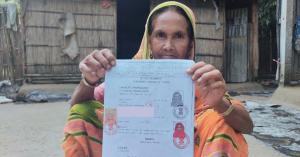
Mazirun Bewa holding up the Foreigners’ Tribunal Order declaring her an Indian

Beyond the legal fight, Mazirun’s story is one of survival and dignity. Uneducated, widowed, and impoverished, she admitted she might not have survived the ordeal without CJP’s support:
“It was not possible for me to do it alone. Maybe I would have died with this burden of being called a foreigner in my own country.”
Mazirun’s ordeal is not an isolated case. Thousands of poor, often unlettered people — disproportionately women and widows — in Assam are routinely served notices branding them “foreigners.” Many have clear documentary evidence of citizenship, yet are dragged into expensive, humiliating, and life-threatening legal battles.
In Mazirun’s case, despite repeated findings by officials that she was not a foreigner, the system still forced her through a long legal battle. This reflects both the arbitrariness of the process and the systemic targeting of marginalised communities.
CJP’s intervention — from psychological counselling, logistical aid, and financial support, to legal defence — ensured justice.
What the order means and its implications
- Legal victory: The Tribunal’s order formally restores Mazirun’s citizenship status and ends the foreigner suspicion in this reference. The order is built on documentary continuity (pre-1966 land records, multiple electoral rolls) and corroborated witness testimony — a classic linkage proof.
- Procedural oddity: Despite prior inquiries and the SP(B)’s recommendation that the case “may perhaps be dropped,” a reference proceeded — showing how bureaucratic inertia or automated reference processes can keep poor people trapped in legal uncertainty.
- Human cost: The order does not erase the years of anxiety, the stigmatising notice, the travel and expense burden (₹300 per hearing vs ₹150 daily earnings), or the humiliation experienced by a widowed, uneducated woman in her 60s. It does, however, restore legal status and dignity.
- CJP’s impact: Practical assistance (document applications, travel funding, counselling, securing local certificates, and courtroom representation) made the legal outcome achievable. Even where the Prodhan’s certificate (Ext:F) was not relied upon by the Tribunal, CJP’s local coordination was crucial in assembling evidence and keeping Mazirun engaged in the process.
Mazirun Bewa’s story is a resounding example of resilience and solidarity. The judgment of the Foreigners’ Tribunal on 21 May 2025 does not just restore her citizenship on paper — it restores her dignity and rights as an equal Indian.
This victory highlights the life-changing impact of CJP’s on-ground work in Assam: defending the voiceless, empowering the vulnerable, and standing firm against the injustice of arbitrary citizenship trials.
The complete order may be read here.
Related:
Victory in Dhubri FT: Jarina Bibi declared Indian after years of ordeal
Assam’s New SOP Hands Citizenship Decisions to Bureaucrats: Executive overreach or legal necessity?
India’s New Immigration Order 2025: Consolidation or continuity of exclusion?
Not a Foreigner! Foreigners’ Tribunal declares Sukumar Baishya Indian citizen