


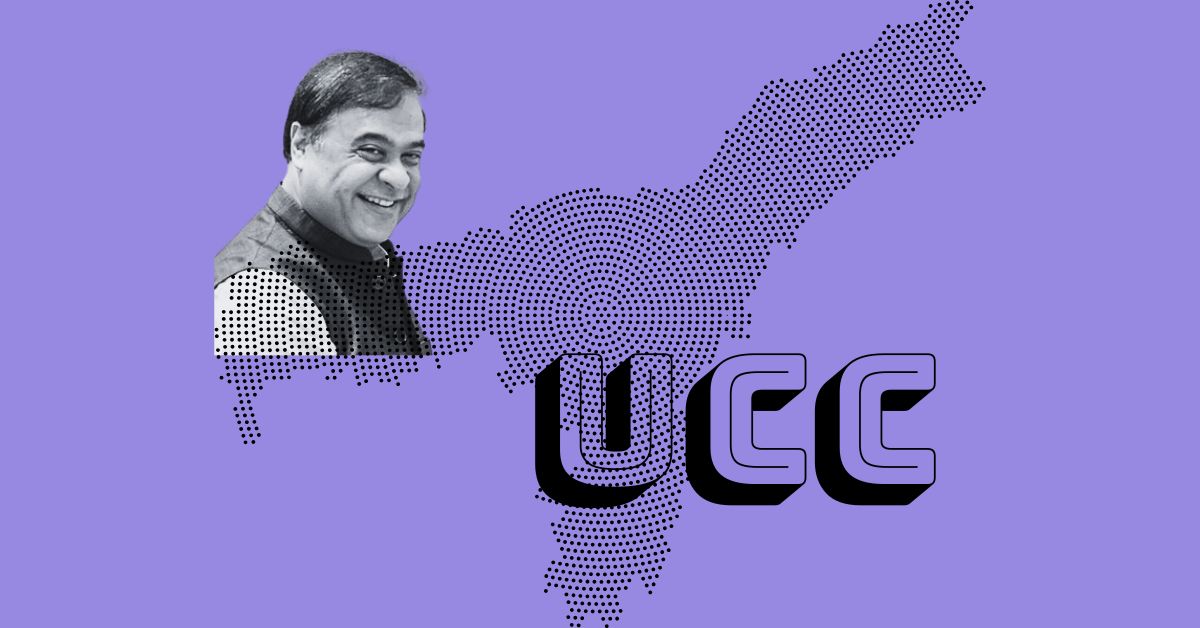
ON MAY 27, 2026 Assam became the first north-eastern state to pass the Uniform Civil Code (‘UCC’). Uttarakhand was the first state to do so in 2024, followed by Gujarat earlier this year. All three governed by the Bhartiya Janta Party (BJP).
The idea of a UCC in India has been debated for decades including within the Constituent Assembly itself, but its recent passage in BJP-governed states has reignited the question of whether this reform is genuinely about protecting women’s rights across communities, or is it primarily a political tool aimed at communalising what is, at its core, a secular problem of gender justice. Chief Minister Himanta Biswa Sarma has openly linked the passage of the UCC to the BJP-RSS ideological project, stating that, “Had I not been a BJP CM and a swayamsevak of RSS, probably I would not have been able to bring the UCC to the assembly.” Interestingly Sarma currently serving as the 15th Chief Minister of Assam was a former member of the Indian National Congress (INC) who joined the BJP only on August 23, 2015!
‘Uniform Civil Code or Gender Justice?’ was the question raised around thirty-two years ago by the 1994 cover story of Communalism Combat. Teesta Seetalvad wrote:
“Through its constant argument that enacting a uniform civil code will bring about national integration, the Sangh Parivar has succeeded in making many Hindus believe that, one, only “separatist-minded” Muslims are opposed to a uniform law, and, two, the uniform civil code will only affect Muslims.”
Remarkably, that observation remains just as germane today. What this narrative however ignores is one, the call to do away with several practices, including polygamy, have come from Muslim women themselves (all while the BJP has adopted this issue as one of its own), and, two, all personal laws irrespective of religion have an-anti woman bias. Reported the Hindustan Times. Practices such as restitution of conjugal rights and the absence of no-fault divorce have existed in many religious communities. The broad powers granted to testators to will away property have long enabled the disinheritance of vulnerable family members across many faiths. The 2018 Law Commission report suggested that the legislature first consider guaranteeing equality within communities‘ between men and women, rather than equality between communities while suggesting that personal law reform over a UCC is recommended.
“Various aspects of prevailing personal laws disprivilege women. This Commission is of the view that it is discrimination and not difference which lies at the root of inequality,” the report read.
What the Bill changes
The Bill aims to unify all personal family laws, including issues related to marriage, divorce, intestate and testamentary succession, and live-in relationships within the State of Assam. It applies to all residents of the state; including those living outside its territories, but it specifically excludes members of any Scheduled Tribes.
It sets uniform conditions for a valid marriage, including a minimum age of 21 for men and 18 for women, replacing the varying thresholds that existed under some personal laws. The religious ceremony through which a marriage is solemnised (whether a Saptapadi, Nikah, Holy Union, Anand Karaj, or any other recognised rite) remains valid and untouched.
The Bill explicitly prohibits polygamy; however, this is not a novel change as only last year, Assam had passed a law banning polygamy across the state. The UCC also standardises the list of prohibited relationships. This has an impact on Muslim personal law, which permitted marriage between first cousins.
Compulsory registration of all marriages within sixty days of the ceremony is introduced for the first time as a uniform requirement though several states, notably Maharashtra had introduced a separate law for this in 1999 while retaining personal laws (Maharashtra Regulation of Marriage Bureaus and Registration of Marriages Act, 1998). Failure to register attracts penalties, though importantly the UCC clarifies that non-registration does not by itself render a marriage invalid. The Bill also establishes procedures for judicial separation and the restitution of conjugal rights. The framework provides standardised grounds for divorce (such as cruelty, desertion, or mutual consent) and extrajudicial methods of dissolving a marriage or unilateral divorce are no longer legally recognised for any community. Maintenance during the pendency of proceedings and permanent alimony after a decree are available to either spouse, again, without any community-specific distinction.
The UCC’s most far-reaching provisions concern succession, where it departs most sharply from the existing personal laws of several communities. It defines a clear ‘Order of Preference’ for how property is distributed when a person dies without a Will. Class-1 heirs (including the spouse, children, and parents) generally succeed simultaneously and take equal shares. For a detailed understanding of this, read a previous analysis by Citizens for Justice and Peace here
Lack of stakeholder consultation
Hasina Khan and Mridul Kaintura writing for Sabrang India in 2024 noted that conservative and orthodox religious leaders had failed their community as they sought to control their bodies under the guise of protecting the religion. However, they also wrote, “Despite spearheading the movement to bring reforms within our own communities, including the formulation of Nikah-Nama, protesting against fatwas and advocating reforms in discriminatory personal laws, the state has never taken any steps to hear our concerns and protect our rights effectively,” they added.
The UCC Bill was cleared without consulting any minority organisations who had demanded further consultations before the Bill was passed. Beyond the absence of consultations, even the text of the Bill was not placed in the public domain, despite the 2014 circular mandating that draft legislation be made publicly available for at least thirty days to invite comments and feedback. The Bill was vetted by the Assam Cabinet only May 12 before it was introduced on May 25 in the State Assembly and passed on May 27 after about five hours of discussion and debate. As per reports in both The Hindu and The Shillong Times.
The manner in which the Assam government pushed through the UCC Bill is not an isolated instance but reflective of a growing pattern across India where major legislative changes are introduced with little transparency and minimal consultation with those most affected. Similar criticisms accompanied the Transgender Persons (Protection of Rights) Amendment Act, 2026, and the Delimitation Bill.
CM Sarma in fact went on record to say that Congress’s opposition does not matter because except one Congress MLA, rest of the 18 MLAs represent a particular religion. He was referring to eighteen of the 19 MLAs of Congress, the largest opposition party, who are Muslims. This brazen vocal exclusion and segregation of elected representatives of the religious minorities bodes ill for any representative and participative democracy. Reported in The Times of India.
Dr Noorjehan Safia Niaz, co-founder of the Bharatiya Muslim Mahila Andolan, had said last December that her organisation had twenty-five points specifically relating to Muslims that must be included in any UCC, among them the preservation of mehr (the compulsory payment by the husband to the wife upon marriage, which provides a measure of financial security). The Bill does not incorporate any of the positive and progressive aspects of Muslim personal law. The mehr, nikahnama (which allows spouses to negotiate mutually agreed and legally enforceable conditions in the marriage contract) have completely omitted or left out, as has the one-third limit rule on willing away property for the first spouse and children, which served as a protection against complete disinheritance. The practice of khula, through which a Muslim woman may initiate divorce on grounds such as irreconcilable differences, neglect, or lack of financial support, has not been codified and extended to all women representing a missed opportunity to give every woman a meaningful right to exit a marriage independently. Such legislative exclusion is reflective of a majoritarian bias through exclusion that fails to introduce or include cultural-religious norms from varied communities that are or maybe progressive. As per a report in reddif.com.
The restitution of conjugal rights, which legally compels an unwilling spouse to return to cohabitation, and in the case of a wife could expose her to the risk of rape and forcible pregnancy, has also been retained at a time when its constitutional validity is actively challenged before the Supreme Court and the 21st Law Commission Report recommended its removal. The Bill is entirely silent on custody, and guardianship which are the areas in which Hindu law and Mohammedan law (after seven years of age) gender-based discrimination has been extensively commented upon as the guardianship of a minor boy or unmarried girl vests in the father before the mother.
Had the government followed stakeholder consultations and the Law Commission’s recommendations, would a Bill ostensibly rooted in gender justice have overlooked such regressive practices?
“Instead of maintaining a silence on all these anti-women and pro-men or pro-Hindu provisions of family laws, should not the debate on reforms in family laws be re-framed by secularists incorporating all these arguments with a correct perspective?” had asked Setalvad in 1994.
Exclusion of Scheduled Tribes
In a report in The Times of India, the most glaring contradiction in a supposedly uniform code is the blanket exemption granted to Scheduled Tribes. As per the last census (which was over 15 years ago!), 12.4 per cent of Assam’s population constitute of scheduled tribes meaning their exclusion removes a significant section of the state’s residents from the scope of legislation. When asked to justify this, CM Sarma reportedly stated that,
“Medicine will be given where there is illness… UCC will give radiotherapy, chemotherapy where there is cancer. Where there is no cancer, there is no necessity of giving radiotherapy.”
“Whether we bring UCC or not, our tribal people never accept polygamy … Our tribal people give equal rights to girls, they do not accept live-in relations. Self regulation is the best regulation. If Hindu and Muslim societies also had customary rights like tribals and our society would have been tied together with equal rights like them, maybe a UCC would not have been required for anyone,” he added.
In his speech in the House, he also stated that the society rarely sees distressed or neglected women within tribal societies, like that of the Shah Bano case because through their customary rights and customary courts, these communities had already been regulating their social systems.
This stance is perhaps ignorant of first, the socio-economic status of tribal women and how that could affect their access to courts and second, the available data and judicial record! Were consultations with tribal women held for the State to arrive at this conclusion?
According to the International Institute for Population Sciences, compared to the national average of 1.4 per cent (NFHS-5), the rate of polygamy was 2.4 among STs. Tribal communities have also historically opposed women’s inheritance rights on the grounds that recognising such rights would result in land being alienated to non-tribals through inter-community marriage. As per reports in The Print and the Hindustan Times.
There are also cases where tribal women have knocked on the doors of courts! In Gopal Singh Bhumij v. Giribala Bhumij (1990), a ST woman who sought the partition of her father’s property, was denied the same by the Patna High Court as she was bound by tribal custom, which excluded daughters from inheritance. In Smt. Butaki Bai v. Sukhbati (2005), a daughter of the Halba tribe similarly failed to obtain inheritance rights because she could not provide sufficient evidence of Hinduisation. In Ram Dev Ram v. Dhani Ram (2016), a daughter of the Uraon tribe was denied inheritance rights because she did not follow the tribal custom. All of this demonstrates that customary tribal law is neither beyond scrutiny nor inherently gender-just.
“What does uniform mean?… The content of this large Bill does not align with its title. Because to be uniform, it has to be the same for everyone staying in this state. I have no objection with someone being left out from it, I respect all tribes and communities, but the name should be changed… The CM and the other MLAs have been talking about ‘rights’ being secured by the Bill, but in that case, aren’t the women of those who are being left out being deprived of their rights?” said MLA Jakir Sikdar. As per a report in the Indian Express.
Mandatory registration of live-in relationships
One of the most controversial features of the recent UCC framework is its mandatory registration framework for live-in relationships which is a significant expansion of state and community oversight into intimate relationships. This applies even if the partners are residents of Assam living outside the state territories. Partners in such a relationship are obligated to submit a statement to the Sub-Registrar; who then conducts a summary inquiry, and must either register the relationship and issue a certificate or refuse to register with written reasons within thirty days. If either partner is below twenty-one years of age, the Sub-Registrar is legally obligated to inform their parents or guardians. In all cases, a copy of the statement is forwarded to the officer-in-charge of the local police station. Third parties are also permitted to provide information or file complaints regarding unregistered live-in relationships.
This means that a woman may marry at eighteen without parental consent, but must wait until twenty-one to enter a live-in relationship without triggering mandatory parental notification. This inconsistency is difficult to justify on any coherent principle of personal autonomy, nor has the State done its bit to explain the reason behind it.
“These are also matters concerning Muslim women, who may once again find themselves subjected to suffering at the hands of the institution of family, the state, and third parties. Here, the third party could be the involvement of any institution, from community Khaps, Jamaats to even Fatwa-judgements. The punitive measures after being unable to register the live-in relationships are in no way a protective measure but to further surveil the relationships that challenge the institution of marriage,” wrote Khan and Kaintura for Sabrang.
The Uttarakhand UCC Rules also require individuals seeking registration of a live-in relationship to furnish certification from a religious leader or community representative. In January 2025, CJP raised concerns that such rules “make it practically impossible for interfaith or inter–caste individuals to be in a live-in relationship. The requirement of religious sanction for two consenting adults to enter a live-in relationship defeats the principle of secularism provided in the Preamble of the Constitution of India.”
The UCC Rules for Assam are expected to be formulated within six months of Presidential assent. One will have to wait and see whether such draconian provisions are a part of the Assam UCC Rules too. On his X, Biswa has already linked the UCC as a panacea from ‘Love Jihad’ signaling the intent to regulate and restrict inter-faith relationships.
This is consistent with a rising trend across India where anti-conversion laws along with the mandatory public notice provisions of the Special Marriage Act, and now the UCC, create records that right-wing and Hindutva vigilante groups use to track and harass interfaith couples. Reports of young couples being attacked, or forcibly separated have become disturbingly common. Read weaponisation of laws to prevent interfaith marriages in Uttrakhand here. Stated a report in The Polis Project.
This was precisely what CJP tried to address when it challenged the constitutional validity of various State enactments regulating religious conversion. Read detailed reports here and here. By forwarding relationship data directly to police stations and permitting third-party complaints, has arguably created a fresh infrastructure for exactly this kind of extra-legal intimidation.
The Bill also maintains a complete silence on the rights of queer and transgender persons within the family, their rights to marry, and their inheritance and succession rights. In a country where the legal recognition of same-sex relationships remains contested and transgender persons continue to face pervasive discrimination, the UCC’s failure to even acknowledge their existence within the family law framework is a profound omission that no claim to progressiveness can easily paper over.
Conclusion
Women across every community have demanded reforms in personal law for decades. That is not the contention here. The concern, however, is that the UCC in name of reform is plausibly being deployed as a selective intervention that leaves comparable inequalities untouched and exempts a portion of the population on grounds it refuses to apply consistently. By introducing registration of live-in relationships, surveillance mechanisms are introduced that go against the right to privacy and dignity guaranteed by the Constitution and judgments by the Supreme Court.
Reports indicate that Madhya Pradesh is next in line and consultations have already begun. A law that is serious about gender justice would incorporate the best practices from every community and also address the silences around queer persons, HUFs, guardianship, and resist the temptation to use intimate relationships as a theatre for communal politics. By these measures, the Assam, Gujarat and Uttrakhand UCCs as passed have already fallen significantly short. Reported The Hindu.
The full draft of The Uniform Civil Code, Assam, 2026 can be accessed here
(The legal research team of CJP consists of lawyers and interns; this resource has been worked on by Tanishka Shah)
Related:
Destroying the basic standards of legislation- the Uttarakhand Model of UCC