


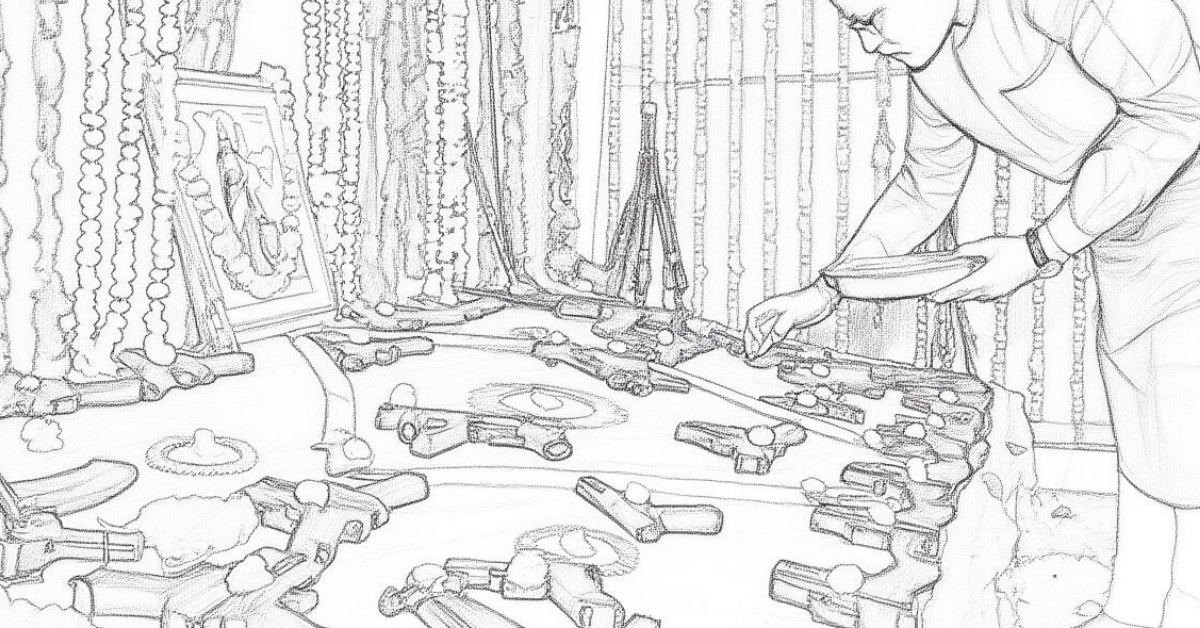
For centuries, Shastra Poojan—the veneration of arms and implements on Vijayadashami (Dussehra)—has embodied a symbolic reverence for strength, discipline, and the triumph of good over evil. Traditionally observed by martial communities and princely states, it reflected the spiritual ethos of self-defence and righteousness. In recent years, however, this ritual has been increasingly reinterpreted and repositioned. Drawn out of the private and devotional sphere of homes and temples, it is now being projected into the public and political domain—repurposed as a spectacle of power and mobilisation. Once was a personal act of faith and reflection is now at risk of being transformed into a tool for division and dominance.
The scattered incidents observed around Dussehra are not, as they might first appear, spontaneous expressions of religious fervour. They are the visible markers of a deeply entrenched, highly coordinated “hate agenda.” This agenda involves a network of right-wing organisations, explicit political patronage, and the strategic co-option of state and secular institutions.
This investigation, based on an analysis of dozens of events across India in 2025, will argue that the modern Shastra Poojan campaign is a multi-pronged political project. It is designed to (1) subvert secular public spaces, including universities and police stations, (2) normalise the public display of weapons as a symbol of religious-political power, (3) provide a sanctioned platform for anti-Muslim hate speech and communal incitement, and (4) indoctrinate a new generation—targeting young girls and children—by framing violence and weapon-bearing as a religious and civic duty. This is not about faith; it is about fomenting fear, asserting dominance, and preparing the ground for future conflict.
CJP is dedicated to finding and bringing to light instances of Hate Speech, so that the bigots propagating these venomous ideas can be unmasked and brought to justice. To learn more about our campaign against hate speech, please become a member. To support our initiatives, please donate now!
The breach of the secular citadel: co-opting universities and state machinery
The most concerning aspect of this pattern is its audacious encroachment into spaces that are, by design, secular and non-partisan: government institutions and universities. This tactic serves a dual purpose as it legitimises the weapon-centric ritual by stamping it with the state’s seal of approval, and it simultaneously attacks the very foundations of secularism in public life.
The Rajasthan University RSS event: a microcosm of conflict
The incident at Rajasthan University (RU) on September 30, 2025, stands as a revealing example of how the ritual is being politically instrumentalised. The university administration, with the Vice-Chancellor’s approval, granted permission to the Rashtriya Swayamsevak Sangh (RSS) to hold a Shastra Poojan ceremony within the campus premises—effectively allowing a partisan socio-political organisation to occupy an academic space. This decision marked a serious institutional lapse, blurring the line between education and ideology. Reported Times of India.
The sequence that followed was both avoidable and foreseeable. Student leaders from the NSUI staged a protest against what they viewed as the communalisation of their university. The situation spiralled when a section of NSUI members reportedly vandalised the event stage set up by the RSS, triggering clashes between the two groups.
राजस्थान यूनिवर्सिटी में RSS के कार्यक्रम के शुरू होने से पहले NSUI कार्यकर्ताओं ने मंच पर चढ़कर पोस्टर फाड़े और पोडियम गिराया
यह ताकत है कांग्रेस की संघियों देख लिया
— Sandeep Singh (@ActivistSandeep) September 30, 2025
The police, instead of intervening impartially, allegedly stood by during the confrontation and later detained several NSUI members, including State President Vinod Jakhar. They were held for nearly 48 hours and booked under serious, unrelated charges.
Former Chief Minister Ashok Gehlot later remarked that “no action” was taken against RSS members accused of initiating the violence.
राजस्थान विश्वविद्यालय में RSS द्वारा शस्त्र पूजा का कार्यक्रम रखना ही आपत्तिजनक है। शिक्षा के स्थान को इस तरह की राजनीतिक गतिविधियों के लिए इस्तेमाल करना कैसे उचित माना जा सकता है? जब NSUI के कार्यकताओं ने इसका विरोध किया तो पुलिस ने बल प्रयोग किया। इसके साथ ही, RSS के… pic.twitter.com/Ew6d2doKen
— Ashok Gehlot (@ashokgehlot51) September 30, 2025
The episode, in essence, reflects a chain of administrative misjudgements—had permission for such an event not been granted in the first place, the confrontation and its aftermath might never have escalated into a larger controversy. The Rajasthan University incident thus encapsulates a troubling pattern that secular institutions are being repurposed as ideological venues, dissent is criminalised, and impunity becomes institutionalised.
State sanction from law enforcement: the Gwalior police incident
If the RU incident demonstrates the subversion of education, the events in Gwalior, Madhya Pradesh, demonstrate the co-option of law enforcement itself. On October 2, 2025, At the DRP line, a Shastra Poojan event was not just permitted; it was actively participated in by the highest-ranking police officials. The Inspector General (IG), Deputy Inspector General (DIG), and Superintendent of Police (SP) were all present, firing celebratory shots from service weapons. The event was further legitimised by the presence of top political figures, including Assembly Speaker Narendra Singh Tomar, as Dainik Bhaskar reported.
This event shatters the illusion of a neutral police force. When the state’s guardians of law—those entrusted with a monopoly on legitimate violence—publicly and ritualistically worship weapons alongside partisan politicians, the line between law enforcement and ideological militia evaporates. It sends an unambiguous message to the public and to the officers themselves: the state’s power and the party’s ideology are one and the same. On many occasions, police permissions are granted because, in many cases, the police themselves are participants.
The organisational machinery: coordinated national campaign
The incidents might appear as “scattered incidents” actually belies the reality of a highly coordinated, nationwide campaign. The list of events from September and October 2025 reveals a clear organisational footprint, dominated by a familiar network of Hindutva groups. This is not a grassroots phenomenon but a top-down strategy.
The key players: VHP, Bajrang Dal, AHP, and Durga Vahini
The key organising force behind this nationwide campaign appears to be the Vishva Hindu Parishad (VHP) and its youth wing, the Bajrang Dal. Their operational footprint is vast, creating a dense cluster of events across Madhya Pradesh.
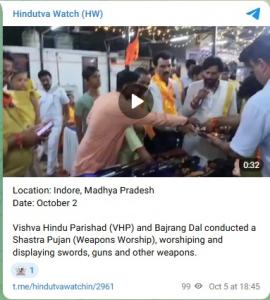
On October 2, in Indore, they conducted a Shastra Pujan displaying and worshipping swords and guns.
This was mirrored in multiple Bhopal events on October 2, including one on Vijay Dashami where dozens of guns and swords were displayed and a speaker called weapons “essential for the protection of dharma” while peddling “love jihad” conspiracies.
On October 2, at another Bhopal event participants brandished guns and swords, chanting, “Who will protect the country, women, and cows? We will.”
The pattern continued in Sihora, Jabalpur on October 2, where members brandished guns and swords while speakers justified keeping weapons for self-defense.
On September 29, a similar event unfolded in Bina Etawa, which also featured members brandishing guns and swords as speakers justified weapon possession for self-defense.
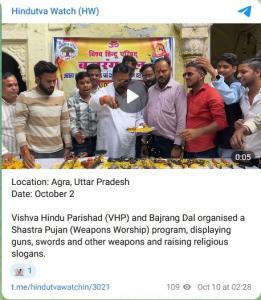
This template was replicated across the country. On October 2, in Agra, Uttar Pradesh guns and swords were worshipped and religious slogans were raised.
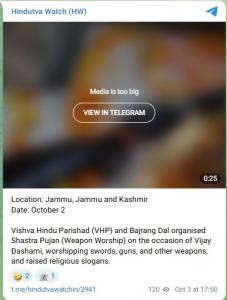
Likewise in Jammu participants worshipped guns and swords and raised religious slogans on October 2, 2025
In Odisha, VHP-Bajrang Dal events followed the same script. The event in Godabhaga, involved brandishing and worshipping weapons.
On October 2, the ceremony in Gudbhela also involved displaying and worshipping weapons.
On October 2, in Dhanakauda, a rally was held after the puja where participants brandished their weapons.
Operating in parallel, on October 2, the Antarrashtriya Hindu Parishad (AHP) and its arm, the Rashtriya Bajrang Dal, led by Pravin Togadia, organised their own series of weapon worship events. Togadia glorified the Babri Masjid demolition, calling it “an act of bravery,” and declared, “Until we started the Ram Mandir movement, only temples were demolished and mosques built over them. This was the first time we demolished that Babri structure and made a temple.” He warned, “To the dreamers of Ghazwa-e-Hind, remember — it is on your chest we built the Ram Mandir. That is just the start; Kashi and Mathura are waiting to be constructed on your chests.”
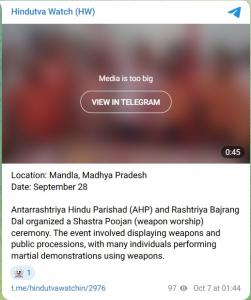
On September 28, in Mandla, Madhya Pradesh, their ceremony involved public processions and martial demonstrations with weapons.
On September 28, in nearby Seoni, MP, their event also included a procession with members brandishing swords, while a speaker justified violence in the name of religion by citing religious texts.
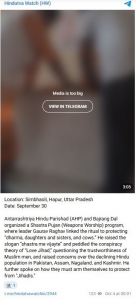
On September 30, in Simbhaoli Hapur, Uttar Pradesh, AHP leader Gaurav Raghav explicitly linked the ritual to protecting “dharma, daughters and sisters, and cows,” peddled the “Love Jihad” conspiracy, and urged followers to arm themselves against “Jihadis.”
Targeting women and children: the role of Durga Vahini
Crucially, the concern about “young girl students being manipulated” is substantiated by the central role of the VHP’s women’s wing, Durga Vahini, and its partner group, Matru Shakti. Their involvement is a deliberate strategy to frame weaponisation as “empowerment” and “self-protection.”
- On September 28, in Rampura, Neemuch (MP), Durga Vahini and Matru Shakti members organised Shastra Puja at multiple Garba pandals, brandishing weapons.
- On September 26, in Hatta, Damoh (MP), a VHP-Bajrang Dal event explicitly “involved children in exhibiting weapons,” with Durga Vahini members in attendance
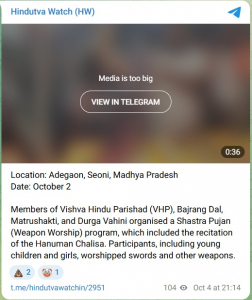
- On October 2, in Adegaon, Seoni (MP), VHP, Bajrang Dal, Matrushakti, and Durga Vahini organised a program where “young children and girls” worshipped swords.
- On September 30, in Jamshedpur, Jharkhand, a VHP-Durga Vahini event on Durga Ashtami, attended by “large numbers of women and children,” featured speakers who peddled the “love jihad” conspiracy, explicitly linking the need for such “awareness” to the Vahini’s founding.
This organisational synergy, replicated from state to state, proves that these are not isolated events. They are the planned execution of a national agenda, sharing a common script, common targets, and a common goal.
From ritual to rhetoric: the weaponisation of hate speech
This leads to the crux of the matter: these events “evolve into platforms for hate speech and inflammatory remarks.” The Shastra Poojan is merely the stage; the main performance is the propagation of communal hatred and open calls for violence. The weapons are not just symbolic props; they are a backdrop that physically underscores the violent rhetoric being delivered.
A platform for vile, anti-Muslim incitement
The speeches delivered at these events are not subtle. They are direct, eliminationist, and consistently target the Muslim community.
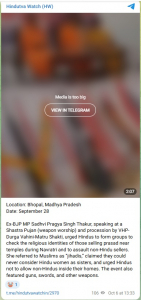
- Bhopal, MP (Sadhvi Pragya): On September 28, at a VHP-Durga Vahini event, former BJP MP Sadhvi Pragya Singh Thakur delivered a virulently anti-Muslim speech. She urged Hindus to “assault non-Hindu sellers” near temples, referred to all Muslims as “jihadis,” and claimed they “could never consider Hindu women as sisters”
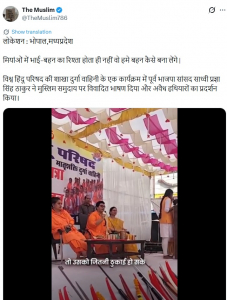

This speech was given in front of an arsenal of displayed guns, swords, and other weapons.
- Indore, MP (Tannu Sharma): On October 1, VHP-Bajrang Dal leader Tannu Sharma used his Shastra Pujan speech to promote the “love jihad” conspiracy in its most graphic form, claiming Muslim men are “trained in mosques to target Hindu girls” for trafficking and to be used as “baby-making instruments.” He then issued a direct call for beheading: “He urged Hindu women to follow Kalka Mata and ‘behead’ anyone who dares to target them”
- Kanpur, UP (Madhuram Sharan Shiva): October 3, at a Ramlila forum, the leader of the “armed-monks group” Shiva Shakti Akhada, Madhuram Sharan Shiva, declared, “To destroy sin, the sinner must be destroyed.” He explicitly called on youth to “fight and eliminate ‘jihadis,’ likening them to demons (rakshas).”
Mainstreaming conspiracy and glorifying violence
The hate speech is built upon a foundation of well-worn conspiracy theories and the glorification of past violence.
- “Love Jihad” and “Land Jihad”: This theme is ubiquitous. On September 30, in Hapur, UP, AHP leader Gaurav Raghav linked the ritual to protecting “dharma, daughters and sisters” and peddled the “Love Jihad” theory to justify arming against “Jihadis”

October 2, in Nagod, Satna (MP), a VHP-Bajrang Dal speaker, with guns displayed on stage, targeted Muslims by invoking both “love jihad” and “land jihad” conspiracies.
- Glorifying Babri Demolition: October 2, in Surat, Gujarat, AHP President Pravin Togadia used a “Trishul Deeksha” event to glorify the Babri Masjid demolition as an “act of bravery.” He then issued a direct threat for future action: “That is just the start; Kashi and Mathura are waiting to be constructed on your chests.”


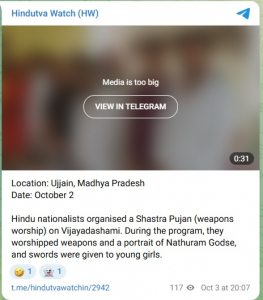
- Worshipping Godse: The glorification extends even to the assassin of Mahatma Gandhi. October 2, in Ahmedabad, Gujarat, the Hindu Sena held a Shastra Pujan “chanting slogans in praise of Nathuram Godse.”
This was repeated in Ujjain, MP on October 2, where Hindu nationalists “worshipped weapons and a portrait of Nathuram Godse.”
This evidence confirms the analysis completely. The Shastra Poojan is the legitimising framework for events whose primary purpose is to spread hate, dehumanise Muslims, and openly call for their elimination, all while normalising violence as a sacred duty. This directly leads to events like the Cuttack clashes and other riots, as the weapons and the incitement from these events spill over into the streets.
A pedagogy of violence: indoctrinating the next generation
Perhaps the most insidious component of this agenda is the focus on “young girl students” and children. This is not about self-protection; it is a systematic “pedagogy of violence.” It seeks to indoctrinate children at their most impressionable age, severing their connection to a secular society and re-forging their identity around the twin poles of weaponry and communal hatred.
The evidence for this is widespread and deeply disturbing.
- Giving weapons to children: On October 2, in Ujjain, MP, the indoctrination was explicit: “swords were given to young girls.”

On September 26, in Hatta, Damoh (MP), “Children were involved in exhibiting weapons” at a VHP-Bajrang Dal-Durga Vahini event.


- Martial demonstrations: On September 29, in Udaipura, Raisen (MP), a VHP-Matrushakti event featured “many children performing martial demonstrations using” weapons.
This was also seen in Mandla, MP on September 28, at an AHP-Rashtriya Bajrang Dal event. This normalises the weapon as an extension of the child’s body.

- Chants of hatred: The indoctrination is both physical and verbal. On October 2, in Maharashtra, far-right influencer Sangram Bapu Bhandare, at a Shiv Pratisthan Hindusthan Shastra Pooja, “led armed children in chanting, ‘Tu Durga ban, tu Kali ban, kabhi na burke wali ban’ (You become Durga, you become Kali, never become one in a burqa. This is a direct, hateful chant that pits one religious identity against another, taught to armed children.
- Posing with weapons: On October 1, in another event in Maharashtra, “Children, including young girls, posed with trishuls” under the guidance of an AHP leader.
On October 2, in Adegaon, Seoni (MP), “young children and girls” were documented worshipping swords.

This strategy aims to create a future generation for whom public weapon-bearing is normal, communal hatred is righteous, and violence is a celebrated tool for religious assertion. It is a long-term project to ensure the pipeline of cadres for this extremist agenda never runs dry.
The architecture of impunity: egal legality and political patronage
The legal basis for stopping these events is clear, rooted in existing statutes that are routinely ignored. The core of the issue lies in The Arms Act, 1959, which is not just about firearms.
- Section 2(1)(c) defines “arms” to include “sharp-edged and other deadly weapons… as the Central Government may… specify.”
- Section 4 strictly prohibits the acquisition or possession of any firearm without a license.
- Section 5 controls the manufacture, sale, and transfer of arms.
The argument that trishuls are merely “religious symbols” is a deliberate smokescreen, one that has been legally challenged and documented for decades. Reports from as far back as 2003 noted that items distributed at Trishul Deeksha events were often “cleverly disguised Rampuri knives, six–eight inches long and sharp enough to kill.” This led the Rajasthan state government itself, in April 2003, to issue a notification “prohibiting people from distributing, acquiring, possessing or carrying double or multi-bladed sharp pointed weapons” as per a report in The Times of India.
This ban was openly defied by organisations like the VHP, setting a long-standing precedent of conflict between these events and state law. The illegality extends far beyond just possession. The Arms Act provides clear authority for law enforcement to act:
- Section 20 allows police to arrest anyone “carrying or conveying any arms under suspicious circumstance” without a warrant.
- Section 22 empowers the District Magistrate to order a search and seizure of any arms believed to be for an “unlawful purpose.”
- Section 25 outlines punishment for the unlicensed sale or transfer of arms.
The claim that these processions are protected as an “essential religious practice” under Articles 25 and 26 of the Constitution has also been tested and refuted by the Supreme Court. In the landmark 1983 case Acharya Jagdishwaranand Avadhuta v. Commissioner of Police, Calcutta (1983) 4 SCC 522, the Court ruled that the Ananda Marga’s Tandava dance with items including a trishul and a knife was not an essential religious rite that could be performed in a public procession.
The Court affirmed that such public displays are subject to regulation by the state for “public order,” a precedent that directly applies to today’s armed processions.
The copy of judgement Acharya Jagdishwaranand Avadhuta v. Commissioner of Police, Calcutta (1983) can be found here
Despite this clear legal framework, attempts to enforce it on a macro level have been thwarted, contributing to the architecture of impunity.
Following widespread communal violence during Ram Navami processions in 2022, a PIL was filed in the Supreme Court by Citizens for Justice and Peace (CJP) in May 2022. This petition sought the creation of national guidelines to regulate these armed religious processions.
The plea was dismissed by the Supreme Court on December 9, 2022. The bench, led by Chief Justice D.Y. Chandrachud, declared that law and order is a “state subject” and that the court could not be “dragged into every area.” The court also remarked that one should not “portray that all religious festivals are the time for riots.”
This dismissal effectively denied a national-level regulatory framework, placing the onus back on the same state and district-level authorities—the DMs and police—who, as seen in Gwalior and Rajasthan University, are often participants or enablers. This judicial deference, while procedurally sound, in practice grants a free pass, ensuring that the law remains on the books but is rarely, if ever, enforced on the streets.
The argument that these are merely “religious symbols” like trishuls is a deliberate smokescreen. The evidence from 2025 shows this is patently false. These events openly and proudly feature modern firearms, transforming the ritual into a menacing display of force.
- Guns and Rifles as centrepieces: The public display of firearms is a consistent theme.
On October 2, in Bhopal, Madhya Pradesh, a VHP-Bajrang Dal event on Vijay Dashami saw participants displaying “dozens of guns, swords, and other weapons.”


On September 28, at another Bhopal event featuring ex-MP Sadhvi Pragya Thakur, the proceedings “also featured guns, swords, and other weapons” as a backdrop to her inflammatory speech.

On October 2, in Indore, Madhya Pradesh, a VHP-Bajrang Dal Shastra Pujan involved the worship and display of “swords, guns and other weapons.”

This was mirrored in Jammu, where on October 2, VHP and Bajrang Dal members organised a Shastra Pujan “worshipping swords, guns, and other weapons”
On October 2, in Agra, Uttar Pradesh, a VHP-Bajrang Dal event was characterised by the “displaying [of] guns, swords and other weapons.”

On October 2, in Varanasi, Uttar Pradesh, an AHP and Rashtriya Bajrang Dal procession “worshipped and displayed guns, swords and other weapons.”
On September 29, in Bina Etawa, Madhya Pradesh, VHP-Bajrang Dal members “brandished guns and swords.”

On October 2, in Nagod, Satna (MP), a VHP-Bajrang Dal event featured “several guns on stage” while speakers targeted Muslims.

- Political displays of massive firepower: This display of weaponry is not limited to militant organisations; it is also a tool for political strong-arming. On October 2, in Kunda, Uttar Pradesh, the event was a staggering show of force at the residence of a sitting politician. MLA Raghuraj Pratap Singh, popularly known as Raja Bhaiya, “held a Shastra Pujan displaying hundreds of guns and rifles at his residence.”
This act, involving an arsenal far beyond any symbolic need, demonstrates a fusion of political power and a capacity for violence, sending an unambiguous message of dominance.
The mass distribution of trishuls, particularly in states like Rajasthan, also contravenes the law, as these are often sharpened and designed as weapons. But the open display of hundreds of unlicensed (or even licensed) firearms in a public, politically charged gathering is a blatant violation of The Arms Act and provisions of the CrPC related to unlawful assembly.
The enablers: political patronage and state impunity
This illegality thrives because it is protected from above. The involvement of “influential figures—MPs, MLAs, and politicians” is not a suspicion; it is a documented fact.
- Elected officials: MLA Raja Bhaiya (Kunda, UP), Assembly Speaker Narendra Singh Tomar (Gwalior, MP), and ex-MP Sadhvi Pragya Thakur (Bhopal, MP) all actively participated in and legitimised these events.
- Government Llegitimisation: A key part of this legitimisation is the government’s formal decision to lift long-standing bans on employees participating in such events, removing any professional consequence for state actors who align with this agenda. This process reversed decades of policy. The initial ban, which barred central government employees from participating in the activities of the Rashtriya Swayamsevak Sangh (RSS), was first imposed on November 30, 1966, and pointedly reiterated on October 28, 1980, to ensure a secular outlook in the bureaucracy.
This 58-year-old prohibition was officially lifted by the central government via an office memorandum from the Department of Personnel and Training on July 9, 2024. This move paved the way for state governments, such as the BJP-led government in Rajasthan, which, around August 24, 2024, issued its own circular lifting a similar 52-year-old ban, thereby granting explicit permission for state employees to participate in RSS activities. As per reports in the The Hindu.
- Systemic impunity: The “no legal action” outcome is the rule, not the exception. The Rajasthan University incident is the most damning proof that the victims are jailed, and the attackers walk free. In Cuttack, as has been noted, rioters with weapons faced no consequences. This is a deliberate tactic, one that draws parallels to the Gujarat Riots: the state machinery steps back (or actively assists) to allow “religious celebrations” to morph into organised violence, knowing that the legal system will be deployed to protect the perpetrators and punish any resistance.
This is how permissions are granted. This is how the law is ignored. The agenda is state-sanctioned, protected by powerful politicians, and enforced by a compromised or complicit law enforcement and legal system.
A year of weaponised faith: the continuum from Ram Navami to Ganpati
While the Shastra Poojan events of Dussehra 2025 present the most recent manifestation of this trend, they are merely the crescendo of a year-long symphony of hate. To view them in isolation is to miss the systemic nature of the rot. An analysis of events stretching back through 2025—encompassing Ram Navami, Ganpati Visarjan, and Durga Puja—reveals that the weaponisation of religious festivals is no longer an anomaly, it has become the standard operating procedure of the right-wing outfits.
This sustained aggression is not accidental. It is the inevitable yield of over a decade of the current regime’s governance, a period characterised by the systematic dismantling of constitutional values and the emboldening of majoritarian forces. The frequency and ferocity of these displays are direct metrics of how deeply the “Hindu Rashtra” project has penetrated the social fabric, sanctified by political patronage and shielded by a compromised state machinery.
The Ganpati festival: from devotion to macabre propaganda
The Ganpati festival in September 2025 witnessed a disturbing shift where the celebration of the deity was side-lined for the promotion of gruesome political propaganda.
In Madhya Pradesh, a state that has become a laboratory for right-rings’ experimentation, religious tableaux (jhankis) were utilised to broadcast graphic Islamophobic imagery. In Mahidpur, Ujjain, on September 5, a tableau explicitly promoted the “Love Jihad” conspiracy theory, depicting Muslim men slaughtering women. This was not a subtle dog whistle but a visual scream designed to provoke, leading inevitably to communal tension and stone-pelting.
In Mahadevgarh, Khandwa, on September 5, another tableau featured a refrigerator with mutilated dolls—a crude exploitation of a high-profile murder case—to suggest that Muslim men are inherent butchers of women.
In Kasravad, Khargone, on September 7, similar gory visuals were paraded through the streets. These were not religious processions; they were mobile hate-speech units, designed to instil fear in minorities and radicalise the majority, turning a festival of joy into a procession of trauma.
The “Decade Plus” of impunity: the state as an extension of the mob
This was explicitly articulated in Karnataka during the Ganpati Visarjan. In Raichur, on September 16, VHP-Bajrang Dal State Convenor Shivananda Sattigeri delivered a speech that stripped away any remaining veneer of the rule of law. He did not just threaten violence; he claimed ownership of the state apparatus, asserting that “the police and army are all Hindus” and that the Prime Minister is aligned with the RSS. He threatened to “chop off the hands” of dissenters and warned that legal challengers would be “beaten and sent to Pakistan.”
The rhetoric is echoed by elected representatives, further blurring the lines. On September 10, in Maddur, Mandya, BJP MLC C.T. Ravi publicly threatened Muslims with “beheading” and “cutting,” reminding them of the consequences of “showing strength.” When lawmakers speak the language of lynch mobs, the weaponisation of festivals ceases to be a law-and-order issue and becomes a state-sponsored project of intimidation.
Durga Puja: the gendered radicalisation
The narrative of 2025 also highlights how this weaponisation is deeply gendered, using the imagery of the Goddess to militarise women and children against a fabricated “other.” During the Durga Puja festivities, the VHP and its wings, Durga Vahini and Matru Shakti, intensified their campaign to frame Muslim men as existential threats.
In Gaya, Bihar, on September 30, women were made to brandish weapons, while in Jamshedpur, Jharkhand, on the same day, speakers used the platform of Durga Ashtami to peddle “Love Jihad” conspiracies to a captive audience of women and children. The message was clear: your faith requires you to be armed.
This indoctrination has reached the level of hate-filled conditioning for children.
In Maharashtra, on October 2, far-right influencer Sangram Bapu Bhandare led armed children in a chant that pitted the identity of the Goddess against the identity of the Muslim woman: “Tu Durga ban, tu Kali ban, kabhi na burke wali ban” (Become Durga, become Kali, never become the one in the burqa). By weaving hate into the rhymes and rituals of children, the regime’s ideological affiliates are ensuring that the cycle of violence continues well beyond the current political tenure.
The calendar of hate: how a decade of impunity weaponised 2025
The festivals of 2025 have ceased to be mere celebrations of faith but they have morphed into a synchronised calendar of intimidation. This year’s timeline—stretching from the aggressive posturing of Ram Navami, through the macabre tableaux of Ganpati Visarjan, to the open weaponisation of Durga Puja—reveals a terrifying new normal.
In Madhya Pradesh, the sanctity of Ganesh Chaturthi was desecrated by floats depicting gruesomely mutilated women, designed solely to incite anti-Muslim hysteria under the guise of “Love Jihad.” In Karnataka, the mask of democracy slipped entirely when BJP leaders publicly threatened beheadings, and VHP convenors declared the police and army to be extensions of the RSS.
This unchecked aggression is not spontaneous but it is the toxic harvest of a “Decade Plus” of the current regime. Ten years of majoritarian party rule have systematically dismantled the firewall between the state and the street.
The normalisation of a violent public square
The 2025 Shastra Poojan campaign, as documented here, is not an expression of Hindu faith. It is the tactical expression of a political agenda that views violence, intimidation, and communal hatred as legitimate tools. It is the “weapon agenda” in its most tactical form.
The evidence is overwhelming. We are witnessing a systematic effort to subvert India’s secular institutions, transforming universities into ideological battlegrounds (Rajasthan University) and police forces into partisan participants (Gwalior). We are seeing a coordinated, nationwide campaign by the VHP, Bajrang Dal, and AHP to use these events as platforms for the vilest, eliminationist hate speech, explicitly calling for the assault (“assault non-Hindu sellers”) and murder (“behead,” “eliminate jihadis”) of Muslims.
Most chillingly, we are watching the deliberate indoctrination of children. By placing swords in the hands of young girls (Ujjain), making children chant anti-Muslim slogans (Maharashtra), and having them perform martial demonstrations (Udaipura), this agenda is attempting to create a new generation for whom violence is not just normal but sacred.
This entire enterprise is shielded by a formidable architecture of political impunity, where MLAs (Raja Bhaiya), MPs (Sadhvi Pragya), and Assembly Speakers (Narendra Singh Tomar) provide cover. The law is rendered meaningless, as police either participate in the rituals or, as seen in Rajasthan, arrest the very students protesting the illegality.
This is the terrain. The ritual of Shastra Poojan has become the chosen vehicle for normalising violence, mainstreaming hate, and asserting a militant religious supremacy over the public sphere. The parallel to pre-riot tactics in places like Gujarat is not just an academic reflection, it is a clear and present warning.
When a mob leader can openly claim the state apparatus as “theirs” without fear of arrest, it proves that impunity has been institutionalised. The most chilling aspect of this year’s agenda was the targeted radicalisation of families, women brandishing swords and children chanting hate before they can fully understand faith.
We are witnessing the solidification of a “militant piety,” where the sword replaces the prayer, and the Constitution is quietly suspended in favour of the rule of the mob. These incidents stand as a warning that the secular citadel is not just being breached, it is being dismantled, festival by festival, under the protective gaze of the state.
Related
Arm yourself with knowledge, not tridents, swords or knives
FIR over hate speech and brandishing of swords at Udupi Durga Daud event