


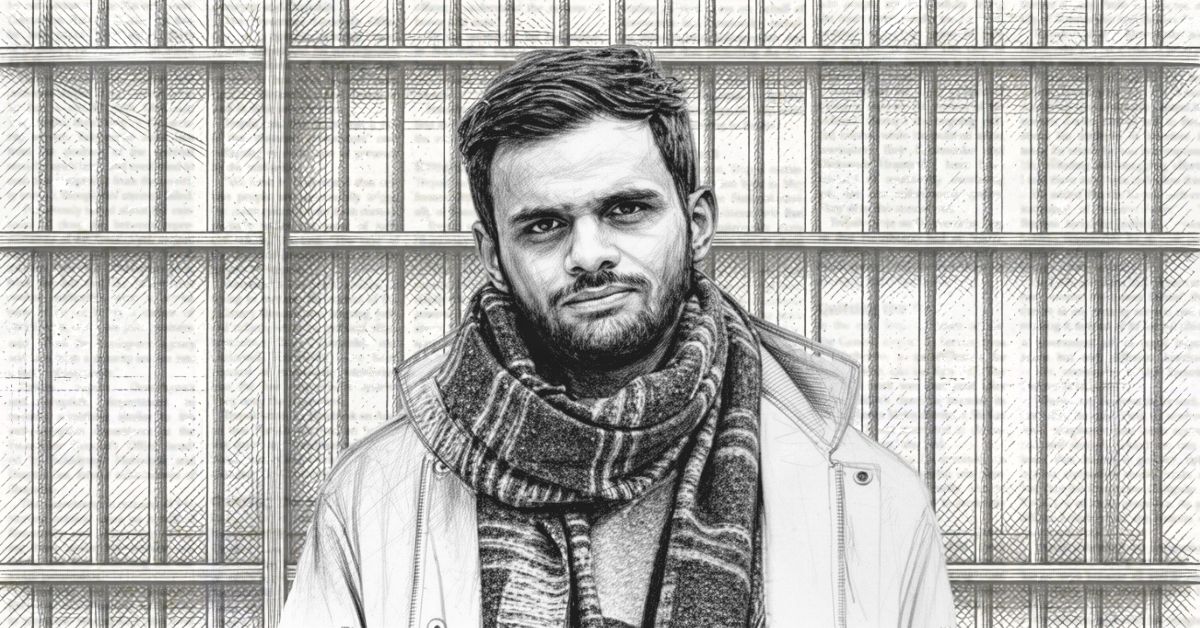
As Umar Khalid completes six years in prison without facing trial, even the discussion of his scholarship, his imprisonment or a documentary about his case has repeatedly become a site of contestation.
A documentary about Khalid scheduled to be screened at the National Law School of India University (NLSIU) on September 14, was suddenly postponed. The Law & Society Committee, which had organised the event, said it had taken the decision because of “logistical and security considerations” and insisted that it was not backing down because of pressure. The documentary, Prisoner No. 626710 is Present, directed by Lalit Vachani, was to be shown to mark Political Prisoners’ Day and six years since Khalid’s arrest.
However, developments around the screening tell a different story. The postponement came after opposition from the Akhil Bharatiya Vidyarthi Parishad (ABVP), which had demanded that the screening be cancelled and subsequently claimed credit for its postponement. The News Minute reported that the organisation affiliated to the Rashtriya Swayamsevak Sangh (RSS) had formally complained to the NLSIU administration about the screening. The Quint likewise reported that the organisers maintained that their decision was not a response to external pressure. Significantly, the NLSIU episode was not an isolated incident.
Just weeks earlier, Jawaharlal Nehru University had formally cancelled the booking of an auditorium for a discussion around Khalid’s book, Fractured Communities: Adivasi Histories and the Politics of Power. While the university cited the organisers’ alleged “non-disclosure of the full facts” of the programme, this was contested by the organisers and as reported in The New Indian Express and Sabrangindia, the programme went ahead with retired professors addressing the gathering just outsider the School of Social Sciences-II building. A report on this may be read here.[1]
There is an unmistakable irony to these episodes.
While universities debate whether his work can be discussed, the much larger question remains unresolved: how long can a person remain imprisoned before the criminal justice system is required to put its case to trial?
Umar Khalid was arrested in September 2020 under the Unlawful Activities (Prevention) Act (UAPA) in connection with the alleged larger conspiracy behind the February 2020 North-East Delhi riots. Six years later, the trial has still not begun. That fact is no longer a footnote to the case. It is the case. Two thousand, one hundred and ninety days as an under-trial prisoner.
Six years, and still waiting for a trial
Khalid has now spent six years in custody as an under trial. The prosecution case against him is “extensive” yet key allegations have not been buffeted by adequate evidence. The Delhi Police filed a charge sheet running into 11 volumes and more than 17,000 pages in September 2020. The larger conspiracy case involves many accused and, according to an August 2026 open letter signed by more than 100 public figures, the prosecution has listed around 900 witnesses. Yet the trial has not begun.
This creates a constitutional problem that cannot simply be answered by pointing to the seriousness of the allegations. Article 21 protects the right to life and personal liberty and has long been interpreted by the Supreme Court to include the right to a speedy trial. In Union of India v. K.A. Najeeb, a three-judge bench of the Supreme Court specifically recognised that prolonged incarceration can, in appropriate circumstances, justify bail even where stringent statutory restrictions apply.
The tension between that constitutional principle and the UAPA’s stringent bail regime now sits at the centre of Khalid’s case. Six years of imprisonment without trial means that the punishment of incarceration is being experienced before guilt has been adjudicated. That distinction matters.
Khalid has not been convicted of the allegations against him. The charges remain allegations. His guilt or innocence is ultimately for a trial court to determine after evidence is tested. But the trial has not begun.
The arrest came after years of being a public dissenter
Khalid’s current incarceration cannot be understood without the political and legal history that preceded it. A former JNU student leader and research scholar, Khalid emerged as a prominent public voice on questions of communalism, citizenship, minority rights and state power.
His name first became nationally prominent during the 2016 JNU controversy. In February that year, he was arrested in connection with an event held at JNU protesting the execution of Parliament attack convicts Afzal Guru and Maqbool Bhat. He and others were accused under provisions including sedition and criminal conspiracy. The case itself became emblematic of the criminalisation of political expression on university campuses. Then, SabrangIndia had interviewed Umar Khalid, and the two-part conversation can be viewed here and here.
In January 2019, the Delhi Police filed a charge sheet against Khalid and former JNU student leader Kanhaiya Kumar in the sedition case. Then came the political upheaval surrounding the Citizenship Amendment Act (CAA 2019) and the proposed National Register of Citizens (NRC). Khalid was among those who participated in and addressed protests against the CAA-NRC framework in 2019 and 2020.
On February 17, 2020, Umar Khalid spoke about peaceful protest and invoked Gandhian methods. A portion of his remarks was subsequently circulated widely on social media after BJP IT-cell head Amit Malviya posted an edited interpretation of his comments. Worse, just ahead of the 2020 Delhi Assembly elections, Kapil Mishra of the Bharatiya Janata Party (BJP) had stated on Twitter, “Delhi mein chote chote Pakistan bane (Delhi will become mini-Pakistan)” and “Shaheen Bagh mein Pak ki entry (Shaheen Bagh will serve as entry for Pakistan) as reported by The New Indian Express and The Hindu.” Mishra was even subsequently booked under Section 125 of the Representation of People Act, 1951 (RP Act), for promoting enmity between classes to gain an advantage during the elections and thereafter in June June 2024, Mishra was summoned by the Additional Chief Metropolitan Magistrate. At the time in 2020, the Delhi High Court made the Delhi Police watch four videos in court establishing hate speeches that had been made by politicians but not acted on by the police. Kapil Mishra was one of the four videos. Justice Murlidhar who came down on the police sharply for inaction was summarily transferred to the Punjab and Haryana High Court. Despite the fact that the case dwindled to naught later, there have been sharp critiques on how justice has been selectively delivered. Not just Mishra but Anurag Thakur, were recorded delivering provocative and incendiary hate speeches at election rallies in February 2020. The courts, including the Supreme Court of India were eventually lenient with them (2026) as compared to the young Muslim student leadership at the helm of the anti-CAA/NRC protests. At an election rally, Anurag Thakur, an elected official of the BJP, was heard leading a chant of “Desh ke gaddaron ko…”, to which the crowd responded, “Goli maaron saalon ko.” The slogan went viral and drew widespread criticism. Just weeks later, Delhi witnessed large-scale communal violence that claimed 53 lives, with allegations raised that such speeches contributed to the charged atmosphere. Yet it was Umar and 17 others who bore the brunt of the blame for the violence.[2]
Days later, North-East Delhi descended into brute and targeted communal violence. Fifty-three people were killed and hundreds were injured. Ignoring the deliberate provocations by elected officials of the ruling BJP, the Delhi Police chose to target on the previous, vibrant and widespread anti-CAA/NRC protest leadership, developed a theory of a “larger conspiracy”, alleging that the anti-CAA protest movement had been used to plan and orchestrate the violence. Khalid became one of the principal accused in that case. Incidentally, while the Aam Aadmi Party (AAP) was in power at the time and returned to power after the state elections, the Delhi police are controlled directly by the central/union ministry for home affairs.
September 2020: The beginning of six years behind bars
Khalid was arrested on September 13, 2020, under the UAPA. The prosecution alleged that he played a central role in the conspiracy behind the riots. The case was not merely an ordinary prosecution arising from individual acts of violence. The police’s case was that Khalid, and others were part of a broader conspiracy connected to the anti-CAA protests and that the protests themselves were used as part of a plan culminating in the violence.
The prosecution has repeatedly described Khalid as one of the alleged “masterminds” of the conspiracy. Khalid has consistently denied the allegations. What followed was a prolonged battle over bail and liberty.
2021: The first long bail battle
In April 2021, a Delhi trial court granted Khalid bail in a separate IPC case relating to the Delhi riots, observing that the material against him was sketchy and that he could not be incarcerated indefinitely on such material. That did not result in his release. His UAPA case continued.
By September 2021, his lawyers were back before the court seeking bail in the larger conspiracy case. The arguments went to the heart of the prosecution’s theory. Khalid’s lawyers argued that participation in protests, membership of WhatsApp groups and advocacy of a chakka jam could not, by themselves, constitute a terrorist conspiracy.
The defence also argued that the prosecution was attempting to paint a large number of individuals with the same brush and that the charge sheet presented a narrative rather than evidence establishing Khalid’s criminal role. The prosecution disputed this and argued that the protests had been systematically organised and synchronised. The bail hearings continued for months. In March 2022, the trial court rejected Khalid’s bail application. The court found a prima facie case against him under the UAPA. Khalid remained behind bars.
2023–24: The Supreme Court route and repeated adjournments
Khalid approached the Supreme Court. Notice was issued in May 2023. What followed was another prolonged sequence of hearings and adjournments. The matter was repeatedly listed before different benches. There were adjournments because of the unavailability of counsel, constitutional bench proceedings, changes in bench composition and the recusal of a judge.
On August 9, 2023, the matter came before Justices A.S. Bopanna and Prashant Kumar Mishra. Justice Bopanna indicated that the matter would come before another bench after Justice Mishra’s recusal. On September 12, the Supreme Court admitted the bail plea but indicated that the documentary material would have to be examined in detail. The hearings continued into October and November. In January 2024, the matter was again repeatedly adjourned. There were 44 deferrals of the matter before the apex court.
Finally, on February 14, 2024, Khalid withdrew the Supreme Court petition, with his counsel telling the court that he would pursue the matter before the trial court on account of a “change in circumstances”. That change did not result in liberty.
2024: Back to the trial court
In July 2024, Khalid moved the Karkardooma court for bail. The proceedings again became protracted. On May 28, 2024, the Karkardooma court rejected his bail plea. The prosecution argued, among other things, that Khalid had amplified what it described as a “false narrative” through social media. The defence rejected the allegations and continued to challenge the evidentiary basis of the prosecution case. The central problem, however, remained unchanged. Khalid was still in prison. And there was still no trial.
2025: Another rejection, another year in custody
On September 2, 2025, the Delhi High Court rejected Khalid’s bail plea. The court accepted the prosecution’s contention that the Delhi riots were the result of a “premeditated, well-orchestrated conspiracy” rather than a spontaneous eruption of violence. The court also held that delay in trial, by itself, could not justify bail given the gravity of the allegations.
Khalid challenged the decision before the Supreme Court. Meanwhile, the years continued to accumulate. In December 2025, a Delhi court granted him interim bail for 14 days so that he could attend his sister’s wedding. It was a brief departure from a pattern otherwise defined by continued incarceration. He returned to prison.
January 5, 2026: the Supreme Court’s crucial order
The most consequential development came on January 5, 2026. The Supreme Court, in Gulfisha Fatima v. State (NCT of Delhi), granted bail to five accused in the Delhi riots larger conspiracy case: Gulfisha Fatima, Meeran Haider, Shifa-ur-Rehman, Mohammad Saleem Khan and Shadab Ahmed. But it denied bail to Umar Khalid and Sharjeel Imam. The distinction drawn by the court became critical (and most contested).
The bench of Justices Aravind Kumar and N.V. Anjaria said that the prosecution material prima facie disclosed what it described as a “central and formative role” for Khalid and Imam, involving planning, mobilisation and strategic direction beyond “episodic and localised acts”. The court held that the threshold under Section 43D (5) of the UAPA was attracted. It also said that the accused could renew their bail applications after the examination of the protected witnesses or after one year from the judgment, whichever was earlier. At the same time, the court directed the trial court to expedite the proceedings.
April 2026: Review rejected
Khalid sought review of the January judgment. On April 20, 2026, the Supreme Court dismissed the review petition, finding no sufficient ground to review its January 5 judgment. The door to immediate reconsideration appeared closed.
May 2026: A Supreme Court bench questions the January approach
On May 18, 2026, a separate Supreme Court bench comprising Justices B.V. Nagarathna and Ujjal Bhuyan delivered the judgment in Syed Iftikhar Andrabi v. National Investigation Agency. The bench emphasised the constitutional significance of liberty and the principle that bail is ordinarily the rule and imprisonment the exception. More significantly, the bench expressed reservations about the January Gulfisha Fatima judgment’s treatment of the Supreme Court’s earlier three-judge decision in K.A. Najeeb.
The judges held that judicial discipline required the two-judge bench deciding Gulfisha to follow the binding precedent laid down by the three-judge bench in Najeeb. The issue was subsequently referred to a larger bench after another Supreme Court bench identified a “perceived conflict” in the approaches taken by different benches. That development was seized upon by Khalid and Imam in their renewed bail proceedings.
And then came the latest bail battle
Khalid and Imam approached the Delhi High Court challenging the rejection of their third bail applications. The Delhi Police has now argued that they should not even be heard at this stage. In its response before the High Court, the police described the fresh bail proceedings as “illegal”, “misconceived” and an attempt to “mislead” the court.
The Supreme Court’s January 5 order, the police says, gave Khalid and Imam liberty to renew their bail applications only after one of two events occurred: the examination of protected witnesses or the expiry of one year from the judgment. According to the prosecution, neither event had occurred when the fresh pleas were filed.
Therefore, the police say, the applications are premature. Scroll.in, reporting on August 27, quoted the prosecution’s position that the May judgment in Andrabi, arising from another case, could not override the specific directions issued in Gulfisha. The police have also relied on the Supreme Court’s May 22 order in Tasleem Ahmed v. State (NCT of Delhi), which acknowledged the divergence between the Gulfisha and Andrabi approaches and referred the issue to a larger bench.
The State’s position is that until the larger bench settles the question, the January judgment continues to bind the High Court.
When does pre-trial detention become punishment?
The prosecution’s argument is this: the allegations are grave, Section 43D(5) applies, the Supreme Court has already assessed the material and Khalid’s alleged role is different from that of the accused who were granted bail. But there is another side to the equation. Khalid has spent six years in prison without trial. The prosecution has reportedly listed around 900 witnesses and there is no sign of the trial beginning any time soon.
The case involves thousands of pages of evidence and many accused. The more complicated the prosecution case becomes, the longer it can take to bring it to trial. But that cannot mean that the complexity of the prosecution’s own case becomes a reason for indefinite pre-trial incarceration. This is precisely why K.A. Najeeb matters. The Supreme Court’s three-judge bench in that case recognised that statutory restrictions on bail cannot be interpreted in a manner that makes constitutional rights meaningless. Where incarceration becomes excessively prolonged and there is no reasonable prospect of the trial being completed within a meaningful timeframe, Article 21 can acquire decisive significance. Detailed pieces may be read here, here and here.
A six-year incarceration has become a public question
On August 15, more than 100 writers, academics, activists, filmmakers, journalists and public figures wrote to Chief Justice of India Surya Kant urging intervention in the continued incarceration of Khalid and Sharjeel Imam. As reported by The Wire, the signatories invoked K.A. Najeeb and argued that nearly six years of detention without the commencement of trial demands constitutional scrutiny. Their intervention reflects a broader anxiety about what prolonged pre-trial incarceration does to the meaning of liberty itself.
Six years is a long time to spend behind bars without a verdict. Umar Khalid has not been convicted of the charges against him, yet six years of pre-trial incarceration have already become a defining fact of his case. His bail battles continue, the prosecution and defence remain locked in arguments over the scope of the UAPA, and the larger question of how long a person can remain imprisoned while awaiting trial remains unresolved.
The courts will ultimately decide the charges against Khalid. But six years of incarceration without that determination cannot be reduced to another date in a long procedural timeline. It is a measure of the extraordinary cost of prolonged pre-trial detention. For Khalid, the wait for trial is no longer simply a stage in the criminal process. It has itself become the story.
Detailed pieces may be read here, here, here and here.
A profile on Umar Khalid may be viewed here.
Related:
The Conspiracy of Silence: HC denies bail to Delhi riots accused
How free are all Indians to exercise their right to peacefully protest under Article 19?
UAPA: Delhi HC denies bail, Umar Khalid’s Incarceration to Continue
4 years onward, activist Gulfisha Fatima remains behind bars
Order denying bail to Dr. Umar Khalid, a mockery of judicial system?
Dastardly attempt to assassinate Umar Khalid
Witch hunt against Umar Khalid and Kanhaiya Kumar continues
[1] Professor Avinash Kumar, who had submitted the requisition for the auditorium, was particularly categorical. “The stated reason for the cancellation of the booking of the SSS auditorium is false,” he said, according to Hindustan Times report. Kumar maintained that the Dean had been fully informed that the event was going to discuss Khalid’s book and that the requisition had been prepared in the format suggested by the Dean himself.
His question was simple: if the university did not know what the event was about, why was the auditorium booking approved in the first place?
[2] In 2020, prior to the Delhi riots, Parvesh Verma was a Member of Parliament (MP) in the Lok Sabha, representing the West Delhi constituency. He belonged to the Bharatiya Janata Party (BJP).
During the February 2020 Delhi Assembly elections, Kapil Mishra was a BJP candidate from the Karawal Nagar constituency (which he lost). He did not hold a formal government or party organizational position during the February 2020 riots. In early 2020, prior to the Delhi riots in February, Anurag Thakur held the designation of Union Minister of State (MoS) for Finance and Corporate Affairs in the Government of India. Simultaneously, he was a serving Member of Parliament (MP) in the Lok Sabha representing the Hamirpur constituency of Himachal Pradesh.