


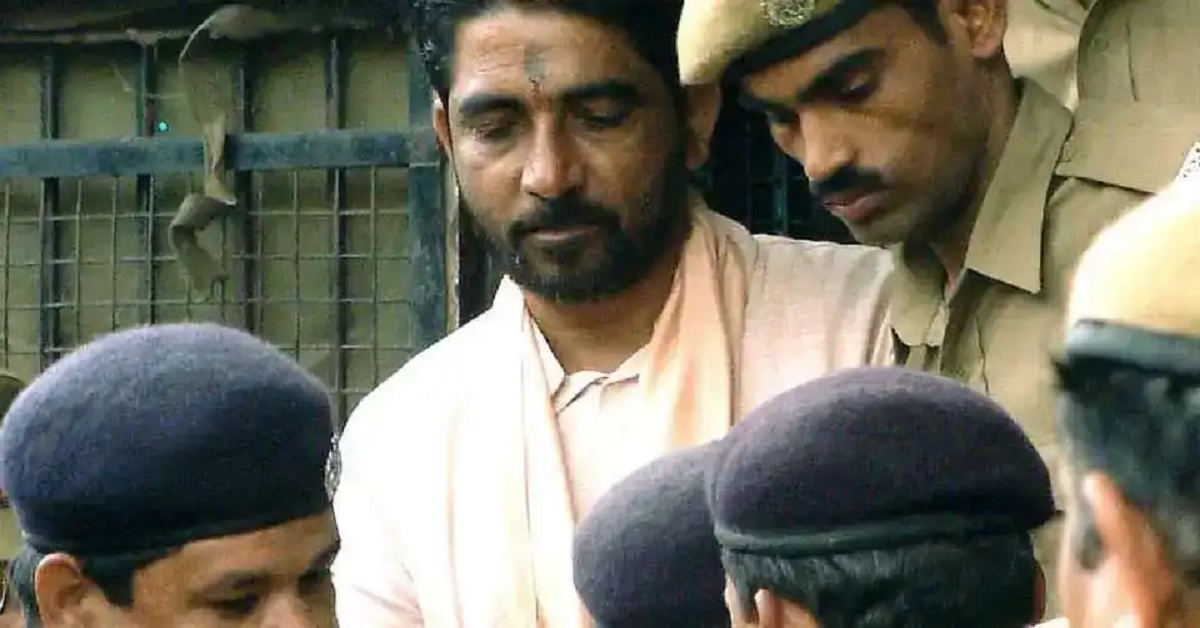
Rabindra Kumar Pal, better known as Dara Singh, the principal convict in three separate murders, each of a religious minority is likely set to walk free after more than 25 years in prison.
Advocate Vishnu Shankar Jain who filed a plea in the Supreme Court seeking Singh’s remission of sentence and release, asserted that he met the state government’s criteria for granting remission (i.e. 25 years). Singh stated that he deeply regretted the offences committed over two decades earlier and sought an opportunity to “give back to society” through service-oriented work. He also claimed that he bore no personal animosity towards the victims and described his actions as the result of “youthful rage.” Singh was 37 years old at the time of his arrest!
The Odisha State Sentence Review Board has recommended his release from jail on ground of “good behaviour.” On July 14, 2026, a bench comprising of Justices Manoj Misra and Vijay Bishnoi of the Supreme Court through its order had asked the Odisha Government to take a decision on the premature release of Singh by August 19. Reportedly, the bench also made an oral observation that, “You take a decision by August 15. Let him also celebrate Independence Day by then.” (As reported by the Hindustan Times).
Three cases Sing has been convicted in
Dara Singh is serving three separate life sentences arising from three separate killings carried out within a single year each targeting a person from a minority religious community.
First, he organised the attack that burned alive Graham Staines, an Australian Christian missionary, along with his two sons as they slept in their vehicle, personally blocking their escape from the flames. Secondly, he was convicted for beating and burning to death Shaikh Rahaman, a Muslim garment trader. In the same year, he led the mob that hunted down and killed Arul Das, a Catholic priest, with an arrow as the priest fled a church his attackers had set alight.
Before these convictions, he was implicated in the killing of Shaikh Imam, a Muslim cattle-truck driver’s assistant, who was beaten to death in September 1998 after his truck was looted and set on fire. Singh was acquitted in that case in 2006 for want of sufficient evidence.
Dara Singh was, at the time of these killings, an active member of the Bajrang Dal (BD) and the Vishva Hindu Parishad (VHP), had campaigned for the Bharatiya Janata Party in the 1998 elections, and regularly attended Rashtriya Swayamsevak Sangh (RSS) camps and rallies. Operating out of Padiabeda village in Mayurbhanj district, he was also a central figure in the Bajrang Dal’s cow-protection campaign, which in his hands took the form of ambushing trucks driven by Muslim cattle traders, intercepting the vehicles, freeing the cattle, and setting the trucks ablaze. It was through this activity, and the local standing it earned him, that he built the base of support that later helped shelter him during the year he spent evading arrest.
The findings of the courts that tried and convicted him in each of the three cases are set out below.
- Murder of Graham Staines and sons (Supreme Court, CRLA 1259 OF 2007)
The case involved the triple murder of Graham Stuart Staines, an Australian Christian Missionary, and his two minor sons, Philip Staines (aged 10) and Timothy Staines (aged 6). Staines had been working among tribal people, particularly lepers, in the State of Orissa for many years. In January 1999, in a remote tribal village in the Keonjhar District of Orissa, a mob of 60 to 70 people arrived at the spot where Staines and his sons were sleeping inside their station wagon. The mob surrounded the vehicle, set it on fire, and actively prevented the victims from escaping the burning vehicle. As a result of the arson and the mob’s actions, all three victims were burnt to death inside the vehicle. Eyewitnesses reported that the attackers raised slogans including “Jai Bajarang Bali” and “Dara Singh Zindabad” during the commission of the crime.
Following the CBI’s investigation, 14 adults including Singh, were put to trial, along with one minor who was tried in Juvenile Court. In September 2003, the Sessions Judge convicted all the accused for life imprisonment but sentenced Dara Singh to death. On appeal in 2005, the Orissa High Court commuted Dara Singh’s death sentence to life imprisonment.
In its judgment on January 21, 2011, the Supreme Court of India upheld the High Court’s decision. The judgment notes that,
“In the case on hand, though Graham Staines and his two minor sons were burnt to death while they were sleeping inside a station wagon at Manoharpur, the intention was to teach a lesson to Graham Staines about his religious activities, namely, converting poor tribals to Christianity. All these aspects have been correctly appreciated by the High Court and modified the sentence of death into life imprisonment with which we concur.” (Para 43)
The Court upheld the commuted the death sentence to life only because it did not meet the ‘rarest of rare’ threshold for capital punishment.
The judgement may be accessed here:
- Sk. Rahaman murder (Odisha HC, CRLA 525 of 2007)
In August 1999, Rahaman, a garment worker, was approached by two individuals for payment of ‘chanda’ (subscription). When Rahaman refused to pay, a loud argument ensued. Dara Singh emerged from the nearby area raising an axe. The victim attempted to flee in panic, but Singh chased him and struck him on the back with the axe. The attackers dragged the victim back to his shop, poured kerosene on him, and set his body and shop on fire. They then looted the shop before fleeing the scene.
The victim was found half-burnt in his shop and was transported to the hospital but, he succumbed to his injuries that same night. The doctor concluded that the cause of death was multiple injuries and burns leading to haemorrhage and shock.
While 38 people were initially prosecuted, the trial court acquitted 37 of them, convicting only Dara Singh for murder (Section 302 IPC). He was sentenced to life imprisonment.
On January 10, 2022, Justices B.P. Routray and S. Muralidhar of Orissa High Court affirmed the sentence and upheld the charges of murder.
The Court explicitly rejected a sentence-reduction plea in this very judgment after Singh’s counsel argued he had already undergone more than 21 years inside the jail custody. When asked that the punishment be modified to time served, the judgment reads:
“Keeping in view the nature of assault, the brutality associated therewith and the circumstances of the crime where no prior enmity existed, and the victim was unarmed and defenceless, there is no case made out for any leniency as far as the sentence is concerned” (Para 15)
The Court found no extenuating circumstances in favour of the Singh at all.
The judgement may be accessed here:
- Fr. Arul Das murder (Odisha HC, CRLA 556 of 2007)
In September 1999, when a group of people from the Christian community were performing a dance in front of the Jambani Church in Begunia, an unlawful assembly of persons, armed with lathis, trespassed into the church premises and searched for Arul Doss, a catholic priest, who was sleeping in one of the rooms. Doss was murdered after being chased and shot with an arrow. Following the murder, the Jambani Church was set on fire and damaged. Police investigators conducted an inquest at the scene and seized four arrows along with blood-stained earth. Medical examinations confirmed that the death was a homicide resulting from arrow injuries to the victim’s vital organs.
Following an investigation, seventeen individuals, including Dara Singh were arrested and sent to trial.
The trial court convicted Singh for various offences, including murder, arson, and trespassing.
On September 7, 2022, a bench of Justices S. Muralidhar and Chittaranjan Dash at Orissa High Court upheld the substantive convictions, concluding that there was a common intention to kill the priest and burn the church. Singh was sentenced to rigorous imprisonment for life for his role.
The judgement may be accessed here:
Standing to challenge a remission order
In Gopal Vinayak Godse v. State of Maharashtra (1961), the Supreme Court said that there is no automatic entitlement to release after any fixed number of years, which is only a threshold of eligibility, not a right.
Shobha Gupta, counsel for Bilkis Bano, made a point in conversation with Teesta Setalvad (Citizens for Justice & Peace, CJP) that applies with equal force here. She argued that life imprisonment, in a case where death penalty was initially sentenced, cannot be treated as a starting point for further mercy, because it was already the mercy. She said that the convicts in Bano’s case had escaped the death penalty for mass murder, and the Bench of Justices Bobde and Nageswara Rao, when dismissing their appeals, effectively told them they had already been fortunate to be spared. Having received that leniency once, Gupta argued, they could not then ask the system to reduce the sentence a second time through early remission. “Double mercy,” in her phrase, is not something the law is built to give.
The entire conversation can be accessed here: In conversation with Bilkis Bano’s lawyer, Adv. Shobha Gupta | Teesta Setalvad | CJP
Based on each of the above cases, the Sentence Review Board must decide on five factors decided in Laxman Naskar v State of West Bengal (2000), namely: (i) whether the offence was an individual/isolated act or a larger act affecting society; (ii) chance of recurrence; (iii) loss of potentiality to commit crime; (iv) purpose of continued confinement; (v) socio-economic condition of the convict’s family.
While deciding the Staines’ murder case, the High Court had appreciated that the killing was an act meant to teach a lesson to Graham Staines about his religious activities. This was also noted by the Supreme Court while upholding the conviction. This perhaps can be said to be a judicial finding that the crime was aimed through the victim at a wider audience and anyone engaged in the same activity, and belonging to the same faith.
These, after all, were not killings committed in private, concealed, or disguised as anything else. Rahaman was axed down in a crowded weekly market, the priest was hunted with bow and arrow as his church burned and Staines and his sons were burned alive in their vehicle while a mob purportedly chanted ‘Jai Bajrang Bali’ and ‘Dara Singh Zindabad.’ An act designed to be witnessed, and to be remembered as a warning, cannot be characterised as one that did not affect society at large. Society was the intended audience. Especially since, it happened three times, each time against a minority religious community. If decided in favour of remission, the board must decide why this demonstrated pattern should be legally treated as a solitary lapse.
Many Hindutva-aligned groups still see Singh’s actions of cow vigilantism, the attacks on missionaries and minority traders as legitimate defence of Hindu culture. If released, they are far more likely to read it as proof that even extreme violence can eventually be forgiven by the state.
(The legal research team of CJP consists of lawyers and interns; this judgement primer has been worked on by Tanishka Shah)
Related:
Remembering the Graham Staines Murder
Bilkis Bano gets Justice: Supreme Court strikes down remission
In conversation with Bilkis Bano’s lawyer, Adv. Shobha Gupta | Teesta Setalvad | CJP