


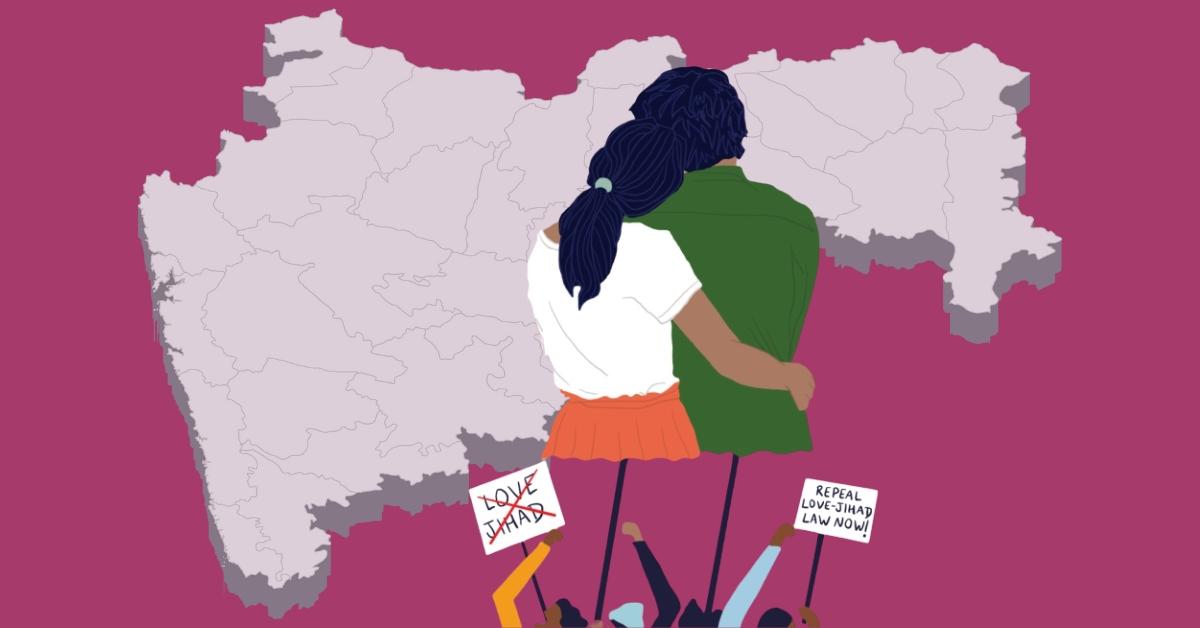
Over the past several weeks, Maharashtra has witnessed a sustained, carefully choreographed campaign by Hindutva organisations to force the state government into enacting a stringent anti-conversion—popularly framed as an ‘anti–love jihad’—law. This mobilisation has unfolded across districts, collectorate offices, public halls, hotels, and street protests, synchronised with the Maharashtra Assembly’s winter session. What is emerging is not an organic public movement responding to demonstrable harm, but a familiar political strategy: manufacture a moral panic, project it as a civilisational crisis, and use street pressure to push through extraordinary criminal legislation that intrudes deeply into private life.
Citizens for Justice and Peace (CJP), along with women’s rights groups, constitutional lawyers, and minority rights organisations, has repeatedly cautioned that such laws—already operational in several BJP-ruled states—have functioned less as safeguards against coercion and more as tools for communal profiling, moral policing, and the criminalisation of adult consensual relationships. Maharashtra is now being pushed to replicate a model that is not only deeply abusive in practice but also under active constitutional challenge before the Supreme Court of India.
It is essential to note that previously, the Maharashtra Government had issued a Government resolution on December 13, 2022, following the gruesome murder of Shraddha Walkar in Delhi allegedly by her inter-faith live-in partner, forming a committee to provide a platform to ‘counsel, communicate and resolve’ issues between couples and families. According to the GR, the committee can seek information of both registered and unregistered marriages. Furthermore, the committee can intervene at the behest of any person, which the plea alleges is a breach of the couple’s privacy “especially when two consenting adults are married to each other”. A challenge against the same, filed by CJP, remains pending in the Bombay High Court. Details of the petition may be read here.
A state-wide, synchronized campaign- Event by event
The scale and coordination of the recent mobilisations are striking. On November 27, in Jalgaon, the Hindu Janajagruti Samiti organised an ‘Anti–Love Jihad’ protest where speakers openly demanded that the Maharashtra Chief Minister ensure the passage of an anti-conversion law in the upcoming winter session of the Assembly. The demand was framed as a matter of urgency and inevitability. Organisers claimed support from over 35 organisations, cited more than 300 citizen statements, and referenced a petition purportedly carrying 15,000 signatures—figures repeatedly invoked to manufacture the impression of overwhelming public consensus.
As the Assembly session approached, the campaign intensified. On December 5, in Amravati, far-right organisations led by the Hindu Janajagruti Samiti submitted a memorandum to the District Collector, addressed to the Chief Minister and Deputy Chief Minister, demanding a ‘strict’ law against the alleged conspiracy of ‘love jihad’. A signature campaign claiming the support of over 3,000 citizens accompanied the submission, making explicit that the objective was legislative pressure during the session rather than redressal of any specific grievance.
On December 7, protests were held across multiple districts. In Dapoli, Ratnagiri, far-right groups once again alleged a systematic conspiracy of ‘love jihad’ and demanded immediate legislative action. The framing was uniform: inter-faith relationships were projected as demographic warfare, and state inaction was portrayed as civilisational betrayal.
The same day, in Akola, the campaign descended into overt communal abuse. At an anti–‘love jihad’ protest, a Hindu Janajagruti Samiti member used derogatory slurs against Muslims—calling them “cowards who used to be Hindus” and “jalli-topiwallas”—and invoked the trope of ‘gaddar Hindus’. Such speech is not incidental; it reveals the communal animus that animates the demand for criminal legislation and signals how such laws are likely to be enforced on the ground.
Also on December 7, in Kothrud, Pune, at a Vishwa Hindu Parishad–Bajrang Dal ‘Shaurya Diwas’ event, speakers claimed that only organisations like the Bajrang Dal could stop ‘love jihad’, religious conversions, and cow slaughter. This assertion effectively erased the boundary between state authority and vigilante power, suggesting that the proposed law is intended to legitimise extra-legal social control.
On December 8, the campaign expanded simultaneously into administrative offices and mainstream political platforms. In Chhatrapati Sambhaji Nagar, delegations led by the Hindu Janajagruti Samiti, alongside BJP leader Kamlesh Katariya, submitted requests at District Magistrate offices across Maharashtra, uniformly urging enactment of a ‘strict’ anti–love jihad law.
The same day, at Hotel Center Point, Nagpur, during a ‘Majha Maharashtra’ event organised by Anand Bazaar Patrika, BJP MLA Nitesh Rane amplified these conspiracies from a mainstream political stage. He invoked ‘love jihad’, ‘land jihad’, and ‘halal jihad’, and further referenced ‘ghazwa-e-Hind’, explicitly linking these ideas to terrorism. Such rhetoric performs a crucial legitimising function: it converts fringe paranoia into a perceived security threat, thereby manufacturing public consent for exceptional criminal law.
Core Criticisms of Anti-Conversion Laws: Why civil liberties groups oppose them
CJP and other civil liberties organisations, women’s rights groups, and constitutional scholars have consistently raised serious objections to anti-conversion laws across states—objections that apply with equal, if not greater, force to the proposed Maharashtra legislation.
- Criminalisation of consent and autonomy: These laws operate on the presumption that adult women—particularly Hindu women—are incapable of making informed choices about relationships and faith. By treating consent as inherently suspect, the laws directly contradict Supreme Court jurisprudence recognising decisional autonomy, bodily integrity, and the right to choose one’s partner.
- Vague and overbroad offences: Terms such as ‘allurement’, ‘undue influence’, and ‘fraud’ are undefined or expansively defined, allowing ordinary acts—companionship, emotional support, marriage, or assistance—to be reinterpreted as criminal inducement. This violates the principle that criminal offences must be narrowly and clearly defined.
- Burden-shifting and presumption of guilt: Many anti-conversion laws invert the foundational criminal law principle of presumption of innocence by shifting the burden onto the accused to prove that no coercion occurred. This is constitutionally suspect and procedurally unjust.
- Third-party complaints and vigilante policing: By allowing relatives—or even unrelated persons—to file complaints, these laws institutionalise vigilante interference in intimate relationships. In practice, police action is often triggered not by the alleged convert but by ideological organisations or hostile family members.
- Discriminatory enforcement: Empirical evidence from other states demonstrates that enforcement disproportionately targets Muslim men and inter-faith couples, entrenching communal profiling and selective policing.
- Chilling Effect on Religious Freedom: Mandatory prior notice requirements and intrusive inquiries deter individuals from exercising their freedom of conscience, effectively converting a fundamental right into a regulated privilege.
CJP has repeatedly warned that these laws do not prevent coercion; they prevent choice.
Pending Petitions Before the Supreme Court: Laws under constitutional cloud
Importantly, CJP’s challenge to anti-conversion laws in several states—including Uttar Pradesh, Madhya Pradesh, Uttarakhand, and Gujarat—is currently pending before the Supreme Court of India. Multiple petitions contend that these statutes violate core constitutional guarantees under Articles 14, 15, 19, 21, and 25.
Detailed report may be read here.
Petitioners have argued that the laws:
- Undermine the right to privacy and decisional autonomy recognised in K.S. Puttaswamy v. Union of India
- Criminalise adult consensual relationships, contrary to Shafin Jahan v. Asokan K.M. and Lata Singh v. State of UP
- Treat women as lacking agency, in violation of equality and dignity
- Enable arbitrary, discriminatory, and communalised policing
- Invert the presumption of innocence by shifting the burden of proof
The Supreme Court has been urged to examine whether the state can subject personal faith, marriage, and belief to prior scrutiny and criminal sanction in the absence of demonstrable harm. These challenges remain pending, rendering the legal framework that Maharashtra is being urged to adopt constitutionally unstable.
Manufacturing panic, normalising surveillance, reshaping criminal law
The Maharashtra campaign exemplifies a broader shift in law making: from evidence-based policy to ideology-driven criminalisation. There is no credible data demonstrating widespread forced conversions through marriage in Maharashtra. Existing criminal law already addresses coercion, cheating, kidnapping, trafficking, and sexual exploitation. The demand for a new law is therefore not remedial but symbolic—designed to signal dominance, discipline intimacy, and legitimise social surveillance.
By framing adult women as perpetual victims, these campaigns rein scribe patriarchal control. By singling out Muslims as conspirators, they normalise collective suspicion. By demanding preventive criminalisation, they erode the basic premise that criminal law punishes acts, not identities or intentions.
What is at stake for Maharashtra
If enacted, an anti-conversion law in Maharashtra will not remain a neutral legal instrument. It will embolden vigilante groups, legitimise moral policing, and place police machinery at the service of ideological enforcement. For inter-faith couples, religious minorities, and women asserting autonomy, the consequences are likely to be immediate and severe: arrests, harassment, prolonged incarceration, and social ostracisation.
As CJP has consistently argued, the real question is not whether forced conversions should be prevented—existing law already does so—but whether the state can be permitted to criminalise choice itself. Maharashtra today stands at a constitutional crossroads: between safeguarding liberty and importing a legal regime already notorious for abuse and under active constitutional scrutiny. The street pressure is loud. The constitutional warning signs are louder still.
Related:
Gujarat High Court Widened Anti-Conversion Law: ‘Victims’ can be prosecuted as offenders