


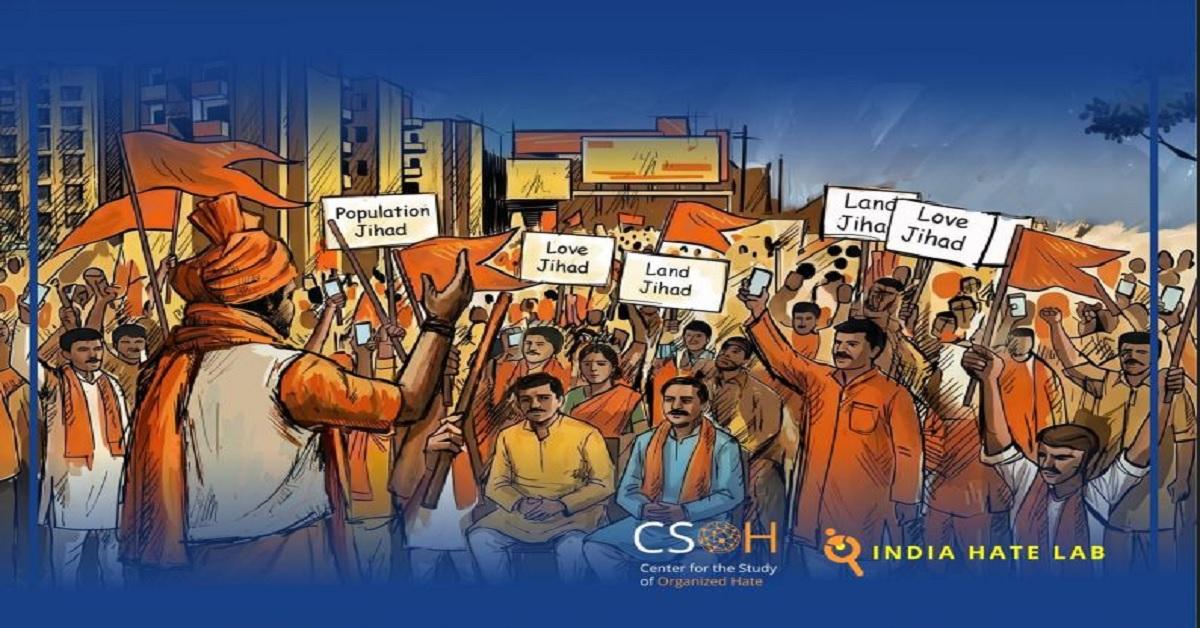
From processions to platforms, hate has become routine: 1,318 verified in-person events in 2025, with BJP-ruled states accounting for 88%
The India Hate Lab (IHL) has documented 1,318 verified in-person hate speech events targeting religious minorities across India in 2025, spanning 21 states, 1 Union Territory, and the National Capital Territory of Delhi. That is nearly four hate speech events every day. Compared to 2024, this reflects a 13% increase, and compared to 2023, a 97% increase from the 668 incidents recorded then.
The findings below have been drawn from India Hate Lab’s 2025 report and it has published key findings.
But the most disturbing insight is not only the rise in numbers. It is the pattern the numbers reveal: hate speech is no longer confined to election campaigns or sudden flashpoints. It is beginning to resemble a routine instrument of mobilisation, used repeatedly across public gatherings—political rallies, religious processions, protest marches, and nationalist events—without consistent institutional consequence.
These are verified public events; the report does not attempt to measure private conversations or all online hate.
IHL’s introduction to the 2025 report makes a crucial point: after the “unprecedented surge” in 2024, 2025 did not mark a correction. It marked consolidation. Hate speech, the report suggests, is now operating as a round-the-clock mechanism for far-right mobilisation—less like a temporary electoral tactic, and more like a continuous mode of governance and street-level politics.
BJP-ruled states remain the main theatre for hate
One of the report’s most striking findings is geographical and political. Of the 1,318 events, 1,164 incidents (88%) occurred in states governed by the BJP, either independently or through coalition partners, as well as in BJP-administered Union Territories. This is a 25% increase from the 931 incidents recorded in BJP-ruled jurisdictions in 2024.
By contrast, the report notes that seven opposition-ruled states recorded 154 hate speech events, a 34% decrease from the 234 incidents documented in those states in 2024.
The concentration is stark. The five highest-reporting jurisdictions were: Uttar Pradesh (266), Maharashtra (193), Madhya Pradesh (172), Uttarakhand (155), and Delhi (76)—together accounting for roughly two-thirds of all incidents.
This is not simply a map of hate; it is a map of political permissiveness, where repeated public incitement appears easier to organise, safer to perform, and harder to penalise.
Muslims are targeted in 98% of events; anti-Christian hate rises sharply
IHL records that 1,289 of the 1,318 events (98%) targeted Muslims—explicitly in 1,156 cases, and alongside Christians in 133 cases. This represents a nearly 12% increase from the 1,147 instances recorded in 2024.
The report also documents a troubling rise in anti-Christian hate speech: 162 incidents (about 12% of all events), reflecting a 41% increase from the 115 anti-Christian incidents recorded in 2024. Of these, Christians were explicitly targeted in 29 cases, and targeted alongside Muslims in 133 cases.
The implication is clear: while anti-Muslim incitement remains the ideological core of this ecosystem, hate against Christians is being normalised more openly and more frequently.
How hate is built: conspiracy ‘jihads’, de–humanisation, and calls to violence
A major portion of hate speech documented in 2025 relied on conspiracy narratives. The report records 656 hate speeches—nearly half—referencing “love jihad,” “land jihad,” “population jihad,” “vote jihad,” and newer variations such as “thook (spit) jihad,” “education jihad,” and “drug jihad.”
These conspiracy frames perform a consistent political function: they translate everyday anxieties into claims of organised minority aggression, and then present majoritarian retaliation—social exclusion, boycott, and violence— as “self-defence.”
The danger is not abstract. IHL records that:
- 308 speeches (23%) contained explicit calls for violence
- 136 speeches contained direct calls to arms
- 120 speeches called for social or economic boycotts (an 8% increase from 2024)
- 276 speeches called for removal or destruction of places of worship, including mosques, shrines, and churches
- 141 speeches used dehumanising language—calling minorities “termites,” “parasites,” “insects,” “pigs,” “mad dogs,” “snake-lings,” “green snakes,” and “bloodthirsty zombies.”
When such language becomes familiar in public life, it does not remain “speech”. It becomes permission—permission to harass, exclude, attack, and deny belonging.
Dangerous speeches: Maharashtra stands out
The report notes that Maharashtra recorded the highest number of “dangerous speeches”—78 incidents, up from 64 in 2024. Nearly 40% of the state’s 193 hate speech events involved explicit calls for violence—the highest proportion recorded for any state.
Among individuals delivering the most dangerous speeches, Maharashtra minister Nitesh Rane is identified as being among the top five actors issuing calls to violence.
This matters because dangerous speech is not merely a measure of “tone”; it reflects an ecosystem where the line between political mobilisation and incitement becomes increasingly thin.
Organisers and actors: a network, not outliers
IHL identifies more than 160 organisations and informal groups as organisers or co-organisers of hate speech events in 2025. The Vishwa Hindu Parishad (VHP) and Bajrang Dal emerge as the most frequent organisers, linked to 289 events (22%), followed by Antarrashtriya Hindu Parishad (138 events).
The report also identifies the most prolific individual hate-speech actors in 2025:
- Uttarakhand CM Pushkar Singh Dhami: 71 speeches
- Pravin Togadia: 46 speeches
- BJP leader Ashwini Upadhyay: 35 speeches
When chief ministers and prominent leaders appear as frequent actors in such datasets, the issue stops being about “fringe” mobilisation. It becomes a question of political signalling, where the top legitimises the bottom, and the bottom operationalises the top.
April spike: processions, backlash rallies, and rapid mobilisation
The report records that April had the highest monthly spike with 158 hate speech events, coinciding with Ram Navami processions and hate rallies organised in response to the Pahalgam terror attack.
In the 16-day period between April 22 and May 7, IHL documented 98 in-person hate speech events, indicating rapid and nationwide anti-Muslim mobilisation.
The pattern is politically significant: a terror incident becomes a trigger not for measured accountability but for public rhetoric, that collapses an entire community into a suspect population.
‘Outsider’ tropes: Rohingya and ‘Bangladeshi infiltrator’ narratives
IHL records 69 hate speech events targeting Rohingya refugees, and 192 speeches invoking the “Bangladeshi infiltrator” trope, frequently used to stigmatise Bengali-origin Muslims as foreigners.
These tropes are effective because they blur the line between citizenship and suspicion, turning identity into a permanent trial—where belonging must be constantly proved and can be constantly denied.
Social media: the multiplier of public hate
A defining feature of 2025 is the speed of amplification. Videos from 1,278 of the 1,318 events were first shared or live-streamed on social media platforms.
The breakdown is telling:
- Facebook: 942 first uploads
- YouTube: 246
- Instagram: 67
- X: 23
This confirms that the “in-person” event is no longer the endpoint. A local gathering becomes national content within minutes—clipped, circulated, and rewarded by engagement. Platform policies against hate speech exist, but the report’s documentation shows how digital impunity persists in practice.
It begins with words—and survives through institutional hesitation
The democratic danger here is not only moral; it is institutional. A society can endure hateful individuals. What it cannot safely endure is predictable public incitement without predictable legal consequence.
When hate speech becomes routine, it creates two realities: one in the Constitution, and one on the streets. The first promises equality and dignity. The second teaches communities to accept humiliation, exclusion, and vulnerability as ordinary facts of life.
The IHL report does not ask whether hate exists. It records what happens when hate is allowed to become ordinary—and how quickly the ordinary can become dangerous.
If hate speech has become routine, the response must become routine too: prompt FIRs where applicable, platform enforcement, and transparent public accountability.
The report may be read here.
(The author is a lawyer and Constitutional Law Researcher based in New Delhi)
Related:
Free Speech in India 2025: What the Free Speech Collective report reveals about a year of silencing