


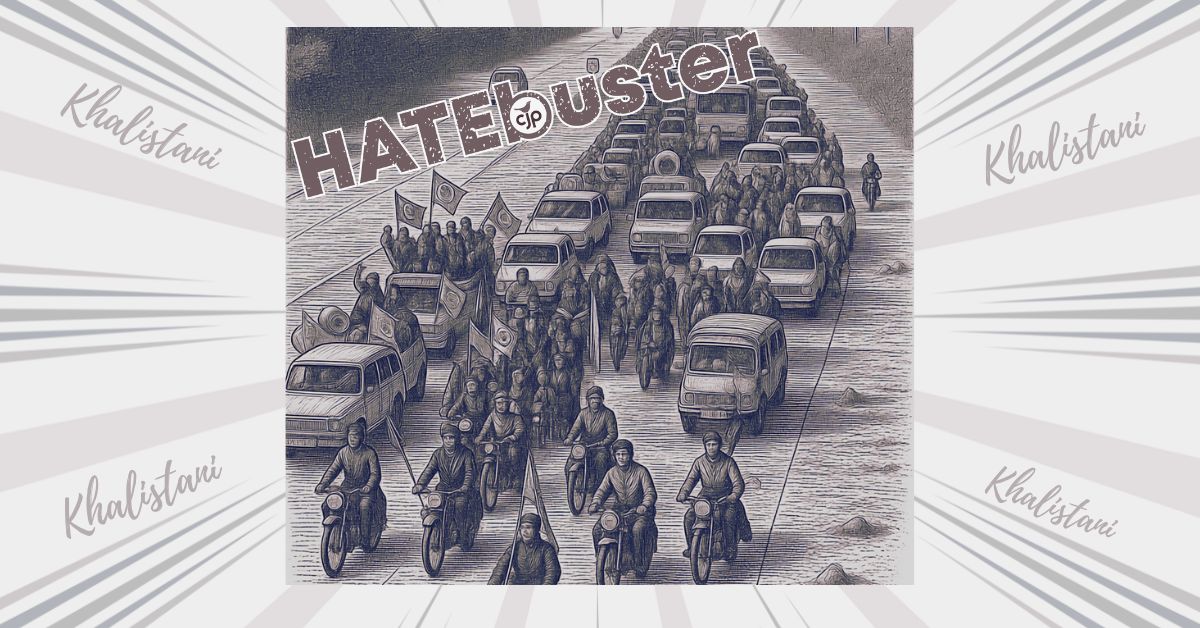
It is often claimed that the Khalistani movement remains popular today and continues to pose a threat to India. Some far-right groups have also argued that the farmers’ protest was not primarily about the farm laws, but rather a Khalistani movement disguised as a farmers’ agitation aimed at weakening India.
These are #KhalistaniTerrorists
They are NOT FARMERS !
No sympathy for ANYONE who is trying to challenge SOVEREIGNTY of my country 🇮🇳
देश से बड़ा कोई नहीं है ! pic.twitter.com/piwi9NKMta— Major Surendra Poonia (@MajorPoonia) January 26, 2021
The term “Khalistani” has had a resurgence in its usage and is now being used as a de-legitimising label ever since 2014 and particularly during the 2020s[1]. Any expression of Sikh political assertion — whether concerning agricultural policy, minority rights, or tragic historical memory such as 1984 — is often reframed by the Right as evidence of separatist intent, placing it beyond the bounds of legitimate debate[2]. However, close to 80 years ago, pre-Independence this epithet had a vastly different meaning.
Origin and Evolution of the Term
The word “Khalistan” – literally “land of the Khalsa” – first appeared in a 1940 pamphlet by Dr V. S. Bhatti as a response to the Muslim League’s demand for a separate Muslim homeland[3]. It was, at its inception, a question of Sikh autonomy within a dissolving empire — not a call to arms.
After the Partition in 1947, the demand for a sovereign Sikh state remained outside mainstream Sikh politics until the late 1970s and 1980s[4], with the rise of radical figures like Jarnail Singh Bhindranwale escalating the issue into armed insurgency.
The 1984 Operation Blue Star — a paramilitary assault on the Golden Temple in Amritsar — and the anti-Sikh pogroms following Prime Minister Indira Gandhi’s assassination marked the movement’s violent peak.
By the mid-1990s, the insurgency had largely collapsed. Within contemporary Punjab, scholars note the movement is “not pronounced at all” and is widely regarded as a utopian ideal rather than an active political programme[5]. The only legally registered pro-Khalistan party received less than one per cent of votes in recent state elections[6].
Contemporary Misuse: A De-legitimising Slur
All Sikhs are Hindus.
I live and work with hundreds of them.
They are more Hindu than a lot of Hindus I know .
Please don’t fall for the Congress propaganda slogan.
Look at the lives of Sikh Gurus instead . @puneet_sahani https://t.co/DyIXa2jipQ
— Dr Omendra Ratnu Sanatani (@satyanveshan) February 8, 2023
The historical trauma suffered by the Sikhs has often been exploited by the majoritarian Hindu right-wing (often dubbed as the Sangh parivar), which views Sikhs as “natural Hindus” and an inseparable part of the Hindu nation. Within this assimilationist logic, Sikhs are praised as the “sword arm” of Hinduism when they align with the state but are branded as “anti-national” enemies if they assert cultural or political autonomy[7]. Such a dual strategy conveniently allows state actors to marginalise any Sikh dissenting voices.
The Farmers’ Protest, 2020–21: As large and medium farmers from north India marched to New Delhi and barricaded the capital to protest three agricultural laws seen as an assault of corporatised firms, state-aligned media and political figures labelled them as “Khalistanis” and “anti-social elements”. The fact is that many who marched and were vocal, including women, were predominantly Sikh farmers from Punjab, though farmers from Rajasthan, Haryana and Uttar Pradesh (UP) also joined the vibrant movement.
Then, in the days of the Covid-19 lockdown, a single television network hosted over 20 debates on alleged “Khalistan infiltration” between November 2020 and January 2021[8]. The hoisting of the Nishan Sahib — a traditional Sikh religious flag — at the Red Fort was deliberately conflated with a “Khalistani flag”, misrepresenting a religious symbol as a separatist emblem[9]. In parliament, Prime Minister Modi characterised the protesters as “andolan jeevi” (professional protestors) and “parasites”, framing their dissent as a “foreign destructive ideology”[10]. These comments from the mighty and powerful signaled where the negative labelling was originating from.
Disha Ravi, 2021: Delhi Police cited “pro-Khalistani content” in court filings against a 22-year-old climate activist, claiming her protest toolkit carried links to a Sikh separatist movement. No substantive evidence of any such connection was established[11].
The California Caste Bill Debate, 2023: A news programme in India portrayed supporters of anti-caste legislation in California as participants in a broader “Break India” and “terrorist” plot, explicitly linking civil rights advocacy to Khalistani extremism – a framing endorsed by a former Indian ambassador[12].
The label is not merely rhetorical. Under India’s Unlawful Activities (Prevention) Act, the state can designate individuals as terrorists without open-court evidence. The Act has been used against journalists, activists, and social media users whose speech is deemed “pro-Khalistani”.
During the 2023 manhunt for Amritpal Singh, a Sikh preacher associated with Waris Punjab De and accused by police of inciting unrest, authorities suspended mobile internet and SMS services across Punjab for several days, affecting approximately 30 million people in the state. Reports also indicate that the government requested platforms to block over 100 accounts, including those of some Sikh activists, journalists, and critics of the government’s actions, while also carrying out hundreds of preventive arrests across the state [13].
Fact versus Propaganda
The empirical evidence does not support the scale of threat suggested by the volume of “Khalistan” rhetoric.
A 2024 Canadian internal security assessment explicitly concluded that non-violent advocacy for an independent Khalistan does not constitute extremism and that only a small number of Canadian Sikhs are credibly linked to violence in India[14]
Imagine displaying posters of Osama bin Laden on the grounds of Canada’s Parliament? It’s especially jarring given that the worst terrorist attack in Canadian history was the 1985 Air India bombing carried out by Khalistani extremists. No other community in Canada receives the… https://t.co/ZNt9fcqv9R
— Rupa Subramanya (@rupasubramanya) June 19, 2026
Journalist and writer Amandeep Sandhu said, “Even if 200,000 people may have shown up to vote at referendums held [by Khalistani groups abroad] …, that number is small compared to the 30 million Sikhs who live in India and around the world”[15].
“They [Sikhs] are about 2% of India’s population, but form 8% of the nation’s army, and Sikh soldiers are among the nation’s most decorated.”, he said.[16]
A 2021 survey by the Pew Research Center, based on in-person interviews with 29,999 adults across India between November 2019 and March 2020, including 1,782 respondents who identified as Sikh, found that 95 per cent of Sikh respondents described themselves as “very proud” to be Indian[17].
Dr Ajai Sahni, the executive director of the Institute for Conflict Management in New Delhi, has observed in an interview with the Financial Times that the Khalistan movement is portrayed in pro-government media in a manner “far out of proportion to the actual threat”[18].
Professor Jagbir Jhutti-Johal, a professor of Sikh studies at the University of Birmingham in the UK, said that increased government attention has inadvertently made the movement “more visible” in public discourse[19].
Moreover, an Australian government assessment notes that violence associated with Khalistani separatism in Punjab has been uncommon in recent decades, as the movement was largely suppressed years ago[20].
Professor Jagbir Jhutti-Johal, in the previously mentioned interview, also said the politics in Punjab now were largely peaceful and primarily focused on practical issues such as improving education and eradicating drugs.
Director Mark Juergensmeyer of the Orfalea Centre for Global & International Studies, UCSB, in his paper Bhindranwale to Bin Laden: Understanding Religious Violence, reports interviewing a militant who had remarked that “the movement is over”, as many of his colleagues had been killed, imprisoned, or driven into hiding, and because public support was gone[21].
Implications for Democratic Debate
The misuse of the word “Khalistani” as a label carries serious consequences. It discourages lawful political protest by branding critics as traitors. It conflates peaceful dissent with violent extremism, leaving little room for legitimate difference of opinion. It displaces substantive socioeconomic grievances — over land rights, drug policy, and historical memory — with a sensational “separatist angle”.
In the end it stigmatises a whole religious community and widens the social divide by sowing mistrust. Treating every Sikh symbol or critical voice as a covert separatist signal is propaganda, not security.
So the next time you encounter the term, put it to the test: who is using it and why? To question this kind of rhetorical weaponisation is hardly anti-national; if anything, it is a necessary push towards upholding the democratic culture on which our nation is founded.
(The programme research team of CJP also consists of interns; this resource has been worked on by Ishan Bhatnagar)
[1] In correspondence with the Research Directorate, a professor of Sikh studies at the University of Birmingham in the UK, whose research topics include Sikh theology and identity in the diaspora (2025-11-08) https://www.irb-cisr.gc.ca/en/country-information/rir/Pages/index.aspx?doc=459105
[2] Evidence for this can be found in David Singh & Christine Moliner (2026) Punjab: Relocations of Hindutva in a Sikh Majority State, Forum for Development Studies, 53:1, 75-83, DOI: 10.1080/08039410.2025.2522700; Moliner, C. (2026). Hindutva in Punjab: Appropriation and resistance. In P. Singh & M. Dhanda (Eds.), Routledge handbook of Punjab studies (pp. 78–86). Routledge. https://doi.org/10.4324/9780429277580-8; Panag, S. (2024). Examining parallels in India’s anti-Sikh narratives from 1984 to the farmers’ protest. Crossings, 6, 119–129. https://crossings.uwinnipeg.ca/index.php/crossings/article/view/205; Sikh American Legal Defense and Education Fund, Indian American Muslim Council, Hindus for Human Rights, & Equality Labs. (2024). Virtually vulnerable: Exposing the human cost of digital harassment. Sikh American Legal Defense and Education Fund. https://saldef.org/wp-content/uploads/Tech-Censorship-Diasporic-Landscape-Report-v2.pdf
[3] Shani, G. (2008). Sikh nationalism and identity in a global age. Routledge. https://doi.org/10.4324/9780203937211
[4] Sikh Historian Harjot Oberoi, “While there were proponents of a Sikh state in the decades surrounding independence, political mobilization for this objective did not begin in earnest until the very late 1970s—at the earliest—and the early 1980s.’ found it in Fair, C. C. (2005). Diaspora involvement in insurgencies: Insights from the Khalistan and Tamil Eelam movements. Nationalism and Ethnic Politics, 11(1–2), 125–156. https://doi.org/10.1080/13537110590927845
[5] In an interview with the Research Directorate, a scholar of South Asian traditions and languages at Harvard University and co-founder of the Sikh Coalition (2024-04-29) in https://www.irb-cisr.gc.ca/en/country-information/rir/Pages/index.aspx?doc=459105
[6] SAD(A) received 49,260 votes (0.3% of the vote share) in the 2017 Legislative Assembly election.
[7] David Singh & Christine Moliner (2026) Punjab: Relocations of Hindutva in a Sikh Majority State, Forum for Development Studies, 53:1, 75-83, DOI: 10.1080/08039410.2025.2522700 “The role assigned to Sikhs in the Hindu nationalist ideological framework as it took shape from the 1920s is clearly articulated in Hindu nationalist ideologue V.D. Savar-kar’s writings, to whom Sikhs are ‘natural Hindus’, fully part of the Hindu nation. … Hindu nationalism has developed a two-pronged strategy with respect to the Sikhs. On the one hand, and in line with their view of Sikhs as natural Hindus, it tries to forcibly incorporate Sikhs into the Hindu nationalist project by portraying them as the sword arm of Hinduism in the struggle against Islam. On the other hand, it may brand Sikhs who resist those attempts at incorporation and/or who actively oppose the BJP, as anti-national forces threatening the unity of the Hindu nation.”
[8] Asheef Iqubbal, A., & Alam, S. (2021). Instrumentalising social media to counter popular narrative: Protests in the times of social media: A case of farmers’ agitation (DEF COVID-19 Ground Report Series). Digital Empowerment Foundation. https://www.defindia.org/wp-content/uploads/2021/05/Farmers-Protests-Report.pdf (The news channel mentioned is Zee News)
[9] Ibid.
[10] https://indianexpress.com/article/india/india-must-save-itself-from-foreign-destructive-ideology-pm-modi-in-rajya-sabha-7179445/
[11] https://time.com/5939627/disha-ravi-india-toolkit-arrest/
[12] Sikh American Legal Defense and Education Fund, Indian American Muslim Council, Hindus for Human Rights, & Equality Labs. (2024). Virtually vulnerable: Exposing the human cost of digital harassment. Sikh American Legal Defense and Education Fund. https://saldef.org/wp-content/uploads/Tech-Censorship-Diasporic-Landscape-Report-v2.pdf
[13] https://www.yahoo.com/news/indias-manhunt-hardline-sikh-leader-194530516.html
[14] https://www.canada.ca/en/security-intelligence-service/corporate/publications/csis-public-report-2024/intelligence-operations.html
[15] https://apnews.com/article/canada-india-sikh-diaspora-separatist-activism-b8c00bae87309d1b3285a5d21c28381f
[16] Ibid.
[17] https://www.pewresearch.org/religion/2021/06/29/religion-in-india-tolerance-and-segregation/#sikhs-are-proud-to-be-punjabi-and-indian
[18] https://www.ft.com/content/1e11a2f2-78c3-41be-ae34-1de5f226a60d from https://www.irb-cisr.gc.ca/en/country-information/rir/Pages/index.aspx?doc=459105#RIR_fnlist8
[19] https://www.canada.ca/en/security-intelligence-service/corporate/publications/csis-public-report-2024/intelligence-operations.html
[20] Australian Government Department of Foreign Affairs and Trade. (2023, September 29). DFAT country information report: India. Australian Government Department of Foreign Affairs and Trade. https://www.dfat.gov.au/sites/default/files/country-information-report-india.pdf
[21] Juergensmeyer, M. (2007). From Bhindranwale to Bin Laden: A search for understanding religious violence. In L. E. Cady & S. W. Simon (Eds.), Religion and conflict in South and Southeast Asia: Disrupting violence (pp. 21–30). Routledge. https://doi.org/10.4324/9780203949559-9