


“Hindusthan ek khwab hai aur iss khwab mei har kisi ke liye jagah hai.”
– Poem by Amir Aziz
It is increasingly evident that Muslims in India are being robbed of their legitimate space and place within a nation that was once imagined as their collective constitutional dream. A vast majority chose to stay back in India after the 1947 bloody Partition, believing in existential roots, lived coexistence and constitutional equality. There have been riots and communal clashes in past decades post-Independence, but rarely was their very belonging to the nation so openly questioned and at grave risk. Rarely was their loyalty publicly doubted, their religion brazenly mocked.
It was uncommon for a sitting Chief Minister to pull a woman’s headscarf[1] simply because of her cultural choice, she donned a headscarf. It was unheard of for a Chief Minister to post violent and provocative imagery (video) depicting him shooting at Muslims[2]! What once manifested as communal ‘push and pull’ now appears to have been hardened and legitimised into something more systemic, an institutionalised propagation of directed othering, hatred and violence.
CJP is dedicated to finding and bringing to light instances of Hate Speech, so that the persons propagating these venomous ideas can be unmasked and brought to justice. To learn more about our campaign against hate speech, please become a member. To support our initiatives, please donate now!
Accidental to Institutional
This messaging is not confined to political speeches only. It is reinforced through ‘mainstream’ cinema; films marketed as if “based on real events,” filled with questionable, even repulsive and inflammatory depictions that amplify suspicion and hostility towards the Muslim. These narratives shape public imagination. In one disturbing instance, children living on the streets of South Mumbai were heard using hateful language against Muslims. When asked where such sentiments originated, they reportedly said that “aunts and uncles” take them to watch films, one of the few outings they can afford, as their parents earn meagre incomes selling roses on Marine Drive. Hatred, it seems, is being curated and consumed.
Policy, too, reflects this exclusion. Measures such as the Special Intensive Revision (SIR) exercise—executed by the Election Commission of India (ECI) though this has been strongly legally contested—have clearly resulted in the disproportionate removal of Muslim names from electoral rolls, raising concerns about potential disenfranchisement. Legislative developments have added to these anxieties. Under the Citizenship (Amendment) Act 2019 (CAA), which came into force last year, members of specified persecuted minorities from neighbouring countries who entered India on or before 31 December 2014 were made eligible for Indian citizenship. Muslims were excluded from this framework. Not only has the Supreme Court of India kept the substantive legal challenges to this much criticised amendment (CAA 2019) in cold storage, the court will only now hear the batch of 250 petitions in early May 2026 (May 5-7, 2026).[3]
More recently, an order issued under the Immigration and Foreigners Act, 2025 extended relief to individuals particularly Hindus from Pakistan, who crossed into India after 2014, with officials stating that the cut-off has effectively been expanded by a decade due to the continued cross-border migration of persecuted minorities. This privileges one community over others in fast-tracked citizenship.
Taken together, these measures have intensified debate over whether citizenship policy is being recalibrated along religious lines, especially when viewed alongside voter roll revisions and public rhetoric framing Muslims as “infiltrators.”
‘Torching’ the lawn
Attempts by Hindutva affiliates to enter Masjids, incidents of mob lynching targeting Muslim vendors, mobs stopping individuals to demand proof of nationality, these have become disturbingly common. In Varanasi, “Operation Torch” was launched to identify so-called illegal migrants.
The forcible closure of Muslim-owned businesses under varying pretexts points toward the economic marginalisation of a community already made vulnerable. The cumulative effect suggests a systematic relegation of Muslims to second-class citizenship within their own country.
On the frontline of this targeting –in 2025-206 at least –are Bengali Muslim migrants—often daily wage labourers, domestic workers, and small vendors struggling for survival.
Direct Violence
“I am very poor, and my family is deeply worried about our future. Why did they beat me? I never forced anyone to buy my food.”
— Riyajul Sheikh, Food vendor from West Bengal
“I am a poor man. I earn a living for my family by selling utensils. After this incident, how will I go out and work?”
— Akmal Hussain, assaulted in Bihar in January 2026
On May 24, 2025, in Aligarh, four Muslim men Arbaz, Aqeel, Kadim, and Munna Khan, were brutally attacked by a mob of cow vigilantes over allegations of beef smuggling. The assailants set their vehicle on fire, blocked a highway, and assaulted them with sharp weapons, bricks, and sticks. One unconscious victim was seen being dragged from a police vehicle. This was reportedly the second attack on the same group at the same location within 15 days, suggesting targeted violence. A forensic report from a government laboratory in Mathura later confirmed that the meat was not beef, debunking the allegations. Police arrested four individuals under provisions of the Bhartiya Nyaya Sanhita for rioting, attempt to murder, extortion, and dacoity.
Riyajul (December 2025) was beaten by a mob and his goods were destroyed. He sells patties by walking through the streets of Kolkata. In one such incident from West Bengal, he was allegedly asked whether he had chicken patties in his box. When he replied in the affirmative, the assault began. When they heard his name, the violence intensified as reported by The Wire. It seems that, for many, the only fault is being Muslim. Such initiative feeds into a larger narrative of suspicion.
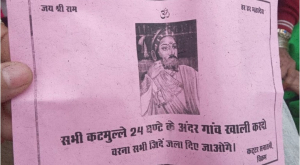
Source: Maktoob Media

Didar Hossain, a rickshaw puller from Agartala, was assaulted by a mob that attempted to burn him alive. He was robbed of his entire day’s earnings and severely beaten.
On December 22, in Basti, Uttar Pradesh, Akhilesh Singh, a leader of the Vishva Hindu Mahasangh, along with members of the group, harassed and threatened a Muslim chicken vendor for operating his shop near a temple. He described the butcher’s knives as “weapons” that could be used to kill people and threatened to file a police complaint for possessing them.
On December 30, in Madhubani, Bihar, approximately 40–50 Hindu nationalist supporters brutally assaulted and paraded a Muslim construction worker. He was falsely branded a Bangladeshi and forced to chant “Jai Shri Ram” and “Bharat Mata ki Jai.” The attackers allegedly threatened to sacrifice him at a Kali temple. Each incident may appear geographically scattered in Odisha, Uttar Pradesh, Jharkhand, Bihar, Tripura but the pattern is chillingly consistent. The slogans are the same. The accusations are similar. The humiliation is public. The violence is performative. And the message is unmistakable: belonging is conditional.
On January 7, 2026, in Jharkhand, a 45-year-old Muslim man was killed by a mob after being accused of cattle theft.
On January 1, 2026, in Bhonkhera, Sikandrabad, Uttar Pradesh, threats were reportedly left inside the homes of Muslim residents in the region, creating an atmosphere of fear at the very threshold of their private spaces.
On January 14, 2026 in Sahada, Balasore, Odisha, cow vigilantes lynched Sheikh Makandar Mohammed, a 35-year-old Muslim helper on a pickup van. He was repeatedly forced to chant “Jai Shri Ram” and “Cow is my mother.” Police later took him to the hospital, where he succumbed to his injuries.
On January 22, 2026, a Bengali Muslim vendor from West Bengal was brutally beaten in Odisha by right-wing extremists who accused him of being a Bangladeshi infiltrator. A similar instance occurred the very next day, another Muslim vendor from Birbhum district, West Bengal, was allegedly forced to produce his Aadhaar card, made to chant religious slogans, and threatened with death if he did not leave Odisha.
Such attacks and atrocities have increasingly been framed as expressions of “patriotism.”
According to Akmal Hussain assaulted in Bihar, January 22 2026 (quoted above) the incident began when a woman showed interest in buying utensils and asked him to come near her home. When he arrived, a man confronted him, called him a Bangladeshi, and demanded identity documents. As he attempted to retrieve his phone, a crowd gathered and began assaulting him. He sustained injuries to his head, arms, and legs. Following the attack, he left the city and returned to his hometown in Hooghly, deeply traumatised.
These are not isolated events. There have been multiple incidents of Muslims being beaten to death and forced to chant slogans such as “Jai Shri Ram” and “Gai humari mata hai” before, during, or after being assaulted.
Institutions of prejudice
The University of Delhi found itself at the centre of controversy after its undergraduate admission form listed inappropriate caste-related entries in the “mother tongue” section. Instead of languages such as Urdu, Maithili, Bhojpuri and Magahi, the form reportedly included terms such as Cham***Mazdoor, Dehati, Mochi, Kurmi, Muslim and Bihari, as reported by The Wire and Hindustan Times.
The inclusion of “Muslim” as a language and the removal of Urdu triggered outrage on social media. Bengali was also allegedly absent. The episode raised concerns about institutional insensitivity and the normalisation of caste and religious stereotyping within academic processes.
Meanwhile, in Jammu and Kashmir, educational spaces became a communal flashpoint.
On January 6, hundreds of police and paramilitary personnel were deployed outside the Civil Secretariat in Jammu to prevent protests by a BJP-backed outfit opposing what it called a “biased” reservation system at the SMVD Institute of Medical Excellence in Reasi district.
The protest, led by the youth wing of the Shri Mata Vaishno Devi (SMVD) Sangharsh Samiti and supported by Hindu right-wing groups, centred on the admission of Muslim and other non-Hindu students. Protesters demanded cancellation of their admissions or closure of the college.
“The presence of non-Hindus on the campus and their style of eating and worship is bound to hurt the sentiments of Hindus… The government should cancel their admission or shut down the college,” a protester stated as reported by The Wire.
The agitation is expected to intensify ahead of the J&K Assembly’s winter session beginning February 2. Colonel Sukhvir Singh Mankotia announced a ‘Sanatan Jagran Yatra’, a hunger strike, a signature campaign, and demonstrations on January 8 and January 10, warning of a shutdown across the Jammu division.
The Chief Minister maintained that the college, established through an Act of the J&K Assembly, does not restrict admissions on religious grounds. However, BJP Leader of the Opposition Sunil Sharma stated that only students “who have faith in Mata Vaishno Devi” should be admitted.
All 50 students were admitted on the basis of NEET rankings. The controversy erupted after only eight Hindu students appeared in the first batch, with the remaining 42 being Muslims from the Kashmir Valley. The issue was allowed to take a sharply communal turn, with right-wing affiliates raising slogans demanding the expulsion of non-Hindu students. Following the outrage countrywide and also by the ruling party and opposition in Kashmir and Jammu, on January 26 this year, the Jammu and Kashmir Board of Professional Entrance Examination (BOPEE) was compelled to “adjust” these 50 excluded students in seven government-run medical colleges across J&K based on NEET-UG merit and their preferences. Read more here
At Jamia Millia Islamia, another controversy unfolded. On December 23, 2025 when the university suspended Professor Virendra Balaji Shahare of the Department of Social Work over a question in an end-semester examination paper titled Social Problems in India, set for BA (Honours) Social Work, Semester I, 2025–26. The query attempted a discussion on the plight of the Muslim minority in India (see below).
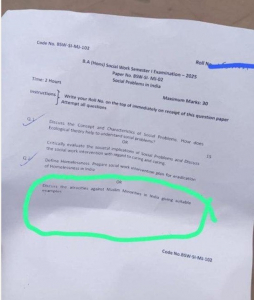
Source: The Wire

Algorithm for and by Hate
Elected officials, sitting in constitutional positions directing hate. This has been a singular feature of the past close to a dozen years and 2025 and early 2026 were no exception.
A video circulated by the Assam BJP in 2025 intensified concerns about the normalisation of dehumanising rhetoric in mainstream politics and even more specifically within law enforcement.
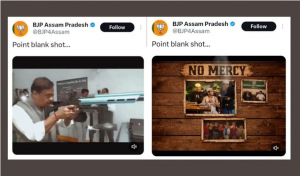
Source ; The Wire, X deleted video

The footage appeared to show Assam Chief Minister Himanta Biswa Sarma handling an air rifle, interspersed with AI-generated visuals depicting bullets striking images of men wearing skull caps and beards widely recognised as markers of Muslim identity. The clip portrayed Sarma as a Western-film hero, overlaid with the slogan “foreigner free Assam” and captioned “point blank shot.” Reports stated that Assamese text in the video included phrases such as “no mercy,” “Why did you not go to Pakistan?” and “There is no forgiveness to Bangladeshis.”
The imagery echoed Sarma’s earlier public remarks. On January 25, during a press conference, he declared: “Only ‘Miyas’ are evicted in Assam. Which Hindu has got notice? Which Assamese Muslim has got notice? We will do some utpaat [mischief], but within the ambit of law.” On January 27, he said: “This Special Revision is preliminary. When the SIR comes to Assam, four to five lakh Miya votes will have to be deleted in Assam.” A day later, he added: “Whoever can give trouble [to Miyas] should. If a rickshaw fare is Rs.5, give them Rs.4. Only if they face troubles will they leave Assam. Himanta Biswa Sarma and the BJP are directly against Miyas.” He has earlier stated that his job was to “make the Miya people suffer.”
Multiple petitions were subsequently filed before the Gauhati High Court seeking action against Sarma for alleged hate speeches targeting Muslims in the state. On Thursday, a Division Bench comprising Chief Justice Ashutosh Kumar and Justice Arun Dev Choudhury issued notices to the Chief Minister, the Central government and the Assam government. The matter is scheduled for hearing on April 21.
The petitions were filed by the Indian National Congress, Assamese scholar Hiren Gohain and the Communist Party of India (Marxist), after the Supreme Court advised them to approach the High Court. Senior advocates including Abhishek Manu Singhvi, Chander Uday Singh and Meenakshi Arora argued that Sarma’s remarks were provocative and threatening, particularly his references to the “miya” community , a term often used in Assam as a pejorative for Bengali-speaking or Bengali-origin Muslims, though the Chief Minister has described it as referring to “illegal immigrants.” The rhetoric has not been confined to one state.
BJP MLA Nitesh Rane posted a tweet on August 5, 2025 asking: if Hindus were being attacked in Bangladesh, why should Indians spare a single Bangladeshi in their country? He added that they would hunt down and kill every Bangladeshi living in India. The tweet was later deleted after controversy.
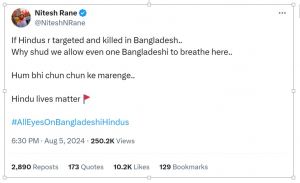

In January 2024, during the Ram Mandir Pran Pratishtha procession in Mira Road, Mumbai, amid communal tensions, Rane made a similar incendiary statement threatening to hunt down individuals. Hate speeches by senior BJP leaders, including Devendra Fadnavis and others, have also drawn criticism, with opposition parties and rights groups alleging a pattern of majoritarian mobilisation. Concerns have extended beyond the executive to the judiciary.
On December 8, 2024, a year before at a lecture on the Uniform Civil Code in Prayagraj organised by the Vishva Hindu Parishad, Justice Shekhar Kumar Yadav of the Allahabad High Court made remarks widely criticised as Islamophobic. Among other statements, he said: “My country is one where the cow, the Gita, and the Ganga form the culture, where every idol embodies Harbala Devi, and where every child is like Ram.” He added: “Here, from childhood, children are guided towards god, taught Vedic mantras, and told about non-violence. But in your culture, from a young age, children are exposed to the slaughter of animals. How can you expect them to be tolerant and compassionate?”
Justice Yadav also used the term ‘kathmullah’, a slur used against Muslims, and stated that “this country and law will function as per the wishes of the majority.” Lawyers’ bodies renewed calls for an in-house inquiry into his remarks.
Stark and questionable has it been that the higher constitutional courts have taken no action against Justice Yadav for this.
But what does the data reveal?
Parallel to this rhetoric, data-driven reports corroborate these patterns of violence.
In November 2025, the United States Commission on International Religious Freedom released an India-specific issue update describing what it termed systemic religious persecution. The report cited the “interconnected relationship” between the Bharatiya Janata Party and the RSS, linking it to citizenship, anti-conversion and cow slaughter laws. It noted that hundreds of Christians and Muslims have been arrested under anti-conversion laws, with 70% of India’s inmates being pre-trial detainees and religious minorities disproportionately represented. In its 2025 Annual Report, USCIRF recommended that the U.S. Department of State designate India as a Country of Particular Concern, or CPC, for engaging in systematic, ongoing, and egregious religious freedom violations.
According to a CSSS report, released in early February 2026, mob violence against Muslims formed a significant category of harm in 2025. Fourteen lynching incidents were reported during the year, resulting in eight recorded deaths. These cases were often linked to allegations of cattle-related offences, suspicions of illegal immigration, and claims of “love jihad,” with some incidents reportedly involving forced religious slogans.
Among the cases cited were the killing of migrant worker Juel Sheikh in Sambalpur, Odisha; multiple lynching incidents in Bihar’s Nawada district; deaths linked to cattle theft accusations in Jharkhand; killings in Maharashtra, Haryana and Madhya Pradesh; an attack on a Muslim migrant in Kerala; and a case involving a student subjected to slurs in Dehradun. Reported by NDTV.
A separate analysis by India Hate Lab recorded 1,318 hate speech incidents in 2025, of which 98 per cent were stated to have targeted Muslims. These reportedly occurred at public rallies, religious gatherings, street events and across social media platforms. Human rights workers quoted in the study argued that such rhetoric had become routine, creating an atmosphere of insecurity despite constitutional guarantees of equal protection.
The CSSS report further raised concerns regarding uneven policing and prosecution, asserting that action appeared swifter in cases involving Hindu victims, while Muslims faced disproportionate arrests or police scrutiny. It also alleged that post-riot narratives sometimes attributed responsibility to Muslims without publicly available evidence.
The study concluded that the violence extended beyond physical attacks to what it described as heightened assertion of majoritarian cultural identity through religious symbols and festivals, alongside marginalisation of Muslim cultural expression. It stated that the cumulative effect was increased impunity for vigilante groups and a deepening sense of insecurity among Muslim citizens.
CSSS noted that its findings were based on monitoring national and regional publications including The Indian Express, The Hindu, The Times of India, Sahafat and Inquilab. Read more on this here.
Conclusion
In a recently released report by Human Rights Watch in February 2026, it was stated that,
“India’s slide to authoritarianism under the Hindu nationalist Bharatiya Janata Party (BJP) – led government continued, with increased vilification of Muslims and government critics. Authorities illegally expelled hundreds of Bengali-speaking Muslims and Rohingya refugees to Bangladesh, some Indian citizens among them, claiming they were “illegal immigrants.” [page no. 215 ]
The demolition of homes belonging to poor, underpaid and hardworking people has become a recurring image of this moment. The victims, in most cases, are among the most economically vulnerable Muslim families. Hindu extremist groups, critics argue, have increasingly operated with overt or tacit support from segments of the government, administration and, in some instances, judicial authority, a development they attribute to the ideological leanings of the Modi government.
At the same time, India’s deepening political ties with Netanyahu’s Israel invoked here specifically as Netanyahu’s Israel to acknowledge that many Israelis oppose the policies of his regime are seen by some observers as reflective of a broader hardening of majoritarian statecraft.
Prime Minister Narendra Modi has warned of a “well-thought-out conspiracy” to alter India’s population composition, referring to “these infiltrators.” Such language, when deployed by the country’s highest elected office, carries consequences. It reinforces the framing of a section of Indian citizens not as equal stakeholders in the republic, but as demographic threats.
When eviction drives, voter roll deletions, hate speeches, vigilante violence and institutional silences converge, they create not just isolated incidents but an atmosphere.
The question that inevitably arises is not only legal or political, but existential: What does it feel like to be a Muslim in Modi’s India?
For many, the answer lies in the steady normalisation of suspicion in the knowledge that citizenship can be questioned, belonging debated, and dignity negotiated.
And that, perhaps, is the deeper crisis beneath the data.
[During the research of this article an overwhelming number of incidents were found, it was difficult to cut down and mention a few. That in itself shows the horrendous state of minorities in our country.]
(The legal research team of CJP consists of lawyers and interns; this resource has been worked on by Natasha Darade)
[1] https://www.amnesty.org/en/latest/news/2025/12/india-chief-ministers-removal-of-womans-hijab-demands-unequivocal-condemnation/
[2] https://www.instagram.com/reel/DUiu9zZin8u/; https://scroll.in/latest/1090625/himanta-sarmas-shooting-at-muslims-video-left-parties-move-supreme-court
[3] https://www.scobserver.in/reports/citizenship-amendment-act-supreme-court-schedules-final-hearings-in-may-2026/; https://www.thehindu.com/news/national/supreme-court-to-hear-caa-petitions-from-may-5/article70651374.ece
Related
India Hate Lab Report 2025: How Hate Speech has been normalised in the public sphere | CJP
CJP 2025: a constitutional vanguard against hate and coercion during elections | SabrangIndia