


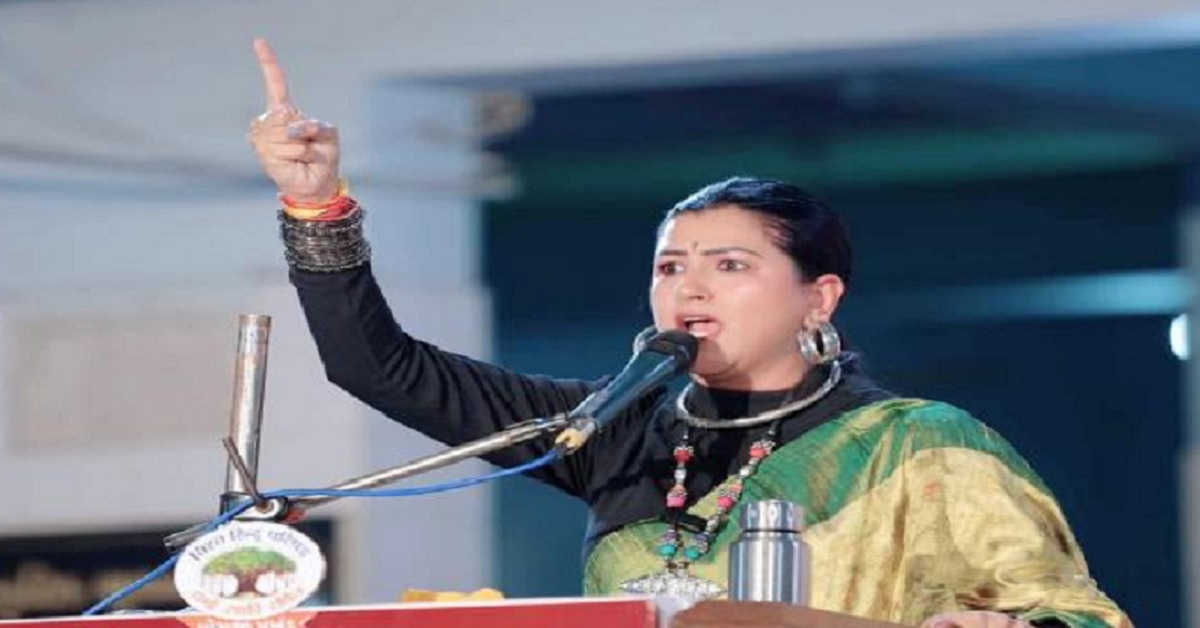
Citizens for Justice and Peace (CJP) has filed a detailed complaint before the State Election Commission of Maharashtra seeking immediate action against self-styled Hindu nationalist speaker Kajal Shingla, also known as Kajal Hindustani, for delivering an explicitly communal, misogynistic, and hate-driven speech at a public religious event in Mumbai on December 25, 2025, at a time when the Model Code of Conduct (MCC) was in force for the Brihanmumbai Municipal Corporation (BMC) elections.
The complaint underscores how Shingla’s speech—delivered from the stage of a Hanuman Katha organised by Dayanidhi Dham Seva Sanstha—constituted a deliberate attempt to weaponise religion, gender, and fear to polarise the electorate and vitiate the electoral atmosphere in one of India’s most diverse and politically sensitive cities.
A religious platform turned into a site of electoral polarisation
According to the complaint, the Model Code of Conduct came into effect on December 15, 2025, following the announcement of municipal elections. Despite this, Shingla used a religious congregation to propagate the discredited and incendiary conspiracy theory of “love jihad”, making sweeping allegations against Muslim men and publicly demeaning Muslim women in language that was both communal and gendered.
At the event, she claimed that her organisation or associates had “brought back 2,500 women in Mumbai from Abduls”—a statement that uses a Muslim name as a proxy for criminality and casts interfaith relationships as coercive, conspiratorial, and inherently illegitimate. The complaint notes that such assertions are not only entirely unverified, but mirror a pattern of rhetoric repeatedly rejected by courts and investigating agencies for lacking any factual basis.
Gendered hate speech and the public shaming of Muslim identity
One of the most disturbing aspects of the speech, as highlighted by CJP, was Shingla’s exhortation to the crowd through the slogan: “Be Durga, be Kali, never be a ‘burqewali.’”
The complaint explains that this slogan operates on multiple levels of harm: it pits Hindu religious symbolism against Muslim identity, portrays Muslim women as objects of shame, and urges the rejection—indeed erasure—of Muslim identity in public life. By instrumentalising women’s bodies and choices to advance a communal narrative, the speech amounts to gendered hate speech, intensifying religious hostility through misogyny.
The video of the speech, now widely circulated online and annexed with the complaint, shows Shingla repeatedly mobilising fear and suspicion by invoking religion, gender, and an imagined Muslim threat before a public audience.
Clear and multiple violations of the Model Code of Conduct
CJP’s complaint details how the speech violates core prohibitions under Part I of the Model Code of Conduct, including:
- Appeals to religion to influence voters
- Use of religious platforms and events for political mobilisation
- Statements that promote hatred and aggravate differences between communities
- Campaign practices that corrupt the free and fair electoral environment
Importantly, the complaint stresses that the MCC applies not only to candidates, but also to any individual whose actions are intended to influence the political climate during elections—a principle repeatedly affirmed by the Election Commission in past cases.
Offences under the Representation of the People Act, 1951
Beyond the MCC, the complaint invokes serious statutory violations under the Representation of the People Act, 1951, including:
- Section 123(3): Appeal to religion, through the invocation of Hindu deities in opposition to Muslim identity
- Section 123(3A): Promotion of enmity and hatred between religious communities
- Section 125: Promoting enmity in connection with elections, a penal offence
CJP argues that Shingla’s speech squarely falls within these provisions, as it was delivered during an election period and was designed to reshape political consciousness along religious lines.
Assault on constitutional values of equality, dignity, and secularism
The complaint situates the speech within a broader constitutional framework, warning that such rhetoric strikes at the heart of India’s constitutional order. By collectively stereotyping Muslims, demeaning Muslim women, and legitimising religious exclusion, the speech violates:
- Article 14 (Equality before the law)
- Article 15 (Non-discrimination on religious grounds)
- Article 21 (Right to dignity, particularly of women)
- The secular, egalitarian, and fraternal values enshrined in the Preamble
CJP notes that the Supreme Court has consistently held that inflammatory speech and incitement cannot be shielded by free speech, especially in the electoral context where the stakes involve democratic participation and social peace.
Threat to free and fair elections in a plural city
Mumbai’s religious diversity makes it particularly vulnerable to the consequences of such polarising rhetoric. The complaint warns that speeches like Shingla’s:
- Create fear and mistrust between communities
- Intimidate minority voters and suppress participation
- Normalise communal hostility as a political strategy
- Risk triggering social tension and unrest
Allowing such conduct to go unchecked, CJP argues, would erode the level playing field essential to democratic elections.
Accountability of event organisers
The complaint also flags the role of Dayanidhi Dham Seva Sanstha, the organiser of the Hanuman Katha, for allowing a religious platform to be used for communal mobilisation during the election period. CJP reminds the Election Commission that organisers of religious events cannot abdicate responsibility when their platforms are used to violate electoral norms.
CJP’s demand for immediate and decisive action
In its prayer, CJP has urged the State Election Commission of Maharashtra to:
- Take immediate cognisance of the complaint and video evidence
- Initiate proceedings under the Model Code of Conduct against Kajal Shingla
- Restrain her from making further communal speeches during the election period
- Examine the role of the organising body
- Issue a general advisory reaffirming that religious platforms cannot be used for communal propaganda during elections.
The complete complaint may be read here.
Related:
From Fringe to Framework: How AHP’s hate ecosystem reconfigured law, society, and electoral politics
From Hate Speech to State Action: How communal vigilantism at Malabar Hill continues unchecked