


For over two decades, Citizens for Justice and Peace (CJP) has consistently worked at the intersection of citizenship, constitutional rights, democratic participation and state accountability. Whether through interventions around communal violence, detention, displacement, migrant rights, NRC proceedings, citizenship documentation, voter exclusion, or legal aid for vulnerable communities, CJP’s work has repeatedly engaged with one foundational constitutional question: who gets recognised by the State, and on what terms?
Long before the current anxieties around Special Intensive Revision (SIR) exercises emerged, CJP had already been deeply involved in questions surrounding identity documentation, citizenship verification and exclusionary administrative processes. Our first intensive and continuing interventions are in the north-eastern state of Assam, where a peculiar blend of exclusivist xenophobic politics shaped policy and actions that have together targeted legitimate Indians in the quagmire of having ‘to establish documented citizenship.’ Read about CJP’d continuing journey through 2025 here.
Subsequently, two years down the line, 2019-2020, during the months and years of fear generated by the CAA-NRC debates, CJP organised extensive documentation and awareness campaigns across several states, helping communities understand legal processes, preserve records, obtain missing documents and resist panic-driven misinformation. The organisation’s interventions consistently focused on ensuring that vulnerable populations—especially minorities, migrants, women, Adivasis, Denotified Tribes (DNTs), informal workers and economically marginalised groups—were not pushed outside the constitutional framework through procedural barriers.
Detailed reports may be read here, here, here and here.
It is from this history of engagement that CJP, together with Vote for Democracy (VFD), began conducting a series of detailed SIR awareness and training sessions in Maharashtra. In 2025, with the elections to the Bihar State Assembly, the State’s most recent efforts to push large sections of Indians to potential disenfranchisement by exacting an unrealistic ‘citizenship test’ began. The Special Intensive Revision (SIR) exercise that subsequently travelled to Bengal, Tamil Nadu, Gujarat and Uttar Pradesh has defied statutory law (Representation of People’s Act, 1951), Constitutional precedents (Article 14, 15 and 21) and the basic principles of due process and natural justice.
Tragically, this SIR exercise has been preceded by the most significant erosion of autonomy and integrity of a constitutional body like the Election Commission of India (ECI), casting a cloud on the very integrity of the election process under Articles 324-326 of the Indian Constitution. Vote for Democracy (VFD), a citizens’ platform guided by experts has analysed and exposed this deterioration of fair and free elections from the parliamentary elections of April-June 2024. VFD’s reports may be read here, here, here and here.
These trainings were never intended to legitimise or endorse a hurried and deeply problematic SIR exercise. In fact, the position adopted by CJP and VFD has remained unequivocal: the current SIR model, as implemented across multiple states, raises profound constitutional concerns because of the manner in which it transfers the burden of proof onto ordinary citizens while creating conditions ripe for exclusion and disenfranchisement. The purpose of the trainings, therefore, was not compliance for its own sake. It was protection.
As the CJP-VFD booklet on SIR itself clearly states, the trainings are meant “strictly to arm you with the tools to defend your rights and navigate this unconstitutional hurdle, not to legitimise it.”
The booklet may be read here and here.
At a time when fear, misinformation and confusion were spreading rapidly among communities, the trainings sought to communicate one essential message: panic helps exclusionary systems thrive. Knowledge, preparation and collective solidarity followed by determined interventions and action, are what protect democratic rights.
The Maharashtra trainings
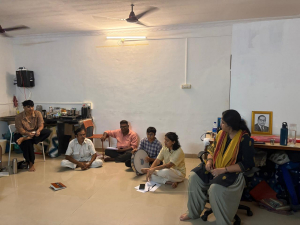
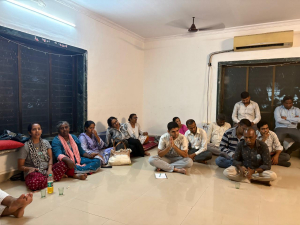
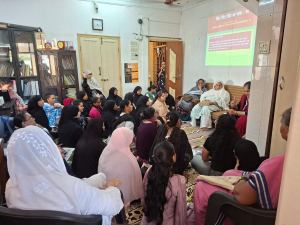
Over the course of several months, CJP conducted three major SIR-focused training and awareness programmes in Maharashtra:
- March 21: Training session with Bombay Catholic Sabha
- April 16: Joint awareness and training session with a Community-Based Organisation (CBO), Agripada, South Mumbai
- April 30: Community training programme with Jan Haqq Sangharsh Samiti
These were not routine seminars or technical workshops. They became spaces where fear, uncertainty and lived experiences surfaced openly.
Participants included community organisers, women’s groups, migrant workers, social activists, minority organisations, students, religious leaders, local volunteers, housing rights advocates, DNT representatives, trade union workers, and ordinary residents increasingly worried about how SIR-style exercises could impact their ability to remain on electoral rolls.
Across all three programmes, a striking reality emerged repeatedly: for many people, the fear was not abstract. It was deeply personal. The idea that decades-old documents could suddenly determine one’s legitimacy as a voter –and thereafter a citizen– triggered anxieties rooted in poverty, displacement, migration, illiteracy, gender discrimination and bureaucratic neglect accumulated over generations.
In fact, for a joint delegation meeting with the CEO of Maharashtra, Chokkalingam in early March 2026, of which CJP was a crucial part, was revelatory. The officer unambiguously stated that the 2003 Guidelines would not be followed but also admitted that ‘no fresh guidelines had yet been issued’ by the ECI, Delhi. Emphasising that the current exercise would be one in determining that ‘only Indians’ figure on the electoral roll, Chokkalingam explained the amendments made to Section 3 of the Indian Citizenship Act, 1955 that distinguished between a) those born before 1987, b) those between 1987 (July 1) and 2004 and those c) those born after that date in terms of what sorts of documentary proof were required to ‘establish’ Indian citizenship. For a) simply being born in India was proof enough, for b) in addition to his/her own birth in India, it was required to establish that at least one of the parents was Indian; and for c) it was important to establish that neither mother nor father was an ‘illegal immigrant.’


The Bihar and West Bengal Experience: Why these trainings became necessary
The Maharashtra sessions were built directly upon the extensive field experiences documented by CJP and VFD teams in states where SIR-related exercises had already generated serious problems. These include Uttar Pradesh, Gujarat and Tamil Nadu. Assam has, meanwhile only so far had a Special Revision (SR) of its rolls, not an SIR.
Ground reports from Bihar and West Bengal revealed patterns of confusion, mass anxiety, arbitrary notices, technological mismatches, documentation hurdles and administrative opacity. These findings eventually culminated in the publication of the detailed handbook Inside the Special Intensive Revision (SIR): Deadly Deadlines, Mechanical Disenfranchisement, and the Ground Reality of Claims and Objections Period & SIR Notices/Hearings.
The booklet combined investigative analysis, field documentation, legal guidance and practical training material. It explained the structure of the SIR process, the roles of electoral officers, the significance of legacy electoral rolls, the functioning of notices and hearings, appeal mechanisms, acceptable documents, and the methods through which exclusion was being operationalised on the ground.
Most importantly, it documented how the current SIR framework represented a dramatic departure from earlier electoral revision exercises.
The 2003 SIR process, for example, had been conducted over nearly six months, relied on existing electoral rolls and EPIC cards as foundational documents, and emphasised facilitative house-to-house verification. Enumerators were not expected to function as citizenship adjudicators. This time round, 2025-2026, with the ECI acting like the weaponised (read unconstitutional) arm of an exclusivist regime, hurried and arbitrary adjudications on citizenship have become the order of the day.
The present model, therefore, has increasingly transformed electoral verification into an exercise marked by compressed timelines, mechanical scrutiny, opaque software systems, and retrospective documentary burdens. CJP and VFD’s field reports documented how software-driven mismatches involving spelling variations, transliteration differences, age-gap calculations and data-entry inconsistencies generated large numbers of “unmatched” or “suspicious” entries.
The Maharashtra trainings therefore emerged not from speculation, but from documented experiences already unfolding elsewhere.
What happens when the poor are asked to prove their existence?
A significant portion of the Maharashtra trainings conducted by CJP focused on helping participants understand the broad range of documents that may potentially be relied upon during SIR-related verification processes. Methods of accessing documents that may exist and be available with local authorities, understanding and tracking legacy and linkages to those voters/citizens who are available and verifiable in the baseline document –the electoral role between 2002-2004—were also granularly shared. CJP’s experiences pan-India across states and regions, intervening on multiple fronts has created a rich knowledge base of accessing documents from levels of the bureaucracy and this is being widely shared. The trainings repeatedly stressed an important point: people often panic because they assume that the absence of one “perfect” document automatically disqualifies them. However, the indicative list itself demonstrates that identity and eligibility can be established through multiple forms of documentary evidence.
Participants were carefully guided through the list of acceptable or supporting documents referenced in the handbook and subsequent judicial interventions. These include: identity cards or pension payment orders issued to government employees or pensioners; identity cards or certificates issued by government authorities, banks, post offices, LIC or PSUs prior to July 1, 1987; birth certificates; passports; matriculation or educational certificates; permanent residence certificates; forest rights certificates; OBC, SC or ST caste certificates; NRC records where available; family registers prepared by state or local authorities; land or house allotment certificates; Aadhaar cards; and Class 10 admit cards or pass certificates.
Throughout the trainings, facilitators repeatedly emphasised that even one among these documents, when supported with supplementary records and consistent identity details, could help establish a person’s identity and continued existence within the social and administrative framework of the country. The sessions therefore focused heavily on practical strategies: how to organise documents chronologically, how to retrieve old records, how to preserve photocopies and acknowledgements, and how to identify alternative supporting papers where primary documents were unavailable.
Yet, as the discussions during the trainings revealed, the ground reality surrounding documentation is far more complicated than official lists often assume. For large sections of the population, documents are not simply lying safely preserved in family cupboards waiting to be produced before authorities. Instead, documentation histories are fragmented by poverty, migration, environmental disasters, displacement, gender discrimination and bureaucratic neglect accumulated over decades. Many participants explained that births in their communities took place at home and were never formally registered. Others spoke of losing papers during drought-induced migration, floods, demolitions, fires or repeated changes in residence. Several older participants described how schools they attended no longer exist, making retrieval of school leaving certificates or mark sheets almost impossible today.
Women repeatedly raised concerns about documentary inconsistencies arising from early (pre 18 or 21 years) marriage-related surname changes, spelling variations and shifts in residence. Some women who were married young explained that they had voted for the first time from their husband’s homes, bypassing any formal electoral linkage with their natal families. This now makes tracing documentary continuity with parental records extremely difficult though not impossible.
Similarly, members of Denotified and Nomadic Tribes (DNTs), migrant workers and daily wage earners pointed out that even obtaining caste certificates, residence proofs or duplicate records often requires multiple visits to government offices—something many cannot afford without losing crucial daily income. For homeless persons, tenants, informal workers and highly mobile populations, stable address-based documentation itself becomes a challenge.
The trainings therefore highlighted a critical contradiction at the heart of documentation-heavy verification exercises: while the State increasingly demands layered documentary proof, millions of people have historically lived at the margins of formal documentation systems themselves. In this context, the sessions sought not only to explain which documents may help, but also to collectively confront the deeper structural inequalities that determine who is able to preserve paperwork, who is visible within administrative systems, and who remains vulnerable to exclusion.
Documents Decide Everything: The fear communities brought into the trainings
One of the most powerful aspects of the Maharashtra sessions was the extent to which people spoke openly about the fragility of their documentary histories. Again and again, participants raised concerns that exposed the enormous disconnect between bureaucratic expectations and lived realities.
The missing birth certificate problem: Perhaps the most recurring concern involved birth certificates.
Large sections of older generations, particularly from rural, working-class and poor communities, were born at home and never formally registered with civil authorities. Institutional births were inaccessible, expensive or culturally uncommon for decades. Women participants repeatedly spoke about how neither they nor their siblings had any birth records because births took place with the assistance of local midwives rather than within hospitals.
The statistics themselves reveal why this remains such a massive issue. Birth registration in India became widespread only relatively recently. Even official data shows significant historical gaps in registration coverage.
For many participants, the sudden expectation that decades-old birth records must now exist produced profound anxiety.
Maharashtra’s histories of drought, migration and loss: Participants also described how environmental and economic crises had repeatedly destroyed family records.
Several communities had lived through devastating droughts across parts of Maharashtra, forcing migration, distress movement and repeated displacement. Others recalled losing documents during floods, cyclones, fires or long-term housing instability. Some participants referred to records lost during the tsunami years or during forced relocations connected to urban redevelopment and informal settlement demolitions. For poor families surviving through cycles of migration and precarious labour, preserving fragile paper records over decades was often impossible.
Yet the current SIR-style expectations assume stable homes, continuous paperwork, formal institutional access and uninterrupted documentation histories.
When the school itself no longer exists: Another major issue that surfaced repeatedly was the problem of accessing school records. Many older government schools, village schools and informal educational institutions no longer exist in their original form. Buildings were demolished, records disappeared, administrations changed, or archives were never digitised.
Several participants explained that even when they knew they had once studied in a particular school, obtaining school leaving certificates or mark sheets today had become practically impossible because the institution itself had shut down or records were destroyed years ago.
For individuals from poor families who studied intermittently or dropped out early to begin work, educational documentation is often fragmentary or inaccessible. Yet these very records are increasingly treated as crucial identity markers.
The invisible burden on Denotified tribes and marginalised communities: The trainings also foregrounded concerns specific to Denotified and Nomadic Tribes (DNTs), whose histories of exclusion from stable settlement patterns, education systems and formal state recognition continue to shape their present vulnerabilities.
Participants pointed out that many DNT communities remain structurally under-documented because generations lived outside formal administrative frameworks. Accessing caste certificates, residence records or historical proofs often requires repeated interactions with distant bureaucratic offices.
For daily wage earners, every visit to a government office means losing a day’s income. The trainings repeatedly emphasised that documentation burdens are never socially neutral. They fall most heavily on those already living precariously.
Women and documentary disruption: Women’s experiences emerged as one of the most significant dimensions of the discussions. Across communities and religions, women described how marriage routinely disrupted documentary continuity. Changes in surname after marriage frequently resulted in inconsistencies across different identity documents.
Many older women explained that they had married before turning 18 and had voted for the first time from their husband’s residence rather than from their natal home. This makes establishing documentary linkage with parental records extraordinarily difficult decades later.
Minor spelling variations across ration cards, Aadhaar cards, voter IDs, educational certificates and marriage-related records further complicate verification. The Maharashtra trainings paid particular attention to these gendered documentary realities because women are often expected to “prove” continuity across names, addresses and households shaped by patriarchal social structures.
Electoral revision cannot become citizenship surveillance
Throughout the sessions, CJP and VFD repeatedly stressed a crucial constitutional principle: electoral revision cannot be converted into a mechanism of suspicion against already-enfranchised citizens.
The handbook itself notes that the present SIR framework reverses long-standing democratic presumptions by effectively treating registered voters as suspect unless they can repeatedly prove their eligibility through documentary evidence.
This is particularly alarming because millions of people currently on electoral rolls have already voted in multiple elections over decades.
The trainings therefore focused heavily on rights awareness:
- understanding notices,
- organising documents,
- preserving acknowledgements,
- seeking written orders,
- attending hearings with support persons,
- filing appeals,
- resisting arbitrary deletions,
- and documenting procedural violations.
Participants were also trained on how to search older electoral rolls, including the 2002–2004 rolls increasingly treated as “legacy data” within SIR processes. The sessions explained the functioning of Booth Level Officers (BLOs), Electoral Registration Officers (EROs), Assistant Electoral Registration Officers (AEROs), appeal processes, and the importance of procedural safeguards.
Rights groups and CBO’s were trained on and encouraged to, by the CJP team, to organise collectively and voice concerns with the offices of the state election commission so that specific concerns and anxieties of the varieties of stake holders—genuine voters, be they migrants from other states, women, minorities, DNTs, displaced persons—could be readily addressed by an otherwise opaque SEC.
CJP’s memorandum to the Maharashtra CEO
Parallel to these trainings, CJP and VFD formally approached the Maharashtra State Election Commission and the Chief Electoral Officer of Maharashtra with a detailed memorandum raising concerns about possible disenfranchisement and procedural opacity.
The memorandum urged authorities to ensure:
- accessible and searchable electoral rolls,
- properly trained personnel,
- multilingual assistance systems,
- protection against algorithmic exclusion,
- public transparency,
- a publicised social audit of the draft revised polls and the final ones (this has been mentioned as a mandatory and healthy requirement in the ECI’s own 2023 Handbook of Guidelines on Electoral Rolls;
- and safeguards against arbitrary deletions.
Importantly, the memorandum emphasised that electoral revision must reduce fear rather than produce it. It warned that when documentation burdens are imposed without adequate support structures, the people who suffer first are always those already pushed to the margins: minorities, migrants, tenants, women, informal workers, DNTs and economically vulnerable populations.
Beyond Documentation: Building collective confidence
What distinguished these Maharashtra trainings was that they did not treat documentation as merely technical paperwork. They recognised documentation as deeply tied to dignity, memory, class, caste, migration, gender and survival.
For many participants, the sessions became spaces where people realised they were not individually “failing” because documents were missing or inconsistent. Rather, their experiences reflected structural realities shared by millions across India.
The trainings therefore consistently emphasised solidarity and collective defence:
- helping elderly persons retrieve records,
- assisting women facing name mismatches,
- supporting migrant workers unable to attend hearings,
- guiding daily wage earners through documentation processes,
- and ensuring that vulnerable communities do not face bureaucratic intimidation alone.
At a time when administrative processes increasingly risk producing fear and invisibility, these sessions attempted to restore confidence in constitutional rights and democratic participation.
A democratic intervention against fear
Ultimately, the SIR trainings conducted by CJP across Maharashtra were not merely legal awareness programmes. They were democratic interventions against fear.
They sought to remind people that the right to vote is not a favour granted conditionally by shifting bureaucratic systems. It is a constitutional guarantee rooted in the promise of universal adult franchise. They also sought to expose a harsh reality: when democratic participation becomes dependent upon perfect documentation histories stretching across decades, exclusion ceases to be accidental. It becomes structural.
For precisely this reason, the trainings insisted that preparation—not panic—must guide public response. Because behind every “missing document,” “mismatched name,” or “unavailable legacy record” is not simply a paperwork problem, but a human history shaped by poverty, migration, patriarchy, displacement, disaster and institutional neglect.
And it is these histories that CJP’s Maharashtra trainings sought to bring into the centre of the conversation—so that democracy is not reduced to an exercise in mechanical verification, but remains anchored in constitutional inclusion, human dignity and collective rights.
Related:
Inside the SIR: A voter roll exercise turning into a test of survival
Demystifying the SIR Notice: A systemic hurdle, not a final verdict
CJP Assam: A journey without parallel, evolving & expanding rights jurisprudence