


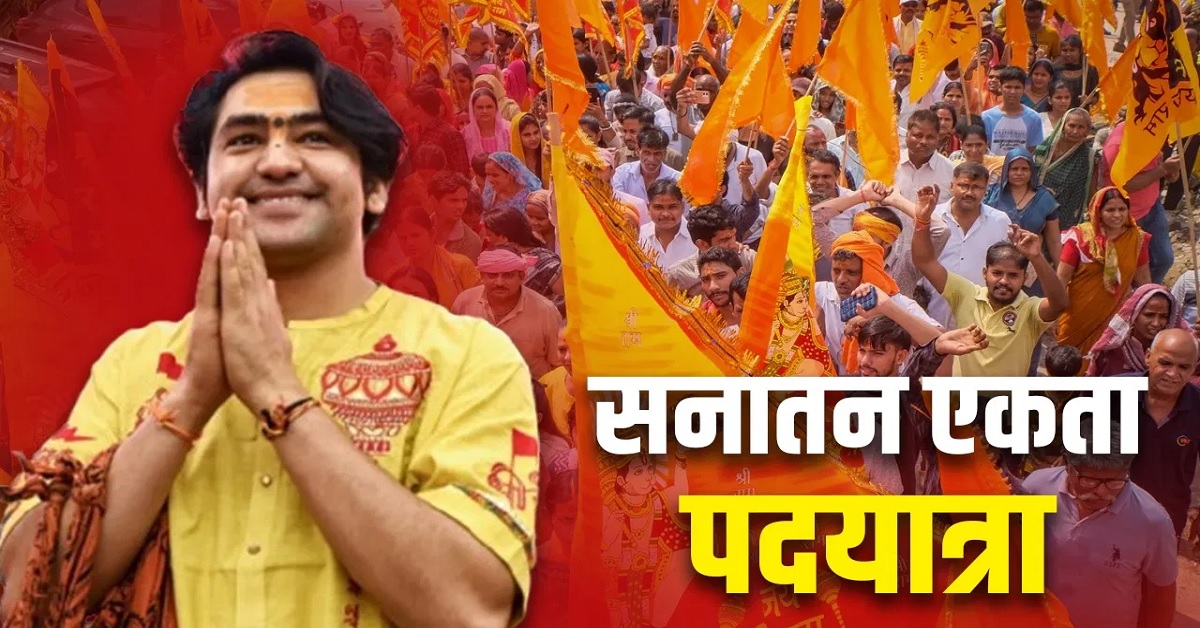
Citizens for Justice and Peace (CJP) has submitted a detailed complaint to the National Commission for Minorities (NCM) flagging an alarming rise in hate speeches delivered during the Hindu Sanatan Ekta Padyatra held from November 7 to 16 across Delhi, Haryana, Uttar Pradesh, and Madhya Pradesh. The organisation has urged the Commission to take immediate cognisance of what it describes as a systematic pattern of communal mobilisation that directly threatens India’s constitutional commitment to secularism, equality, and public order.
The complaint highlights how the padyatra—led by Dhirendra Krishna Shastri of Bageshwar Dham and traversing 422 village panchayats—was framed as a campaign for “Hindu unification” and the creation of a “Hindu Rashtra,” while repeatedly othering non-Hindu communities, especially Muslims, through charged rhetoric. CJP notes that these speeches did not remain confined to religious or cultural expression but crossed into fearmongering, exclusion, conspiracy theories, and open provocation, creating an environment ripe for hostility and public disorder.
CJP is dedicated to finding and bringing to light instances of Hate Speech, so that the bigots propagating these venomous ideas can be unmasked and brought to justice. To learn more about our campaign against hate speech, please become a member. To support our initiatives, please donate now!
Escalation of Hate Rhetoric across States
The complaint presents a chronological mapping of the speeches and categorises them into direct hate speech, exclusionary hate speech, and fearmongering, with further indicators like economic boycotts, conspiracy theories, and threats of vigilante violence.
In Ghaziabad, the yatra began with explicit demographic fearmongering—claims of Hindus supposedly “declining” and standing on the “brink of becoming minorities.” Statements insinuating that communities associated with “chadar” and “father” should decrease in number were highlighted as clear exclusionary attacks. The recurring invocation of “love jihad” further entrenched conspiracy theories weaponised against Muslims.
At the next major stop in Delhi, the rhetoric intensified. One speaker warned that in twenty years Hindus would be fighting for their very existence, and accused Muslims and Christians of adopting “foreign identities.” The praise of “bulldozer justice” and insinuations that Muslims would seize Hindu property were documented as statements bordering on direct incitement.
In Faridabad, a communal rhyme—“tel lagao Dabur ka, naam mita do Babur ka”—was used to evoke historical resentment, while the line “Jo Ram ka nahi wo kisi kaam ka nahi” blatantly ostracised minorities. A later Faridabad event referred to fears of India turning into “Bangladesh,” invoking imagery of dispossession and persecution to generate panic.
In Palwal, speeches openly demanded daily commitment to building a Hindu Rashtra and framed all conversions to Islam or Christianity as inherently “illegal,” merging conspiracy with ideological exclusion. Another speaker urged audiences to “buy from Hindus, employ only Hindus,” amounting to an explicit call for an economic boycott of Muslims.
The complaint documents how, on November 12, Dhirendra Shastri made sweeping insinuations that “only Non-Hindus are terrorists,” blamed madrassas for producing extremism, and warned of “bomb blasts in every street” if Hindus did not unite. CJP flags this as a combination of direct hate speech, fearmongering, and misinformation designed to criminalise an entire community.
In Banchari, speakers told people who disagreed with Vande Mataram or the worship of Ram to “go to Pakistan or Afghanistan,” directly equating religious identity with foreignness. References to Kashmiri Pandit displacement were used to justify the idea that Hindus could soon be driven from their homes.
At Chhatarpur, the rhetoric leaned on mockery and conditional belonging, suggesting that those who refuse to chant Vande Mataram should “book a ticket to Lahore.” Proposals for DNA testing of those who disagree with Hindu practices added an additional layer of derision and pseudo-scientific exclusion.
The speech in Mathura invoked the violent mobilisation of the Babri Masjid demolition and called for reclaiming the Shahi Idgah Mosque, evoking historical tensions and encouraging crowds toward aggressive action.
Legal Implications Outlined in the Complaint
CJP’s complaint does not merely document hate speech but sets out the legal provisions under which the incidents fall.
The organisation notes violations of:
- Article 14 (equality before law), due to calls for segregation and economic exclusion
- Article 15 (non-discrimination), owing to open appeals to religious discrimination
- Article 19(1)(a) read with 19(2), as the speeches constitute incitement and threats to public order
- Article 25, by delegitimising and attacking the religious practices of minorities
The complaint also lists specific offences under the Bharatiya Nyaya Sanhita (BNS), 2023:
- Section 196 – promoting enmity between groups
- Section 197 – assertions prejudicial to national integration
- Section 299 – deliberate insult intended to outrage religious feelings
- Section 352 – intentional insult likely to provoke breach of peace
- Section 353 – statements causing public fear, alarm, or inciting communities
The organisation further references the Supreme Court’s jurisprudence on hate speech, including Pravasi Bhalai Sangathan, Shreya Singhal, Amish Devgan, and the Tehseen Poonawalla lynching guidelines, to underline the constitutional and judicial standards violated during the padyatra.
A section of the complaint underscores the “extremity of speech,” the authority wielded by speakers like Dhirendra Shastri and Devkinandan Thakur, and the massive audience sizes—factors that amplify the potential for mobilisation, disorder, and violence.
CJP alerts NCM on the situation
One of the most urgent concerns raised by CJP is the scale and influence of the padyatra. With an estimated 3,00,000 participants, celebrity spiritual leaders with millions of followers, and openly majoritarian slogans gaining traction, the organisation warns that unchecked hate campaigns could lead to real-world violence, as seen in Dhutia, Madhya Pradesh, where a crowd attempted to burn Shastri’s effigy and the situation escalated into a police lathi charge.
The complaint emphasises that this is not a communal dispute, but a “systematic campaign of hate speech meant to serve political purposes” and capable of triggering targeted violence against vulnerable groups.
Prayers before the NCM
CJP has requested the NCM to:
- Take cognisance of the complaint under Section 9(1)(d) of the NCM Act
- Initiate a fact-finding mission on the padyatra
- Direct administrations to monitor rallies, record speeches, and ensure safeguards
- Protect targeted communities through nodal officers per Tehseen Poonawalla guidelines
- Ensure immediate FIRs for hate speech
- Recommend strong social media regulation to curb the circulation of hateful content
Reiterating that the complaint is not against any religion or religious exercise, CJP concludes that the issue at hand concerns the rule of law and the constitutional guarantee of equal citizenship, now under strain due to repeated, organised calls for a religious nationhood project.
The Complaint may be read here:
Image Courtesy: tv9hindi.com
Related
Sanatan Ekta Padyatra – Unmasking the March of Majoritarianism
Targeted as ‘Bangladeshis’: The hate speech fuelling deportations
CJP files complaints against the Hate Speeches delivered in Uttar Pradesh